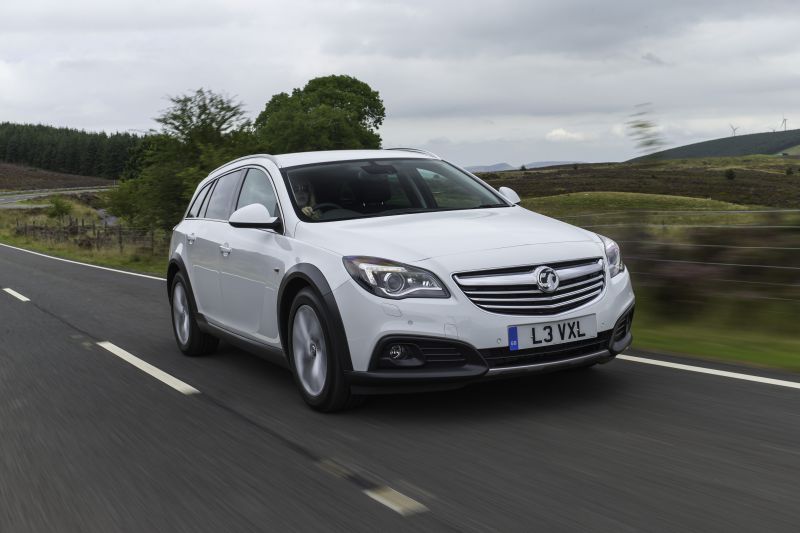
The Vauxhall Insignia I Country Tourer 2.0 CDTi ecoTEC (163 Hp) Start/Stop represents a compelling offering in the European D-segment, a market segment characterized by mid-size family cars. Launched in 2013 and produced until 2017, this particular variant of the first-generation Insignia was Vauxhall’s answer to the growing demand for vehicles that combined the practicality of a station wagon with the rugged aesthetic of an SUV. As a brand primarily sold in the United Kingdom, Vauxhall is the British counterpart to Opel, and the Insignia (known as the Opel Insignia in mainland Europe) served as its flagship mainstream model, succeeding the long-running Vectra.
The Country Tourer variant distinguished itself from the standard Insignia Sports Tourer (station wagon) with a more adventurous styling package, typically including protective body cladding and a slightly raised ride height, though this specific 2.0 CDTi ecoTEC model featured a front-wheel-drive architecture rather than all-wheel drive. This made it an appealing choice for consumers seeking enhanced utility and a robust appearance without the added complexity or fuel consumption often associated with full-fledged SUVs. Powered by a highly efficient 2.0-liter common rail turbo-diesel engine, this model emphasized fuel economy and reduced emissions, perfectly aligning with European market trends and regulatory pressures of its era.
Engine & Performance of the Vauxhall Insignia I Country Tourer
At the heart of the Vauxhall Insignia I Country Tourer 2.0 CDTi ecoTEC lies a sophisticated 1,956 cubic inch (2.0-liter) inline-four turbo-diesel engine, designated A20DTH. This powertrain was engineered for a blend of robust performance and exceptional fuel efficiency, a hallmark of European diesel technology. It delivers a respectable 163 horsepower at 4000 rpm, providing ample power for both urban commuting and long-distance highway cruising. More impressively, the engine generates a substantial 258.15 lb.-ft. of torque, available across a wide and accessible band from 1750 to 2500 rpm. This broad torque plateau ensures strong pulling power from low engine speeds, making the vehicle feel responsive and effortless to drive, particularly when fully loaded or towing.
The engine’s ‘ecoTEC’ designation, combined with a Start/Stop system, highlights Vauxhall’s focus on environmental performance and running costs. The Start/Stop system automatically shuts off the engine when the vehicle is stationary, such as at traffic lights, and restarts it seamlessly when the driver is ready to move, significantly reducing fuel consumption and emissions in city driving conditions. Power is sent to the front wheels via a smooth-shifting 6-speed manual transmission, offering engaging control for the driver.
In terms of raw performance, the Insignia I Country Tourer 2.0 CDTi ecoTEC is capable of accelerating from 0 to 60 mph in a brisk 9.4 seconds, with a top speed reaching 132.97 mph. These figures underscore its capability as a competent and versatile family hauler. Furthermore, its adherence to the Euro 5 emission standard, coupled with a particulate filter, demonstrates its commitment to cleaner exhaust gases. Fuel economy is a standout feature, with a combined rating of 52.3 US mpg (4.5 liters per 100 km), making it an incredibly economical choice for its size and segment. CO2 emissions are kept low at 119 g/km, further enhancing its appeal in markets where vehicle taxation is often linked to environmental impact.
Design & Features
The Vauxhall Insignia I Country Tourer adopts a five-door station wagon (often referred to as an “estate” in European markets) body style, offering a highly practical and spacious interior for five occupants. Its design language is both elegant and robust, blending the Insignia’s sleek lines with elements that convey an active, outdoorsy lifestyle. While the core dimensions are shared with the standard Insignia wagon, the Country Tourer variant typically featured unique front and rear bumpers, protective wheel arch and sill cladding, and often a slightly elevated ride height, giving it a more commanding presence on the road. This particular model measures 193.7 inches in length, 73.07 inches in width (82.05 inches including mirrors), and 59.96 inches in height, with a substantial 107.76-inch wheelbase, contributing to a stable ride and generous interior volume.
Inside, the Insignia Country Tourer prioritizes comfort and utility. The cabin provides seating for five adults, with ample legroom and headroom, particularly in the front. The true strength of the station wagon body style, however, lies in its cargo capacity. The Insignia I Country Tourer offers a minimum trunk space of 19.07 cubic feet (540 liters), which can be expanded to a cavernous 54.03 cubic feet (1530 liters) with the rear seats folded down. This extensive cargo area makes it an ideal vehicle for families, outdoor enthusiasts, or anyone requiring significant hauling capability for luggage, sports equipment, or everyday goods.
Key features include a comprehensive safety suite, with ABS (Anti-lock Braking System) as standard, providing critical stability during emergency braking. The suspension system is designed for both comfort and confident handling, featuring an independent McPherson setup with coil springs and an anti-roll bar at the front, complemented by an independent multi-link suspension at the rear. This configuration helps absorb road imperfections while maintaining composure through corners. Braking is handled by ventilated discs at the front and solid discs at the rear, ensuring reliable stopping power. The vehicle also boasts a relatively tight minimum turning circle of 37.4 feet, aiding maneuverability in tighter urban environments despite its substantial length.
Technical Specifications
| Vauxhall Insignia I Country Tourer 2.0 CDTi ecoTEC (163 Hp) Start/Stop | |
| General Information | |
| Brand | Vauxhall |
| Model | Insignia |
| Generation | Insignia I Country Tourer |
| Engine Type | 2.0 CDTi ecoTEC (163 Hp) Start/Stop |
| Production Start | 2013 year |
| Production End | 2017 year |
| Powertrain Architecture | Internal Combustion Engine |
| Body Type | Station wagon (estate) |
| Seats | 5 |
| Doors | 5 |
| Performance Specifications | |
| Fuel Consumption (Urban) | 5.6 l/100 km (42 US mpg) |
| Fuel Consumption (Extra Urban) | 3.9 l/100 km (60.3 US mpg) |
| Fuel Consumption (Combined) | 4.5 l/100 km (52.3 US mpg) |
| CO2 Emissions | 119 g/km |
| Fuel Type | Diesel |
| Acceleration 0 – 60 mph | 9.4 sec |
| Maximum Speed | 132.97 mph (214 km/h) |
| Emission Standard | Euro 5 |
| Weight-to-Power Ratio | 10.7 kg/Hp, 93.5 Hp/tonne |
| Weight-to-Torque Ratio | 5 kg/Nm, 200.8 Nm/tonne |
| Engine Specifications | |
| Power | 163 Hp @ 4000 rpm |
| Power per liter | 83.3 Hp/l |
| Torque | 258.15 lb.-ft. (350 Nm) @ 1750-2500 rpm |
| Engine Layout | Front, Transverse |
| Engine Model/Code | A20DTH |
| Engine Displacement | 119.36 cu. in. (1956 cm3) |
| Number of Cylinders | 4 |
| Engine Configuration | Inline |
| Cylinder Bore | 3.27 in. (83 mm) |
| Piston Stroke | 3.56 in. (90.4 mm) |
| Valves per Cylinder | 4 |
| Fuel Injection System | Diesel Commonrail |
| Engine Aspiration | Turbocharger, Intercooler |
| Valvetrain | DOHC |
| Engine Oil Capacity | 4.76 US qt (4.5 l) |
| Coolant Capacity | 9.51 US qt (9 l) |
| Engine Systems | |
| Features | Start & Stop System, Particulate filter |
| Space, Volume and Weights | |
| Kerb Weight | 3842.66 lbs. (1743 kg) |
| Trunk (Boot) Space – Minimum | 19.07 cu. ft. (540 l) |
| Trunk (Boot) Space – Maximum | 54.03 cu. ft. (1530 l) |
| Fuel Tank Capacity | 18.49 US gal (70 l) |
| Permitted Trailer Load (with brakes 12%) | 3527.4 lbs. (1600 kg) |
| Permitted Trailer Load (without brakes) | 1543.24 lbs. (700 kg) |
| Dimensions | |
| Length | 193.7 in. (4920 mm) |
| Width | 73.07 in. (1856 mm) |
| Width (including mirrors) | 82.05 in. (2084 mm) |
| Height | 59.96 in. (1523 mm) |
| Wheelbase | 107.76 in. (2737 mm) |
| Front Overhang | 40.16 in. (1020 mm) |
| Rear Overhang | 45.79 in. (1163 mm) |
| Minimum Turning Circle | 37.4 ft. (11.4 m) |
| Drivetrain, Brakes and Suspension | |
| Drivetrain Architecture | Internal combustion engine drives the front wheels. |
| Drive Wheel | Front-wheel drive |
| Gearbox Type | 6 gears, manual transmission |
| Front Suspension | Independent, McPherson with coil spring and anti-roll bar |
| Rear Suspension | Independent multi-link suspension |
| Front Brakes | Ventilated discs |
| Rear Brakes | Disc |
| Assisting Systems | |
| Systems | ABS (Anti-lock braking system) |
Legacy and Market Impact of the Vauxhall Insignia I Country Tourer
The Vauxhall Insignia I Country Tourer, particularly in its efficient 2.0 CDTi ecoTEC (163 Hp) Start/Stop configuration, carved out a significant niche within the highly competitive European D-segment. While not sold in the United States, its impact in its primary markets, especially the UK, was substantial. It stood as a direct competitor to other well-established family wagons and “allroad” style vehicles, such as the Ford Mondeo Estate, Volkswagen Passat Alltrack (though this Insignia variant was FWD), Skoda Superb Combi, and even the Mazda 6 Tourer. Its appeal lay in offering a practical, spacious, and fuel-efficient alternative to the burgeoning SUV market, providing a more car-like driving experience with SUV-esque aesthetics.
Vauxhall’s reputation for building reliable and value-driven family cars was further solidified by the Insignia. The Country Tourer variant specifically resonated with buyers who appreciated its rugged styling, which hinted at off-road capability without the associated cost and complexity of an all-wheel-drive system (in this specific FWD configuration). For many, it represented a sensible compromise, providing a commanding road presence and enhanced practicality for light outdoor activities, while retaining the superior on-road dynamics and fuel economy of a traditional wagon.
The 2.0 CDTi ecoTEC engine was a key factor in its market success. Diesel engines, particularly efficient ones like this, dominated the European large family car segment during the Insignia’s production run. Its strong torque, low running costs, and respectable performance made it an attractive proposition for both private buyers and large corporate fleets, which often prioritize fuel efficiency and low CO2 emissions for tax benefits. The inclusion of features like the Start/Stop system and a particulate filter underscored Vauxhall’s commitment to meeting evolving environmental standards and consumer expectations for greener vehicles.
Ultimately, the Vauxhall Insignia I Country Tourer played a crucial role in maintaining Vauxhall’s presence in a segment that was slowly being encroached upon by SUVs and crossovers. It demonstrated that a traditional station wagon, when properly styled and equipped with an efficient powertrain, could still offer a compelling package of versatility, comfort, and economy. Its legacy is one of a practical, no-nonsense family vehicle that provided a comfortable and economical motoring solution for countless European families, embodying the practicality and engineering prowess expected from a mainstream European manufacturer.