
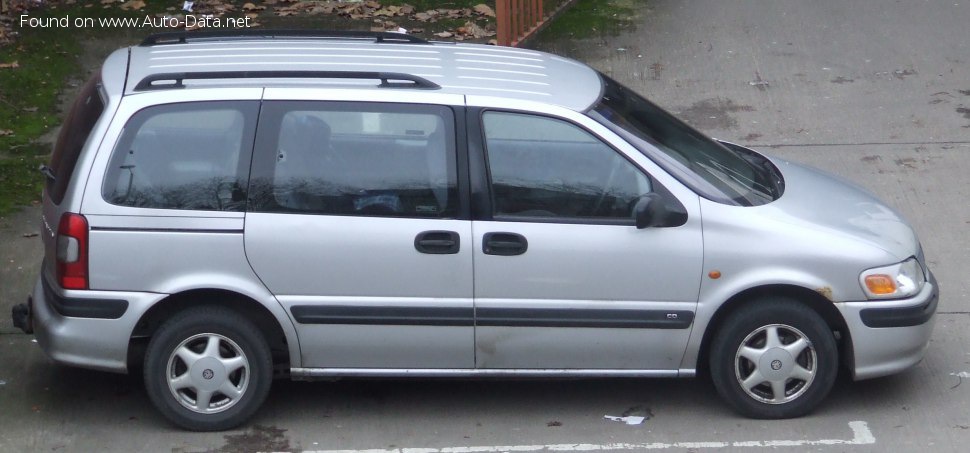
The Vauxhall Sintra 2.2 DTI, produced between 1997 and 1999, was a large, seven-seat minivan aimed at families seeking spacious and versatile transportation. Part of the first generation Sintra (X22), it represented Vauxhall’s entry into the increasingly popular people-carrier segment in Europe. While not officially sold in the United States, the Sintra is notable for its collaboration with other European manufacturers – it was jointly developed with Citroën (who marketed it as the Evasion/Xantia) and Peugeot (who sold it as the 806). The Sintra aimed to provide a comfortable and practical alternative to traditional estate cars and larger saloons, offering a high seating capacity and flexible interior configuration.
Vauxhall Sintra 2.2 DTI: Overview and Market Position
The Sintra occupied a crucial space in the European market during the late 1990s, a period witnessing a surge in demand for multi-purpose vehicles (MPVs). Families were increasingly looking for vehicles that could accommodate their growing needs, and the Sintra, with its seven-seat capacity and generous luggage space, directly addressed this demand. It competed with models like the Renault Espace, Ford Galaxy, and Volkswagen Sharan. The 2.2 DTI variant, powered by a direct injection turbocharged diesel engine, was positioned as a fuel-efficient option for long-distance travel and family use. The Sintra’s design prioritized practicality and interior space over sporty aesthetics, reflecting its intended role as a functional family vehicle.
Engine & Performance
The heart of the Sintra 2.2 DTI is its 2.2-liter inline-four cylinder diesel engine, designated X22DTH. This engine produces 116 horsepower at 3800 rpm and 260 Nm (191.77 lb.-ft.) of torque at 1900 rpm. The engine utilizes direct injection and a turbocharger with an intercooler to enhance power and efficiency. While not a performance-oriented vehicle, the Sintra 2.2 DTI offered adequate power for everyday driving and long journeys, particularly benefiting from the diesel engine’s strong low-end torque. Acceleration from 0 to 100 km/h (0-62 mph) takes 14.5 seconds, and 0 to 60 mph is achieved in approximately 13.8 seconds. The top speed is rated at 175 km/h (108.74 mph). Fuel economy is a strong point, with urban consumption at 10 l/100 km (23.5 US mpg) and extra-urban consumption at 6.8 l/100 km (34.6 US mpg). The engine’s power-to-weight ratio is 66.9 Hp/tonne, and the torque-to-weight ratio is 149.9 Nm/tonne.
Design & Features
The Vauxhall Sintra is a five-door minivan with a boxy, functional design. Its primary focus is maximizing interior space and practicality. The vehicle comfortably seats seven passengers across three rows, with the rear seats often capable of being folded or removed to create a larger cargo area. The Sintra boasts a minimum trunk capacity of 460 liters (16.24 cu. ft.), expanding to a substantial 3765 liters (132.96 cu. ft.) with the rear seats folded. Safety features for the era included ABS (Anti-lock Braking System). The interior is designed for durability and ease of cleaning, reflecting its family-oriented purpose. The Sintra’s suspension utilizes an independent McPherson strut setup at the front with coil springs and an anti-roll bar, providing a comfortable ride. Braking is handled by ventilated discs at the front and discs at the rear. The steering system is a rack and pinion type, offering responsive handling. The vehicle rides on 205/65 R15 tires mounted on 6J x 15 inch wheel rims.
Technical Specifications
| Brand | Vauxhall |
| Model | Sintra |
| Generation | Sintra |
| Type (Engine) | 2.2 DTI (116 Hp) |
| Start of production | 1997 |
| End of production | 1999 |
| Powertrain Architecture | Internal Combustion engine |
| Body type | Minivan |
| Seats | 7 |
| Doors | 5 |
| Fuel consumption (economy) – urban | 10 l/100 km (23.5 US mpg) |
| Fuel consumption (economy) – extra urban | 6.8 l/100 km (34.6 US mpg) |
| Fuel Type | Diesel |
| Acceleration 0 – 100 km/h | 14.5 sec |
| Acceleration 0 – 62 mph | 14.5 sec |
| Acceleration 0 – 60 mph | 13.8 sec |
| Maximum speed | 175 km/h (108.74 mph) |
| Weight-to-power ratio | 15 kg/Hp |
| Weight-to-torque ratio | 6.7 kg/Nm |
| Power | 116 Hp @ 3800 rpm |
| Power per litre | 52.8 Hp/l |
| Torque | 260 Nm @ 1900 rpm (191.77 lb.-ft. @ 1900 rpm) |
| Engine layout | Front, Transverse |
| Engine Model/Code | X22DTH |
| Engine displacement | 2198 cm3 (134.13 cu. in.) |
| Number of cylinders | 4 |
| Engine configuration | Inline |
| Cylinder Bore | 86 mm (3.39 in.) |
| Piston Stroke | 94.6 mm (3.72 in.) |
| Compression ratio | 18.5:1 |
| Number of valves per cylinder | 4 |
| Fuel injection system | Direct injection |
| Engine aspiration | Turbocharger, Intercooler |
| Valvetrain | DOHC |
| Engine oil capacity | 5.5 l (5.81 US qt | 4.84 UK qt) |
| Coolant | 5.9 l (6.23 US qt | 5.19 UK qt) |
| Kerb Weight | 1735 kg (3825.02 lbs.) |
| Max. weight | 2430 kg (5357.23 lbs.) |
| Max load | 695 kg (1532.21 lbs.) |
| Trunk (boot) space – minimum | 460 l (16.24 cu. ft.) |
| Trunk (boot) space – maximum | 3765 l (132.96 cu. ft.) |
| Fuel tank capacity | 70 l (18.49 US gal | 15.4 UK gal) |
| Length | 4670 mm (183.86 in.) |
| Width | 1830 mm (72.05 in.) |
| Height | 1711 mm (67.36 in.) |
| Wheelbase | 2845 mm (112.01 in.) |
| Front track | 1562 mm (61.5 in.) |
| Rear (Back) track | 1608 mm (63.31 in.) |
| Minimum turning circle (turning diameter) | 12 m (39.37 ft.) |
| Drivetrain Architecture | The Internal combustion engine (ICE) drives the front wheels of the vehicle. |
| Drive wheel | Front wheel drive |
| Number of gears and type of gearbox | 5 gears, manual transmission |
| Front suspension | Independent, type McPherson with coil spring and anti-roll bar |
| Front brakes | Ventilated discs |
| Rear brakes | Disc |
| Assisting systems | ABS (Anti-lock braking system) |
| Steering type | Steering rack and pinion |
| Tires size | 205/65 R15 |
| Wheel rims size | 6J x 15 |
The Vauxhall Sintra 2.2 DTI, while not a groundbreaking vehicle in terms of innovation, provided a practical and spacious solution for families in the late 1990s. Its collaborative development and focus on functionality cemented its place as a significant player in the European MPV market.
