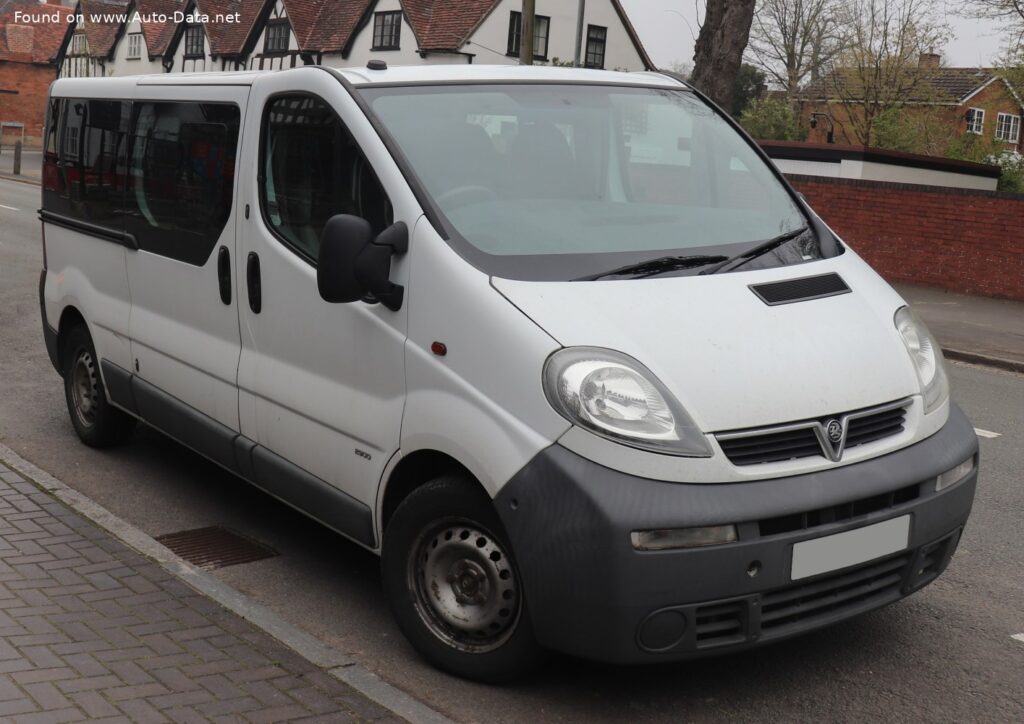
The Vauxhall Vivaro Doublecab LWB (Long Wheelbase) is a commercial vehicle produced by the British manufacturer Vauxhall, a subsidiary of Stellantis. The facelifted version, introduced in 2006 and continuing through 2014, represents a significant update to the first-generation Vivaro, which was originally launched in 2001. This model occupies the mid-size van segment, designed to cater to businesses and families requiring both passenger and cargo space. The Doublecab configuration specifically offers seating for up to five occupants alongside a substantial cargo area, making it a versatile option for tradespeople, shuttle services, and larger families. The 2.0 CDTI 16V (115 Hp) DPF Tecshift variant, equipped with a diesel particulate filter and automated manual transmission, was a popular choice within the Vivaro range.
Vauxhall Vivaro Doublecab LWB (facelift 2006)
The Vauxhall Vivaro, and its sister vehicles – the Renault Trafic, Nissan Primastar, and Opel Vivaro – were the result of a joint venture between Renault and Nissan. This collaboration allowed each brand to offer a competitive van without the substantial development costs. In the UK market, the Vivaro quickly gained recognition for its reliability, practicality, and relatively comfortable driving experience compared to some of its competitors. The Doublecab LWB version, in particular, addressed the need for a van that could function as both a work vehicle and a family transport, offering a compelling blend of utility and passenger comfort. The 2006 facelift brought cosmetic updates, improved interior trim, and refinements to the engine range, including the introduction of more efficient diesel engines and particulate filters to meet increasingly stringent European emission standards.
Engine & Performance
The 2006 Vauxhall Vivaro Doublecab LWB 2.0 CDTI 16V is powered by a 1995 cc (121.74 cu. in.) inline four-cylinder diesel engine. This engine, designated M9R 780, produces 115 horsepower (Hp) at 3500 rpm and 290 Newton-meters (213.89 lb.-ft.) of torque at 1600 rpm. The engine features a turbocharger with an intercooler, enhancing performance and efficiency. Fuel is delivered via a diesel commonrail injection system, contributing to smoother operation and reduced emissions. The engine’s power-to-weight ratio is 16.1 kg/Hp, and its torque-to-weight ratio is 6.4 kg/Nm. The “Tecshift” designation refers to the automated manual transmission with six gears, offering the convenience of an automatic while maintaining the efficiency of a manual gearbox. Fuel economy is rated at 7.9 l/100 km (29.8 US mpg) in urban conditions, 6.8 l/100 km (34.6 US mpg) on the extra-urban cycle, and 7.2 l/100 km (32.7 US mpg) combined. CO2 emissions are 192 g/km, meeting Euro 4 emission standards.
Design & Features
The Vauxhall Vivaro Doublecab LWB is a five-door minivan with a body-on-frame construction. Its long wheelbase provides a generous cargo area behind the second row of seats, offering a minimum trunk capacity of 4191 liters (148 cu. ft.). The vehicle’s design prioritizes practicality and functionality, with a focus on maximizing interior space. The Doublecab configuration features two rows of seating, accommodating up to five passengers. Safety features for the 2006 model year include ABS (Anti-lock Braking System). The vehicle’s dimensions are substantial, with a length of 5182 mm (204.02 in.), a height of 1960 mm (77.17 in.), and a wheelbase of 3498 mm (137.72 in.). The front suspension utilizes an independent McPherson strut setup with coil springs and an anti-roll bar, while the rear suspension employs a semi-independent longitudinal arm and transverse torsion shaft arrangement. Hydraulic power steering provides assisted steering control. The vehicle rides on 215/65 R16 tires.
Technical Specifications
| Brand | Vauxhall |
| Model | Vivaro |
| Generation | Vivaro Doublecab LWB (facelift 2006) |
| Type (Engine) | 2.0 CDTI 16V (115 Hp) DPF Tecshift |
| Start of production | 2006 |
| End of production | 2014 |
| Powertrain Architecture | Internal Combustion engine |
| Body type | Minivan |
| Seats | 5 |
| Doors | 5 |
| Fuel consumption (urban) | 7.9 l/100 km (29.8 US mpg) |
| Fuel consumption (extra urban) | 6.8 l/100 km (34.6 US mpg) |
| Fuel consumption (combined) | 7.2 l/100 km (32.7 US mpg) |
| CO2 emissions | 192 g/km |
| Fuel Type | Diesel |
| Emission standard | Euro 4 |
| Weight-to-power ratio | 16.1 kg/Hp |
| Weight-to-torque ratio | 6.4 kg/Nm |
| Power | 115 Hp @ 3500 rpm |
| Torque | 290 Nm @ 1600 rpm (213.89 lb.-ft. @ 1600 rpm) |
| Engine layout | Front, Transverse |
| Engine Model/Code | M9R 780 |
| Engine displacement | 1995 cm3 (121.74 cu. in.) |
| Number of cylinders | 4 |
| Engine configuration | Inline |
| Number of valves per cylinder | 4 |
| Fuel injection system | Diesel Commonrail |
| Engine aspiration | Turbocharger, Intercooler |
| Valvetrain | DOHC |
| Engine oil capacity | 7.7 l (8.14 US qt | 6.78 UK qt) |
| Coolant capacity | 6.4 l (6.76 US qt | 5.63 UK qt) |
| Kerb Weight | 1854 kg (4087.37 lbs.) |
| Max. weight | 2970 kg (6547.73 lbs.) |
| Max load | 1116 kg (2460.36 lbs.) |
| Trunk (boot) space – minimum | 4191 l (148 cu. ft.) |
| Fuel tank capacity | 90 l (23.78 US gal | 19.8 UK gal) |
| Length | 5182 mm (204.02 in.) |
| Height | 1960 mm (77.17 in.) |
| Wheelbase | 3498 mm (137.72 in.) |
| Minimum turning circle | 13.17 m (43.21 ft.) |
| Drivetrain | Front wheel drive |
| Number of gears | 6 |
| Gearbox type | automatic transmission Tecshift |
| Front brakes | Ventilated discs, 305 mm |
| Rear brakes | Disc, 280 mm |
| Front suspension | Independent, McPherson with coil spring and anti-roll bar |
| Rear suspension | Semi-independent, longitudinal arms with transverse torsion shafts |
| Tires size | 215/65 R16 |