
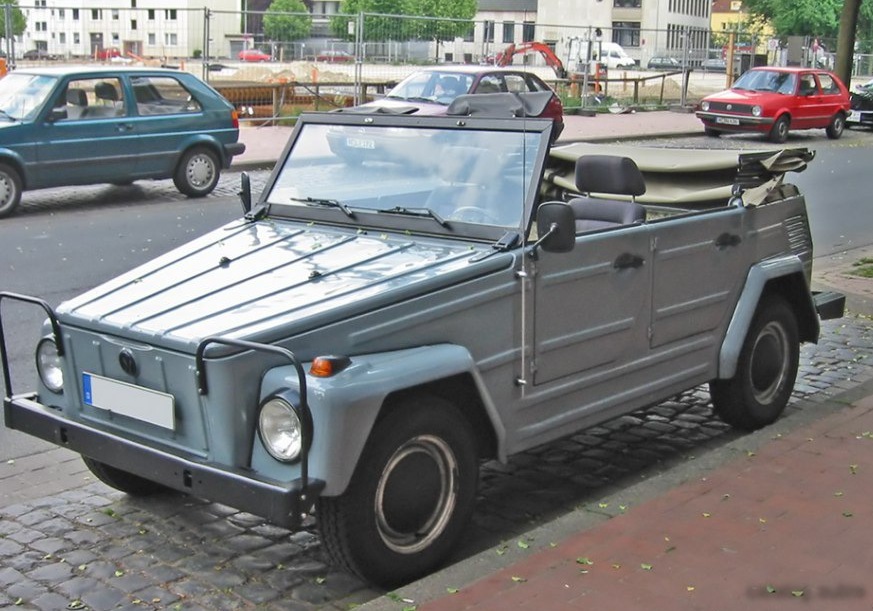
The Volkswagen Type 181, known as the Kübelwagen (German for “bucket car”) in its original military guise and later as the Thing in the United States, was a utility vehicle produced by Volkswagen from 1970 to 1973. Distinct for its minimalist design and rugged construction, the 181 was initially developed for military use, stemming directly from the post-World War II Type 82 Kübelwagen. This civilian adaptation offered a unique, no-frills transportation option, particularly appealing to those seeking a simple, durable, and affordable vehicle. The 1.6-liter, 44 horsepower variant represents the base engine offering during the production run, positioning it as the entry-level model within the 181 lineup. It was sold primarily in Europe and, to a lesser extent, exported to the United States, where its quirky appearance and off-road capability garnered a cult following.
Technical Specifications
| Brand | Volkswagen |
| Model | 181 |
| Generation | 181 |
| Type (Engine) | 1.6 (44 Hp) |
| Start of production | 1970 |
| End of production | 1973 |
| Powertrain Architecture | Internal Combustion Engine |
| Body type | Off-road vehicle, Cabriolet |
| Fuel Type | Petrol (Gasoline) |
| Power | 44 Hp |
| Engine Aspiration | Naturally Aspirated |
Powertrain & Engine Architecture
The Volkswagen 181 1.6 utilized the air-cooled, naturally aspirated 1.6-liter flat-four engine, derived from the Volkswagen Beetle. This engine, internally designated as the Type 113, produced 44 horsepower at 4,000 rpm and approximately 86 lb-ft of torque at 3,000 rpm. The engine featured a simple overhead valve (OHV) valvetrain with two valves per cylinder. Fuel delivery was managed by a single Solex carburetor, a common setup for Volkswagen’s air-cooled engines of the era. The engine’s relatively low compression ratio (around 7.8:1) allowed it to run reliably on lower octane fuels, a practical consideration for its intended use. The 1.6-liter engine was paired with a four-speed manual transmission as standard. An automatic transmission was not offered on this base model. The engine’s air-cooled design eliminated the need for a radiator, water pump, and coolant, simplifying the vehicle’s construction and reducing potential maintenance points. However, it also meant the engine was more susceptible to overheating in extremely hot climates or during prolonged periods of strenuous use.
Driving Characteristics
The 1.6-liter engine in the 181 provided adequate, but not exhilarating, performance. Acceleration was leisurely, with a 0-60 mph time estimated to be around 18-20 seconds. The four-speed manual transmission offered a relatively wide range of gear ratios, allowing the driver to keep the engine within its optimal power band. However, the engine’s limited horsepower meant that climbing steep hills or carrying a heavy load required frequent downshifting. The 181’s relatively light weight (around 2,200 lbs) helped to mitigate the engine’s power deficit. The vehicle’s simple suspension – consisting of independent torsion beam front suspension and swing axle rear suspension – provided a comfortable ride on paved roads, but its off-road capabilities were limited by the lack of four-wheel drive. The 181’s steering was direct and responsive, contributing to its nimble handling. Compared to later, more powerful 181 variants (which were not widely available in the US), the 1.6-liter model prioritized fuel economy and simplicity over outright performance.
Equipment & Trim Levels
The Volkswagen 181 1.6 was deliberately spartan in its equipment levels. It was designed as a utilitarian vehicle, and as such, comfort and convenience features were minimized. Standard equipment included basic cloth seats, a steering wheel, and a speedometer. A fuel gauge and oil temperature gauge were often optional extras. The interior was typically finished in a durable, washable plastic material. The 181’s doors featured simple fabric straps instead of traditional door handles. A folding canvas top was standard, providing limited weather protection. Optional extras included a heater, a radio, and upgraded seat upholstery. The 181’s dashboard was minimalist, with a flat, unadorned design. The vehicle’s overall aesthetic was functional rather than luxurious.
Chassis & Braking
The 181’s chassis was based on a reinforced Beetle platform, providing a robust and durable foundation. The vehicle featured a monocoque construction, with a separate body and chassis. The front suspension utilized independent torsion beam springs and shock absorbers, while the rear suspension employed a swing axle design with torsion bars. This suspension setup provided a reasonable balance between ride comfort and off-road capability. The 181’s braking system consisted of drum brakes on all four wheels. The brakes were mechanically operated, providing adequate stopping power for the vehicle’s weight and performance. Steering was handled by a worm-and-roller system, offering direct and responsive control. The 181’s tires were typically all-terrain tires, designed to provide good traction on a variety of surfaces.
Market Reception & Comparison
The Volkswagen 181 1.6 received mixed reviews from automotive critics. While its rugged construction, simple design, and affordability were praised, its limited performance and spartan equipment levels were often criticized. Compared to other small cars of the era, such as the Fiat 500 or the Mini Cooper, the 181 offered a more utilitarian and off-road-oriented experience. However, it lacked the refinement and performance of these more mainstream vehicles. Fuel economy was reasonable for the time, averaging around 25-30 mpg. Reliability was generally good, thanks to the engine’s simple design and robust construction. The 181’s unique appearance and quirky character appealed to a niche market of buyers who appreciated its unconventional design and rugged capabilities. Compared to the later 1.7-liter versions, the 1.6 offered a lower purchase price but sacrificed some performance.
Legacy
The Volkswagen 181, particularly the 1.6-liter variant, has become a sought-after classic among collectors and enthusiasts. Its simple mechanical design makes it relatively easy to maintain and repair. The engine’s durability and reliability have contributed to its longevity. However, finding original parts can be challenging, as production ceased over 50 years ago. The 181’s unique history and distinctive appearance have cemented its place in automotive culture. Today, well-maintained examples command a premium price in the used car market. The 181 serves as a reminder of a time when vehicles were designed for practicality and durability rather than luxury and sophistication. Its enduring appeal lies in its simplicity, ruggedness, and undeniable character.
