
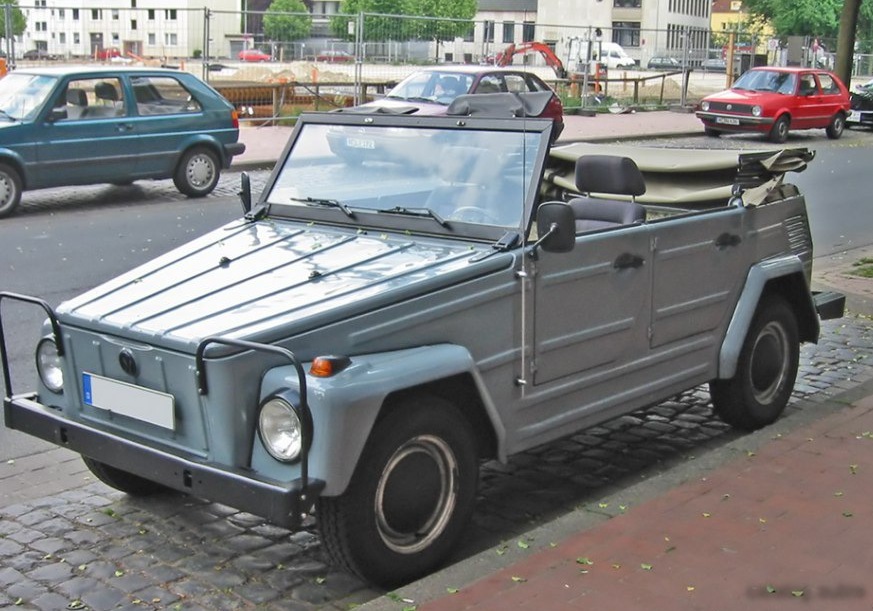
The Volkswagen Type 181, often nicknamed the “Thing” in the United States, is a rear-engine, rear-wheel drive, off-road vehicle produced by Volkswagen from 1968 to 1983. Originally designed for the military, it was intended to be a simple, rugged, and utilitarian vehicle. Production spanned several countries, including West Germany, Mexico, and Brazil. The 1.6-liter, 46 horsepower variant represented the base engine option for much of its production run, particularly in markets where fuel economy and affordability were paramount. It served as a unique offering in a period dominated by more conventional automotive designs, appealing to a niche market seeking a no-frills, capable vehicle.
Technical Specifications
| Brand | Volkswagen |
| Model | 181 |
| Generation | 181 |
| Type (Engine) | 1.6 (46 Hp) |
| Start of production | 1968 year |
| End of production | 1983 year |
| Powertrain Architecture | Internal Combustion engine |
| Body type | Off-road vehicle, Cabriolet |
| Seats | 4 |
| Doors | 4 |
| Fuel consumption (combined) | 11.2 l/100 km (21 US mpg, 25.2 UK mpg, 8.9 km/l) |
| Fuel Type | Petrol (Gasoline) |
| Maximum speed | 109 km/h (67.73 mph) |
| Weight-to-power ratio | 19.6 kg/Hp, 51.1 Hp/tonne |
| Weight-to-torque ratio | 9.4 kg/Nm, 106.7 Nm/tonne |
| Power | 46 Hp @ 4000 rpm |
| Power per litre | 29 Hp/l |
| Torque | 96 Nm @ 2800 rpm (70.81 lb.-ft. @ 2800 rpm) |
| Engine layout | Rear, Longitudinal |
| Engine displacement | 1584 cm3 (96.66 cu. in.) |
| Number of cylinders | 4 |
| Engine configuration | Boxer |
| Cylinder Bore | 85.5 mm (3.37 in.) |
| Piston Stroke | 69 mm (2.72 in.) |
| Compression ratio | 7.3:1 |
| Number of valves per cylinder | 2 |
| Fuel injection system | Carburettor |
| Engine aspiration | Naturally aspirated engine |
| Valvetrain | OHV |
| Engine oil capacity | 2.5 l (2.64 US qt | 2.2 UK qt) |
| Kerb Weight | 900 kg (1984.16 lbs.) |
| Max. weight | 1340 kg (2954.19 lbs.) |
| Max load | 440 kg (970.03 lbs.) |
| Trunk (boot) space – minimum | 153 l (5.4 cu. ft.) |
| Length | 3780 mm (148.82 in.) |
| Width | 1641 mm (64.61 in.) |
| Height | 1621 mm (63.82 in.) |
| Wheelbase | 2400 mm (94.49 in.) |
| Front track | 1354 mm (53.31 in.) |
| Rear (Back) track | 1384 mm (54.49 in.) |
| Ride height (ground clearance) | 201 mm (7.91 in.) |
| Drivetrain Architecture | The Internal combustion engine (ICE) drives the rear wheels of the vehicle. |
| Drive wheel | Rear wheel drive |
| Number of gears and type of gearbox | 4 gears, manual transmission |
| Front suspension | Trailing arm, Torsion |
| Rear suspension | Trailing arm, Torsion |
| Front brakes | Drum |
| Rear brakes | Drum |
| Steering type | Worm-reduction unit |
| Wheel rims size | 5J x 14 |
Powertrain & Engine Architecture
The heart of the 181 1.6 was a 1584cc, air-cooled, horizontally-opposed four-cylinder engine. This “boxer” engine, designated with engine codes like AS or AD, was a staple of Volkswagen’s engineering philosophy for decades. It featured a simple overhead valve (OHV) valvetrain with two valves per cylinder. Fuel delivery was managed by a single Solex carburetor, a common setup for the time, prioritizing simplicity and ease of maintenance over outright performance. The engine’s longitudinal rear-engine placement contributed to the vehicle’s unique handling characteristics. The standard transmission was a four-speed manual gearbox, chosen for its robustness and direct connection to the rear wheels. This configuration, while not offering blistering acceleration, provided adequate power for its intended purpose – traversing varied terrain and providing reliable transportation.
Driving Characteristics
The 1.6-liter engine in the Type 181 delivered modest performance. With only 46 horsepower, acceleration was leisurely, and highway speeds required careful planning. The four-speed manual transmission offered relatively wide gear ratios, emphasizing low-end torque over high-speed cruising. Compared to later, more powerful 181 variants (like those with the 1.7-liter engine), the 1.6 felt noticeably slower. However, the lower power output also contributed to better fuel economy and reduced stress on the drivetrain. The rear-engine layout and torsion bar suspension provided a unique driving experience, characterized by a somewhat bouncy ride but excellent off-road capability. The vehicle’s light weight (around 1984 lbs) helped mitigate the lack of power, making it surprisingly nimble in off-road situations.
Equipment & Trim Levels
The Volkswagen 181 1.6 was intentionally spartan in its equipment levels. It was designed to be a functional vehicle, not a luxury one. Standard features included basic instrumentation (speedometer, fuel gauge), a simple steering wheel, and vinyl upholstery. Doors featured large openings and could be removed entirely for open-air driving, contributing to its appeal as a recreational vehicle. Options were limited but could include a heater, a folding soft top, and different exterior colors. The interior was typically finished in utilitarian materials, designed to withstand the rigors of off-road use. There wasn’t a complex trim level structure; the 1.6 represented the base model, with upgrades primarily consisting of optional accessories.
Chassis & Braking
The Type 181 utilized a robust chassis designed for off-road durability. It featured a body-on-frame construction, providing a solid foundation for tackling rough terrain. Suspension consisted of torsion bar springs at both the front and rear, offering a reasonable degree of articulation and ride comfort. Braking was handled by drum brakes on all four wheels, which were adequate for the vehicle’s weight and performance but lacked the stopping power of more modern disc brake systems. Steering was accomplished via a worm-reduction unit, providing a direct but somewhat heavy feel. The vehicle’s high ground clearance (7.91 inches) was a key asset for off-road driving, allowing it to navigate obstacles with ease.
Market Reception & Comparison
The 181 1.6 received mixed reviews. Critics acknowledged its ruggedness and off-road capability but often criticized its lack of power and refinement. Compared to other Volkswagen models of the time, such as the Beetle or the Type 2 (Bus), the 181 offered a more specialized and utilitarian experience. Within the 181 lineup, the 1.6-liter version was positioned as the entry-level model, appealing to buyers prioritizing affordability and fuel economy over performance. The later 1.7-liter engine offered a noticeable power increase, but at a higher price point. Fuel economy for the 1.6 was relatively good for the era, averaging around 21 US mpg, but reliability was generally high across all 181 variants due to the simplicity of the engine and drivetrain.
Legacy
The Volkswagen Type 181, particularly the 1.6-liter variant, has gained a cult following among automotive enthusiasts. Its unique design, rugged construction, and simple mechanics have made it a popular choice for restoration and modification. While the 1.6-liter engine isn’t known for its high performance, it’s relatively easy to maintain and rebuild. Today, well-maintained examples of the 181 1.6 command a premium in the used car market, appealing to collectors and those seeking a distinctive and capable off-road vehicle. The Type 181 remains a testament to Volkswagen’s engineering ingenuity and its commitment to producing vehicles that are both functional and enduring.
