
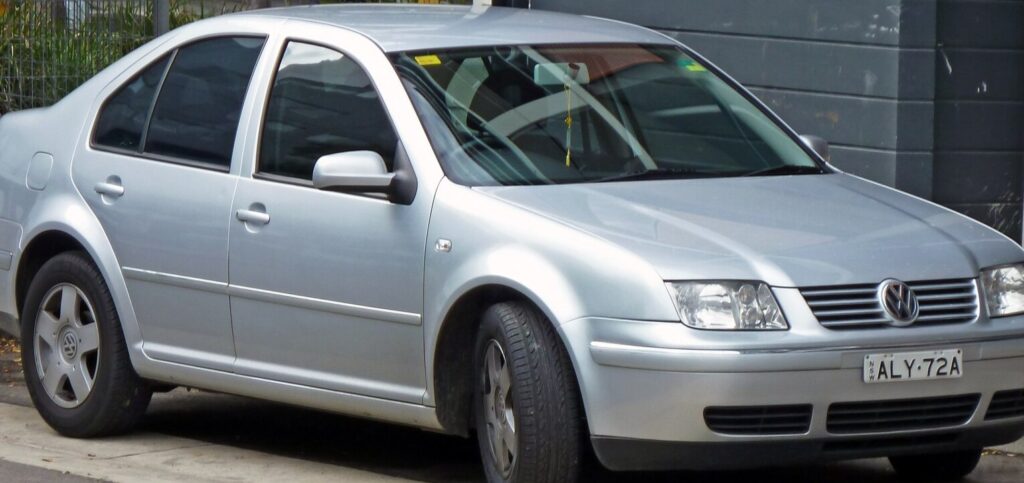
The Volkswagen Bora 1.4 16V, produced from May 1999 to 2005, represented the entry point into the Bora (1J2) sedan range, Volkswagen’s replacement for the Jetta in many markets. Positioned as an affordable and practical family car, the 1.4 16V aimed to deliver reasonable fuel economy and everyday usability. It was a key component of Volkswagen’s strategy to offer a broad range of options within the A4 platform, also known as the 1HX0/A3 platform, shared with models like the Golf, New Beetle, and Audi A3. This variant was primarily sold in Europe and other markets outside of North America, where the Jetta name continued.
Technical Specifications
| Brand | Volkswagen |
| Model | Bora |
| Generation | Bora (1J2) |
| Type (Engine) | 1.4 16V (75 Hp) |
| Start of production | May, 1999 |
| End of production | 2005 |
| Powertrain Architecture | Internal Combustion engine |
| Body type | Sedan |
| Seats | 5 |
| Doors | 4 |
| Fuel consumption (urban) | 8.6 l/100 km (27.4 US mpg, 32.8 UK mpg, 11.6 km/l) |
| Fuel consumption (extra urban) | 5.4 l/100 km (43.6 US mpg, 52.3 UK mpg, 18.5 km/l) |
| Fuel consumption (combined) | 6.6 l/100 km (35.6 US mpg, 42.8 UK mpg, 15.2 km/l) |
| Fuel Type | Petrol (Gasoline) |
| Acceleration 0 – 100 km/h | 14.9 sec |
| Acceleration 0 – 62 mph | 14.9 sec |
| Acceleration 0 – 60 mph | 14.2 sec |
| Maximum speed | 171 km/h (106.25 mph) |
| Weight-to-power ratio | 15.5 kg/Hp, 64.4 Hp/tonne |
| Weight-to-torque ratio | 9.2 kg/Nm, 108.2 Nm/tonne |
| Power | 75 Hp @ 5000 rpm |
| Power per litre | 54 Hp/l |
| Torque | 126 Nm @ 3800 rpm (92.93 lb.-ft. @ 3800 rpm) |
| Engine layout | Front, Transverse |
| Engine Model/Code | APE, AHW, AKQ, AXP, BCA |
| Engine displacement | 1390 cm3 (84.82 cu. in.) |
| Number of cylinders | 4 |
| Engine configuration | Inline |
| Cylinder Bore | 76.5 mm (3.01 in.) |
| Piston Stroke | 75.6 mm (2.98 in.) |
| Compression ratio | 10.5:1 |
| Number of valves per cylinder | 4 |
| Fuel injection system | Multi-port manifold injection |
| Engine aspiration | Naturally aspirated engine |
| Valvetrain | DOHC |
| Engine oil capacity | 3.5 l (3.7 US qt | 3.08 UK qt) |
| Coolant | 6 l (6.34 US qt | 5.28 UK qt) |
| Kerb Weight | 1165 kg (2568.39 lbs.) |
| Max. weight | 1710 kg (3769.9 lbs.) |
| Max load | 545 kg (1201.52 lbs.) |
| Trunk (boot) space – minimum | 455 l (16.07 cu. ft.) |
| Trunk (boot) space – maximum | 785 l (27.72 cu. ft.) |
| Fuel tank capacity | 55 l (14.53 US gal | 12.1 UK gal) |
| Length | 4376 mm (172.28 in.) |
| Width | 1735 mm (68.31 in.) |
| Width including mirrors | 2018 mm (79.45 in.) |
| Height | 1446 mm (56.93 in.) |
| Wheelbase | 2519 mm (99.17 in.) |
| Front track | 1513 mm (59.57 in.) |
| Rear (Back) track | 1494 mm (58.82 in.) |
| Drag coefficient (Cd) | 0.32 |
| Minimum turning circle | 10.9 m (35.76 ft.) |
| Drivetrain Architecture | The Internal combustion engine (ICE) drives the front wheels of the vehicle. |
| Drive wheel | Front wheel drive |
| Number of gears and type of gearbox | 5 gears, manual transmission |
| Front suspension | Independent, type McPherson with coil spring and anti-roll bar |
| Rear suspension | Semi-independent, coil spring |
| Front brakes | Ventilated discs |
| Rear brakes | Disc |
| Assisting systems | ABS (Anti-lock braking system) |
| Steering type | Steering rack and pinion |
| Power steering | Hydraulic Steering |
| Tires size | 195/65 R15 |
| Wheel rims size | 6J x 15 |
Powertrain & Engine Architecture
The Bora 1.4 16V utilized a 1.4-liter, inline four-cylinder engine, available with several engine codes including APE, AHW, AKQ, AXP, and BCA. These engines were characterized by their relatively simple design and reliance on multi-port fuel injection. The 16-valve dual overhead camshaft (DOHC) configuration helped to improve breathing and, consequently, power output compared to older single overhead cam designs. The engine’s modest 75 horsepower at 5000 rpm and 93 lb-ft of torque at 3800 rpm were sufficient for everyday driving, but didn’t offer significant performance. The engine was transversely mounted, driving the front wheels. The standard transmission was a five-speed manual, but a four-speed automatic transmission was also offered, though it impacted fuel economy and acceleration.
Driving Characteristics
The 1.4 16V Bora, particularly when equipped with the automatic transmission, offered a comfortable but uninspiring driving experience. Acceleration was leisurely, taking nearly 15 seconds to reach 60 mph. The automatic transmission, while providing convenience, featured relatively long gear ratios designed to maximize fuel efficiency rather than performance. Compared to the more powerful 1.8-liter and 2.0-liter variants, or even the diesel options, the 1.4 felt noticeably underpowered, especially when fully loaded or tackling inclines. The suspension, tuned for comfort, provided a reasonably smooth ride, but didn’t offer the sporty handling found in some of its competitors.
Equipment & Trim Levels
The 1.4 16V Bora typically came with a basic level of equipment. Standard features generally included power steering, central locking, electric front windows, and an anti-lock braking system (ABS). Interior upholstery was typically cloth, and the dashboard featured a functional but somewhat basic design. Optional extras included air conditioning, alloy wheels, a radio/cassette player (later upgraded to CD players), and upgraded interior trim. Trim levels varied by market, but generally followed a progressive structure, with the 1.4 representing the entry-level offering.
Chassis & Braking
The Bora 1.4 16V utilized a McPherson strut front suspension with coil springs and an anti-roll bar, providing a comfortable ride and predictable handling. The rear suspension was a semi-independent torsion beam setup, which was cost-effective but less sophisticated than fully independent systems. Braking consisted of ventilated discs at the front and solid discs at the rear. The ABS system provided enhanced braking control, particularly on slippery surfaces. The relatively light weight of the 1.4 model, at around 2568 lbs, helped to compensate for its modest power output and braking performance.
Market Reception & Comparison
The Bora 1.4 16V was generally well-received as an affordable and practical family car. Critics praised its fuel efficiency and comfortable ride, but often criticized its lack of performance. Compared to the higher-spec Bora models, such as the 1.8 and 2.0-liter versions, the 1.4 offered significantly less power and a less engaging driving experience. However, it was considerably cheaper to purchase and operate, making it an attractive option for budget-conscious buyers. The 1.9 TDI diesel variant offered superior fuel economy and torque, but at a higher initial cost.
Legacy
The Volkswagen Bora 1.4 16V, while not a performance icon, has proven to be a relatively reliable and durable vehicle. The engine, while not particularly powerful, is generally known for its longevity when properly maintained. In the used car market, these Boras are often sought after as affordable and economical transportation. Common issues include wear and tear on suspension components and potential problems with the automatic transmission. However, parts availability is generally good, and the relatively simple mechanical design makes them relatively easy to repair. The Bora 1.4 16V represents a practical and sensible choice for those seeking a reliable and fuel-efficient compact sedan.
