
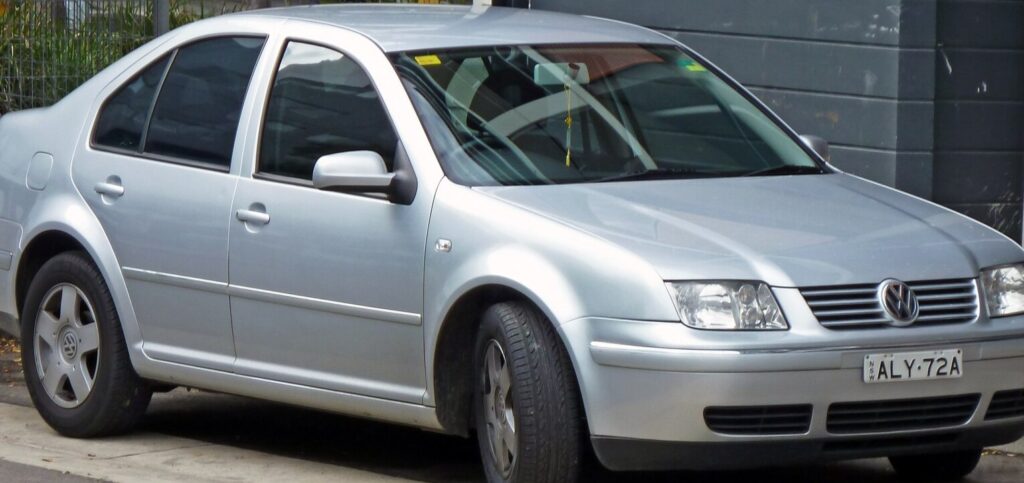
The Volkswagen Bora 1.6, produced between 1998 and 2000, represented an entry-level offering within the first generation (1J2) Bora lineup. Positioned as a more affordable alternative to the higher-spec models, it aimed to provide practical, economical transportation within the compact sedan segment. The Bora itself was Volkswagen’s replacement for the Jetta in Europe, sharing its platform – the A4 – with the Golf, Audi A3, and SEAT Leon. This 1.6-liter variant was primarily targeted at buyers prioritizing fuel efficiency and lower purchase price over outright performance, making it a popular choice for families and commuters.
Technical Specifications
| Brand | Volkswagen |
| Model | Bora |
| Generation | Bora (1J2) |
| Type (Engine) | 1.6 (100 Hp) |
| Start of production | 1998 |
| End of production | 2000 |
| Powertrain Architecture | Internal Combustion engine |
| Body type | Sedan |
| Seats | 5 |
| Doors | 4 |
| Fuel consumption (urban) | 10.6 l/100 km (22.2 US mpg) |
| Fuel consumption (extra urban) | 6 l/100 km (39.2 US mpg) |
| Fuel consumption (combined) | 7.7 l/100 km (30.5 US mpg) |
| Fuel Type | Petrol (Gasoline) |
| Acceleration 0 – 100 km/h | 11.7 sec |
| Acceleration 0 – 62 mph | 11.7 sec |
| Acceleration 0 – 60 mph | 11.1 sec |
| Maximum speed | 188 km/h (116.82 mph) |
| Weight-to-power ratio | 11.9 kg/Hp |
| Weight-to-torque ratio | 8.2 kg/Nm |
| Power | 100 Hp @ 5600 rpm |
| Torque | 145 Nm @ 3800 rpm (106.95 lb.-ft. @ 3800 rpm) |
| Engine layout | Front, Transverse |
| Engine Model/Code | AEH, AKL |
| Engine displacement | 1595 cm3 (97.33 cu. in.) |
| Number of cylinders | 4 |
| Engine configuration | Inline |
| Cylinder Bore | 81 mm (3.19 in.) |
| Piston Stroke | 77.4 mm (3.05 in.) |
| Compression ratio | 10.3:1 |
| Number of valves per cylinder | 2 |
| Fuel injection system | Multi-port manifold injection |
| Engine aspiration | Naturally aspirated engine |
| Valvetrain | OHC |
| Engine oil capacity | 4.5 l (4.76 US qt | 3.96 UK qt) |
| Coolant capacity | 5 l (5.28 US qt | 4.4 UK qt) |
| Kerb Weight | 1185 kg (2612.48 lbs.) |
| Max. weight | 1720 kg (3791.95 lbs.) |
| Max load | 535 kg (1179.47 lbs.) |
| Trunk (boot) space – minimum | 455 l (16.07 cu. ft.) |
| Trunk (boot) space – maximum | 785 l (27.72 cu. ft.) |
| Fuel tank capacity | 55 l (14.53 US gal | 12.1 UK gal) |
| Length | 4376 mm (172.28 in.) |
| Width | 1735 mm (68.31 in.) |
| Width including mirrors | 2018 mm (79.45 in.) |
| Height | 1446 mm (56.93 in.) |
| Wheelbase | 2519 mm (99.17 in.) |
| Front track | 1513 mm (59.57 in.) |
| Rear track | 1494 mm (58.82 in.) |
| Drag coefficient (Cd) | 0.32 |
| Minimum turning circle | 10.9 m (35.76 ft.) |
| Drivetrain Architecture | Front wheel drive |
| Number of gears | 5 |
| Gearbox type | Manual transmission |
| Front suspension | Independent, McPherson with coil spring and anti-roll bar |
| Rear suspension | Semi-independent, coil spring |
| Front brakes | Ventilated discs |
| Rear brakes | Disc |
| Assisting systems | ABS (Anti-lock braking system) |
| Steering type | Steering rack and pinion |
| Power steering | Hydraulic |
| Tires size | 195/65 R15 |
| Wheel rims size | 6J x 15 |
INTRODUCTION
The Volkswagen Bora 1.6, launched in 1998, was a key component of VW’s strategy to offer a modern, practical sedan to a wider audience. Built on the A4 platform, it shared many components with the Golf Mk4, but presented a more traditional three-box sedan design. The 1.6-liter engine, designated with engine codes AEH and AKL, was the base engine option, offering a balance between affordability and acceptable performance. Production of this specific variant continued until 2000, after which it was superseded by updated engine options and trim levels.
Powertrain & Engine Architecture
The heart of the Bora 1.6 is the 1.6-liter inline-four cylinder engine. This engine, part of Volkswagen’s EA827 family, featured a cast iron block and an aluminum cylinder head. It utilized a single overhead camshaft (SOHC) valvetrain with two valves per cylinder. Fuel delivery was managed by a Bosch Motronic multi-port fuel injection system, providing precise control over the air-fuel mixture. The engine produced 100 horsepower at 5600 rpm and 145 Nm (107 lb-ft) of torque at 3800 rpm. The engine was paired with a five-speed manual transmission, which was the most common configuration. While an automatic transmission was available, it was less frequently chosen due to its impact on fuel economy and performance. The engine’s design prioritized reliability and fuel efficiency over outright power, making it a suitable choice for everyday driving.
Driving Characteristics
The Bora 1.6, with its 100 horsepower and five-speed manual transmission, offered adequate, but not exhilarating, performance. Acceleration from 0 to 60 mph took approximately 11.1 seconds, and the top speed was around 117 mph. The engine felt somewhat strained when pushed hard, particularly when fully loaded with passengers or cargo. The five-speed gearbox was well-matched to the engine’s characteristics, providing reasonable gear ratios for both city and highway driving. Compared to the more powerful 1.8-liter and VR6 variants, the 1.6 felt noticeably slower, especially during overtaking maneuvers. However, the lighter weight of the 1.6 compared to the VR6 did contribute to slightly better handling and fuel economy. The automatic transmission option further diminished performance, resulting in slower acceleration and a less engaging driving experience.
Equipment & Trim Levels
The Bora 1.6 typically came with a relatively basic level of equipment, reflecting its position as the entry-level model. Standard features generally included power steering, central locking, electric front windows, and an adjustable steering column. Interior upholstery was typically cloth, and the dashboard featured a simple, functional design. Optional extras included air conditioning, alloy wheels, a radio/cassette player, and upgraded interior trim. Higher trim levels, such as the ‘Comfort’ or ‘Trendline’ packages, added features like rear electric windows, a multi-function display, and improved seat fabrics. Safety features included ABS brakes and driver and passenger airbags.
Chassis & Braking
The Bora 1.6 utilized a MacPherson strut front suspension and a semi-independent torsion beam rear suspension. This setup provided a comfortable ride quality, although it wasn’t particularly sporty. The front brakes were ventilated discs, while the rear brakes were solid discs. ABS (Anti-lock Braking System) was standard, enhancing braking performance and stability. The suspension was tuned for comfort rather than handling precision, and the steering, while accurate, lacked significant feedback. The relatively light weight of the 1.6 model helped to mitigate some of the limitations of the suspension and braking system.
Market Reception & Comparison
The Bora 1.6 received mixed reviews from automotive critics. While praised for its fuel efficiency and affordability, it was often criticized for its lack of power and somewhat uninspired driving experience. Compared to the 1.8-liter and VR6 models, the 1.6 offered significantly less performance, but at a lower price point. The 1.8-liter engine provided a noticeable improvement in power and responsiveness, while the VR6 offered a more luxurious and sporty experience. In terms of reliability, the 1.6-liter engine proved to be generally robust, although regular maintenance was essential. Fuel economy was a strong point, with combined fuel consumption averaging around 30.5 US mpg.
Legacy
The Volkswagen Bora 1.6 remains a relatively common sight on used car markets today. Its simple engine design and robust construction contribute to its long-term reliability, although age-related issues such as corrosion and wear and tear are common. The 1.6-liter engine is known for its durability, but regular oil changes and maintenance are crucial to prevent problems. The Bora 1.6 represents a practical and affordable entry point into Volkswagen ownership, offering a comfortable and economical driving experience for those prioritizing value over performance. While not a particularly exciting car, it served as a reliable and dependable transportation option for many drivers during its production run.
