
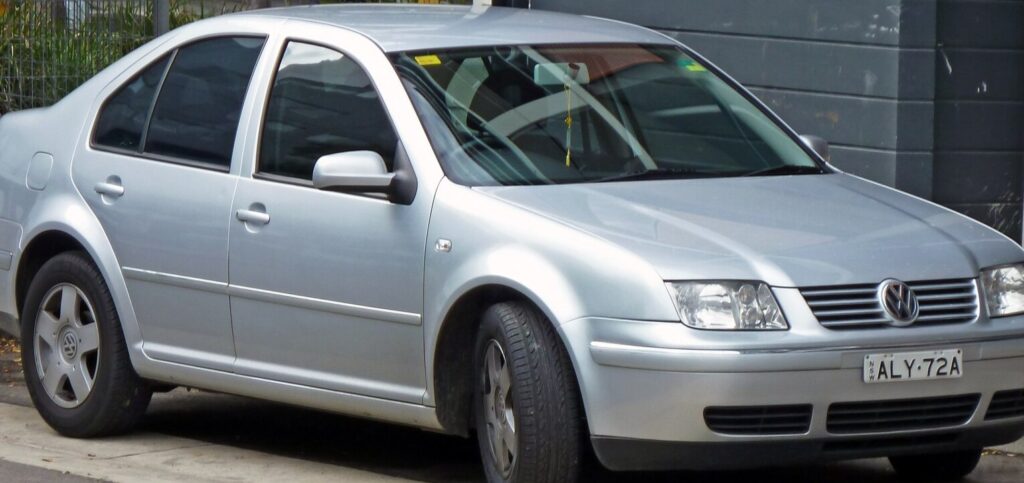
The Volkswagen Bora 1.6 FSI, produced between 2001 and 2005, represented a key entry point into the compact sedan market for Volkswagen in Europe and other regions. Part of the 1J2 series, the Bora was essentially the European equivalent of the Jetta sold in North America. The 1.6 FSI variant, equipped with a 110 horsepower engine and typically paired with a five-speed manual transmission, was positioned as a fuel-efficient and affordable option within the Bora lineup, appealing to buyers prioritizing practicality and economy over outright performance. It sat below the more powerful 1.8T and 2.0 models, offering a more accessible price point.
Technical Specifications
| Brand | Volkswagen |
| Model | Bora |
| Generation | Bora (1J2) |
| Type (Engine) | 1.6 FSI (110 Hp) |
| Start of production | 2001 |
| End of production | 2005 |
| Powertrain Architecture | Internal Combustion engine |
| Body type | Sedan |
| Seats | 5 |
| Doors | 4 |
| Fuel consumption (urban) | 7.9 l/100 km (29.8 US mpg, 35.8 UK mpg, 12.7 km/l) |
| Fuel consumption (extra urban) | 5.2 l/100 km (45.2 US mpg, 54.3 UK mpg, 19.2 km/l) |
| Fuel consumption (combined) | 6.2 l/100 km (37.9 US mpg, 45.6 UK mpg, 16.1 km/l) |
| CO2 emissions | 149 g/km |
| Fuel Type | Petrol (Gasoline) |
| Acceleration 0 – 100 km/h | 11.2 sec |
| Acceleration 0 – 62 mph | 11.2 sec |
| Acceleration 0 – 60 mph | 10.6 sec |
| Maximum speed | 194 km/h (120.55 mph) |
| Weight-to-power ratio | 11.1 kg/Hp, 89.8 Hp/tonne |
| Weight-to-torque ratio | 7.9 kg/Nm, 126.5 Nm/tonne |
| Power | 110 Hp @ 5800 rpm |
| Power per litre | 68.8 Hp/l |
| Torque | 155 Nm @ 4500 rpm (114.32 lb.-ft. @ 4500 rpm) |
| Engine layout | Front, Transverse |
| Engine Model/Code | BAD |
| Engine displacement | 1598 cm3 (97.52 cu. in.) |
| Number of cylinders | 4 |
| Engine configuration | Inline |
| Cylinder Bore | 76.5 mm (3.01 in.) |
| Piston Stroke | 86.9 mm (3.42 in.) |
| Compression ratio | 12:1 |
| Number of valves per cylinder | 4 |
| Fuel injection system | Direct injection |
| Engine aspiration | Naturally aspirated engine |
| Valvetrain | DOHC |
| Engine oil capacity | 3.5 l (3.7 US qt | 3.08 UK qt) |
| Coolant | 6 l (6.34 US qt | 5.28 UK qt) |
| Kerb Weight | 1225 kg (2700.66 lbs.) |
| Max. weight | 1760 kg (3880.14 lbs.) |
| Max load | 535 kg (1179.47 lbs.) |
| Trunk (boot) space – minimum | 455 l (16.07 cu. ft.) |
| Trunk (boot) space – maximum | 785 l (27.72 cu. ft.) |
| Fuel tank capacity | 55 l (14.53 US gal | 12.1 UK gal) |
| Length | 4376 mm (172.28 in.) |
| Width | 1735 mm (68.31 in.) |
| Width including mirrors | 2018 mm (79.45 in.) |
| Height | 1446 mm (56.93 in.) |
| Wheelbase | 2519 mm (99.17 in.) |
| Front track | 1513 mm (59.57 in.) |
| Rear (Back) track | 1494 mm (58.82 in.) |
| Minimum turning circle | 10.9 m (35.76 ft.) |
| Drivetrain Architecture | The Internal combustion engine (ICE) drives the front wheels of the vehicle. |
| Drive wheel | Front wheel drive |
| Number of gears and type of gearbox | 5 gears, manual transmission |
| Front suspension | Independent, type McPherson with coil spring and anti-roll bar |
| Rear suspension | Semi-independent, coil spring |
| Front brakes | Ventilated discs |
| Rear brakes | Disc |
| Assisting systems | ABS (Anti-lock braking system) |
| Steering type | Steering rack and pinion |
| Power steering | Hydraulic Steering |
| Tires size | 195/65 R15 |
| Wheel rims size | 15 |
Powertrain & Engine Architecture
The heart of the Bora 1.6 FSI was the BAD engine code, a 1.6-liter inline-four cylinder powerplant. This engine was notable for its use of Fuel Stratified Injection (FSI), a direct injection technology that allowed for more precise fuel delivery and improved combustion efficiency. Unlike traditional port fuel injection, FSI injected fuel directly into the combustion chamber, enabling higher compression ratios and reduced knocking. The engine featured a double overhead camshaft (DOHC) valvetrain with four valves per cylinder, contributing to its relatively high output for its displacement. The five-speed manual transmission was the most common pairing, offering a balance between fuel economy and driver control. While an automatic transmission was available, it was less frequently chosen due to its impact on performance and fuel consumption.
Driving Characteristics
The 1.6 FSI Bora offered a competent, if not particularly exciting, driving experience. With 110 horsepower, acceleration was adequate for everyday driving, but overtaking maneuvers required planning. The engine delivered its peak torque of 155 Nm (114 lb-ft) at 4500 rpm, meaning drivers needed to rev the engine to access its full potential. The five-speed manual transmission provided a reasonable spread of gears, but the relatively long gearing emphasized fuel economy over spirited acceleration. Compared to the 1.8T models, the 1.6 FSI felt noticeably slower, but it offered a smoother and more refined driving experience, particularly at lower speeds. The suspension, tuned for comfort, provided a reasonably compliant ride, absorbing bumps and imperfections in the road surface effectively.
Equipment & Trim Levels
The 1.6 FSI Bora typically came with a fairly basic level of equipment, reflecting its position as the entry-level model. Standard features generally included power windows, central locking, and an audio system. Air conditioning was often an optional extra. Interior upholstery was typically cloth, and the dashboard featured a functional, if somewhat understated, design. Higher trim levels offered upgrades such as alloy wheels, upgraded audio systems, and climate control. Safety features included ABS brakes and driver and passenger airbags.
Chassis & Braking
The Bora 1.6 FSI utilized a McPherson strut front suspension and a semi-independent coil spring rear suspension. This setup provided a good balance between ride comfort and handling. The front brakes were ventilated discs, offering good stopping power, while the rear brakes were solid discs. The steering was a hydraulic power-assisted rack and pinion system, providing precise and responsive steering feel. The car rode on 195/65 R15 tires, which contributed to its comfortable ride quality.
Market Reception & Comparison
The Bora 1.6 FSI was generally well-received by critics as a practical and economical family car. Its fuel efficiency was a major selling point, and its direct injection engine offered a noticeable improvement in fuel economy compared to older designs. However, some critics found the engine to be underpowered, particularly when fully loaded or driving on hilly terrain. Compared to the more powerful Bora variants, the 1.6 FSI offered a lower purchase price and lower running costs, making it an attractive option for budget-conscious buyers. The 1.8T models offered significantly more performance, but at a higher price and with increased fuel consumption. The diesel variants, such as the 1.9 TDI, provided even better fuel economy but lacked the refinement of the FSI engine.
Legacy
The Volkswagen Bora 1.6 FSI, while not the most exciting variant in the lineup, proved to be a reliable and durable car. The FSI engine, when properly maintained, is known for its longevity. Today, these Boras can be found on the used car market at affordable prices. Common issues include wear and tear on suspension components and potential problems with the fuel injectors, but overall, the 1.6 FSI powertrain is considered relatively robust. The Bora, as a whole, remains a popular choice for those seeking a practical and affordable compact sedan, and the 1.6 FSI variant continues to offer a compelling value proposition for budget-minded buyers.
