
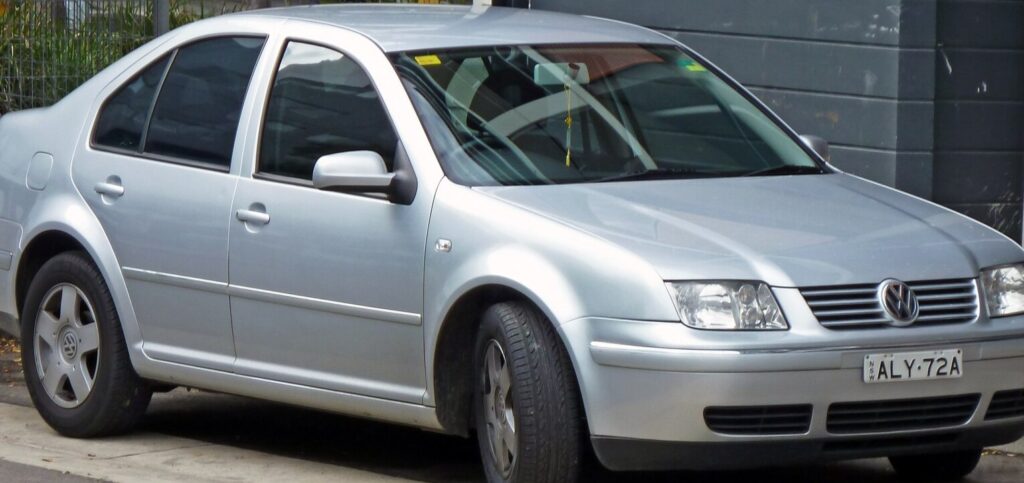
The Volkswagen Bora 1.8 Turbo 20V with the Tiptronic automatic transmission, produced between 2000 and 2005, represented a significant offering in the compact sedan segment. Part of the 1J2 series, the Bora was Volkswagen’s replacement for the Jetta in Europe (though the Jetta name continued in North America). This particular variant, powered by the 1.8-liter turbocharged engine and paired with a five-speed Tiptronic gearbox, aimed to provide a balance of performance and convenience for buyers seeking a more refined driving experience than the base models, but without the higher price tag of the more powerful options. It occupied a mid-range position within the Bora lineup, appealing to those prioritizing comfort and ease of use over outright sportiness.
Technical Specifications
| Brand | Volkswagen |
| Model | Bora |
| Generation | Bora (1J2) |
| Type (Engine) | 1.8 Turbo 20V (150 Hp) Tiptronic |
| Start of production | 2000 year |
| End of production | 2005 year |
| Powertrain Architecture | Internal Combustion engine |
| Body type | Sedan |
| Seats | 5 |
| Doors | 4 |
| Fuel consumption (economy) – urban | 12.7 l/100 km (18.5 US mpg, 22.2 UK mpg, 7.9 km/l) |
| Fuel consumption (economy) – extra urban | 6.8 l/100 km (34.6 US mpg, 41.5 UK mpg, 14.7 km/l) |
| Fuel consumption (economy) – combined | 8.9 l/100 km (26.4 US mpg, 31.7 UK mpg, 11.2 km/l) |
| Fuel Type | Petrol (Gasoline) |
| Acceleration 0 – 100 km/h | 9.8 sec |
| Acceleration 0 – 62 mph | 9.8 sec |
| Acceleration 0 – 60 mph | 9.3 sec |
| Maximum speed | 212 km/h (131.73 mph) |
| Weight-to-power ratio | 8.7 kg/Hp, 115.6 Hp/tonne |
| Weight-to-torque ratio | 6.2 kg/Nm, 161.8 Nm/tonne |
| Power | 150 Hp @ 5700 rpm |
| Power per litre | 84.2 Hp/l |
| Torque | 210 Nm @ 1750-4600 rpm (154.89 lb.-ft. @ 1750-4600 rpm) |
| Engine layout | Front, Transverse |
| Engine Model/Code | AGU, AUM |
| Engine displacement | 1781 cm3 (108.68 cu. in.) |
| Number of cylinders | 4 |
| Engine configuration | Inline |
| Cylinder Bore | 81 mm (3.19 in.) |
| Piston Stroke | 86.4 mm (3.4 in.) |
| Compression ratio | 9.5:1 |
| Number of valves per cylinder | 5 |
| Fuel injection system | Multi-port manifold injection |
| Engine aspiration | Turbocharger |
| Valvetrain | DOHC |
| Engine oil capacity | 4.5 l (4.76 US qt | 3.96 UK qt) |
| Coolant | 5 l (5.28 US qt | 4.4 UK qt) |
| Kerb Weight | 1298 kg (2861.6 lbs.) |
| Max. weight | 1820 kg (4012.41 lbs.) |
| Max load | 522 kg (1150.81 lbs.) |
| Trunk (boot) space – minimum | 455 l (16.07 cu. ft.) |
| Trunk (boot) space – maximum | 785 l (27.72 cu. ft.) |
| Fuel tank capacity | 55 l (14.53 US gal | 12.1 UK gal) |
| Length | 4376 mm (172.28 in.) |
| Width | 1735 mm (68.31 in.) |
| Width including mirrors | 2018 mm (79.45 in.) |
| Height | 1446 mm (56.93 in.) |
| Wheelbase | 2519 mm (99.17 in.) |
| Front track | 1513 mm (59.57 in.) |
| Rear (Back) track | 1494 mm (58.82 in.) |
| Minimum turning circle | 10.9 m (35.76 ft.) |
| Drivetrain Architecture | The Internal combustion engine (ICE) drives the front wheels of the vehicle. |
| Drive wheel | Front wheel drive |
| Number of gears and type of gearbox | 5 gears, automatic transmission Tiptronic |
| Front suspension | Independent, type McPherson with coil spring and anti-roll bar |
| Rear suspension | Semi-independent, coil spring |
| Front brakes | Ventilated discs |
| Rear brakes | Disc |
| Assisting systems | ABS (Anti-lock braking system) |
| Steering type | Steering rack and pinion |
| Power steering | Hydraulic Steering |
| Tires size | 195/65 R15 |
| Wheel rims size | 6J x 15 |
Powertrain & Engine Architecture
The heart of this Bora variant is the 1.8-liter, 20-valve turbocharged inline-four cylinder engine. Engine codes AGU and AUM were commonly found in this application. This engine utilized multi-port fuel injection and a K04 turbocharger, delivering 150 horsepower and 210 Nm (155 lb-ft) of torque. The turbocharger provided a significant boost in power compared to naturally aspirated engines of similar displacement. The engine’s 20-valve configuration (five valves per cylinder – three intake, two exhaust) enhanced breathing and contributed to its relatively high specific output. The Tiptronic transmission is a four-speed automatic with a manual shift mode, allowing drivers some control over gear selection. It’s a conventional torque converter automatic, offering smooth shifts but not the responsiveness of a dual-clutch transmission.
Driving Characteristics
The 1.8 Turbo Tiptronic Bora offered a comfortable and capable driving experience. Acceleration from 0-60 mph took around 9.3 seconds, which was respectable for its time, but noticeably slower than the manual transmission or higher-powered VR6 versions. The Tiptronic transmission, while convenient, did introduce some power loss compared to the manual. The gear ratios were tuned for fuel efficiency and smooth cruising, rather than outright performance. In typical driving situations, the engine provided adequate power for overtaking and highway merging. The Tiptronic allowed drivers to hold gears for longer during spirited driving, but it wasn’t as engaging as a fully manual gearbox. The suspension provided a comfortable ride, absorbing bumps and imperfections in the road well.
Equipment & Trim Levels
The 1.8 Turbo Tiptronic Bora typically came equipped with features such as air conditioning, power windows, power locks, and an aftermarket radio. Higher trim levels added options like alloy wheels, a sunroof, and upgraded interior trim. Interior upholstery was generally cloth, with leather options available as an upgrade. The dashboard layout was functional and straightforward, typical of Volkswagen’s design philosophy at the time. Optional extras included a CD changer, upgraded sound system, and heated front seats.
Chassis & Braking
The Bora’s chassis featured an independent McPherson strut front suspension and a semi-independent torsion beam rear suspension. This setup provided a good balance of ride comfort and handling. Brakes were ventilated discs at the front and solid discs at the rear. Anti-lock Braking System (ABS) was standard. The steering was rack and pinion with hydraulic power assistance, offering a reasonably direct and responsive feel. The suspension was tuned for comfort, with stabilizer bars helping to reduce body roll during cornering.
Market Reception & Comparison
The 1.8 Turbo Tiptronic Bora was generally well-received by automotive critics as a practical and comfortable family sedan. It was praised for its refined engine, smooth transmission, and spacious interior. However, some critics noted that the Tiptronic transmission dulled the engine’s performance compared to the manual version. Compared to the more powerful VR6 Bora, the 1.8 Turbo offered better fuel economy but less exhilarating acceleration. Against the 1.9 TDI diesel Bora, it provided more power but significantly lower fuel efficiency. The 1.8 Turbo Tiptronic appealed to buyers who prioritized comfort and convenience over outright performance.
Legacy
The 1.8 Turbo engine, in various iterations, proved to be relatively reliable, although preventative maintenance, particularly regarding the turbocharger and cooling system, is crucial. The Tiptronic transmission, while generally durable, can be prone to issues with age, including slipping and harsh shifting. Today, the Bora 1.8 Turbo Tiptronic can be found on the used car market at affordable prices. It represents a good value for buyers seeking a comfortable and reliable compact sedan, but potential buyers should be aware of the potential maintenance costs associated with an older turbocharged vehicle and automatic transmission.
