
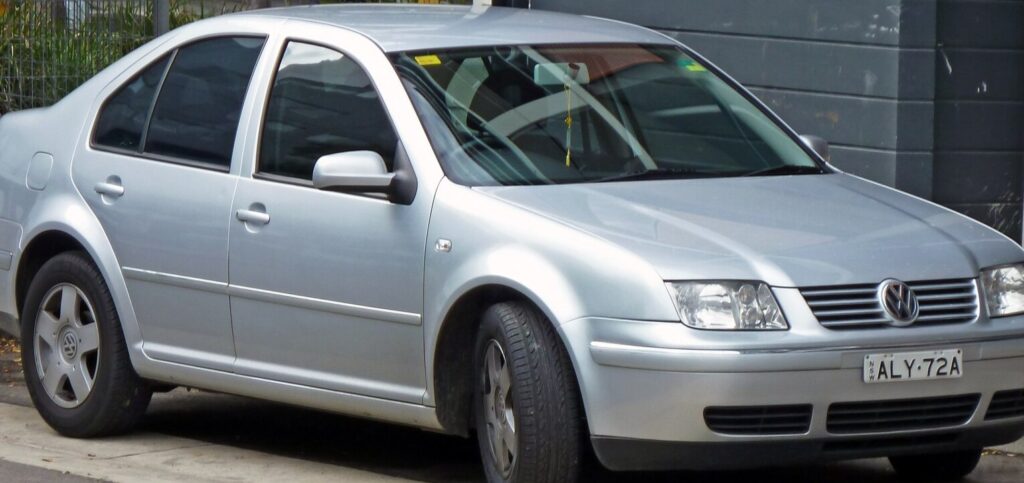
The Volkswagen Bora 1.9 TDI 4MOTION, produced between 2000 and 2005, represented a compelling blend of practicality, fuel efficiency, and all-weather capability within the compact sedan segment. Positioned as a mid-range offering in the Bora (Jetta in North America) lineup, it catered to drivers seeking a diesel-powered vehicle with the added security of Volkswagen’s 4MOTION all-wheel-drive system. The Bora itself was the successor to the Volkswagen Vento, and shared its platform (the A4/1J platform) with the Golf Mk4, Audi A3, and SEAT Leon, offering a more traditionally styled sedan alternative to the Golf’s hatchback configuration. This particular variant, with its 100 horsepower TDI engine and six-speed manual transmission, aimed to balance performance with excellent fuel economy, making it a popular choice in European markets.
Technical Specifications
| Brand | Volkswagen |
| Model | Bora |
| Generation | Bora (1J2) |
| Type (Engine) | 1.9 TDI (100 Hp) 4MOTION |
| Start of production | 2000 year |
| End of production | 2005 year |
| Powertrain Architecture | Internal Combustion engine |
| Body type | Sedan |
| Seats | 5 |
| Doors | 4 |
| Fuel consumption (economy) – urban | 8.2 l/100 km (28.7 US mpg, 34.4 UK mpg, 12.2 km/l) |
| Fuel consumption (economy) – extra urban | 5 l/100 km (47 US mpg, 56.5 UK mpg, 20 km/l) |
| Fuel consumption (economy) – combined | 6.2 l/100 km (37.9 US mpg, 45.6 UK mpg, 16.1 km/l) |
| CO2 emissions | 167 g/km |
| Fuel Type | Diesel |
| Acceleration 0 – 100 km/h | 12.7 sec |
| Acceleration 0 – 62 mph | 12.7 sec |
| Acceleration 0 – 60 mph | 12.1 sec |
| Maximum speed | 185 km/h (114.95 mph) |
| Weight-to-power ratio | 13.8 kg/Hp, 72.3 Hp/tonne |
| Weight-to-torque ratio | 5.8 kg/Nm, 173.5 Nm/tonne |
| Power | 100 Hp @ 4000 rpm |
| Power per litre | 52.7 Hp/l |
| Torque | 240 Nm @ 1800 rpm (177.01 lb.-ft. @ 1800 rpm) |
| Engine layout | Front, Transverse |
| Engine Model/Code | ATD, AXR, BEW |
| Engine displacement | 1896 cm3 (115.7 cu. in.) |
| Number of cylinders | 4 |
| Engine configuration | Inline |
| Cylinder Bore | 79.5 mm (3.13 in.) |
| Piston Stroke | 95.5 mm (3.76 in.) |
| Compression ratio | 19:1 |
| Number of valves per cylinder | 2 |
| Fuel injection system | Pump-nozzle (Unit Injector) |
| Engine aspiration | Turbocharger, Intercooler |
| Valvetrain | OHC |
| Engine oil capacity | 4.5 l (4.76 US qt | 3.96 UK qt) |
| Coolant | 6 l (6.34 US qt | 5.28 UK qt) |
| Kerb Weight | 1383 kg (3048.99 lbs.) |
| Max. weight | 1920 kg (4232.88 lbs.) |
| Max load | 537 kg (1183.88 lbs.) |
| Trunk (boot) space – minimum | 340 l (12.01 cu. ft.) |
| Trunk (boot) space – maximum | 670 l (23.66 cu. ft.) |
| Fuel tank capacity | 63 l (16.64 US gal | 13.86 UK gal) |
| Length | 4376 mm (172.28 in.) |
| Width | 1735 mm (68.31 in.) |
| Width including mirrors | 2018 mm (79.45 in.) |
| Height | 1446 mm (56.93 in.) |
| Wheelbase | 2519 mm (99.17 in.) |
| Front track | 1513 mm (59.57 in.) |
| Rear (Back) track | 1494 mm (58.82 in.) |
| Minimum turning circle | 10.9 m (35.76 ft.) |
| Drive wheel | All wheel drive (4×4) |
| Number of gears and type of gearbox | 6 gears, manual transmission |
| Front suspension | Independent, type McPherson with coil spring and anti-roll bar |
| Rear suspension | Semi-independent, coil spring |
| Front brakes | Ventilated discs |
| Rear brakes | Disc |
| Assisting systems | ABS (Anti-lock braking system) |
| Steering type | Steering rack and pinion |
| Power steering | Hydraulic Steering |
| Tires size | 195/65 R15 |
| Wheel rims size | 6J x 15 |
Powertrain & Engine Architecture
The heart of the Bora 1.9 TDI 4MOTION is the 1.9-liter, four-cylinder diesel engine, typically identified by engine codes ATD, AXR, or BEW depending on the specific year and market. This engine is a direct-injection diesel, utilizing the pump-nozzle (Unit Injector) technology developed by Bosch. This system delivers highly pressurized fuel directly into the combustion chamber, promoting efficient combustion and contributing to the engine’s torque output. The engine features an overhead camshaft (OHC) valvetrain with two valves per cylinder. A turbocharger with an intercooler is employed to increase power output by forcing more air into the engine. The six-speed manual transmission was the standard offering, providing a good balance between fuel economy and driver control. The transmission’s gear ratios were optimized to take advantage of the engine’s strong low-end torque.
Driving Characteristics
The 1.9 TDI 4MOTION Bora offered a distinctly different driving experience compared to its gasoline-powered siblings or even higher-output TDI variants. While not a performance car, the 100 horsepower and 240 Nm (177 lb-ft) of torque provided adequate power for everyday driving. Acceleration from 0-60 mph took around 12.1 seconds, and top speed was approximately 115 mph. The strength of this engine lay in its mid-range grunt, making it easy to overtake and maintain highway speeds. The six-speed manual transmission allowed drivers to keep the engine in its optimal power band. The 4MOTION all-wheel-drive system provided enhanced traction, particularly in inclement weather, making it a safer and more confident vehicle to drive year-round. Compared to the 1.8L gasoline versions, the TDI offered significantly better fuel economy and a more relaxed driving style. It lacked the outright punch of the VR6 models, but provided a more economical and practical alternative.
Equipment & Trim Levels
The Bora 1.9 TDI 4MOTION typically came with a reasonable level of standard equipment. This included power windows, central locking, ABS brakes, and a basic audio system. Interior upholstery was usually cloth, with options for upgraded materials. Trim levels varied by market, but generally offered options such as alloy wheels, air conditioning, a sunroof, and upgraded audio systems. The dashboard layout was functional and straightforward, typical of Volkswagen’s design philosophy at the time. Optional extras could significantly enhance the comfort and convenience of the vehicle.
Chassis & Braking
The Bora’s chassis featured an independent McPherson strut suspension at the front and a semi-independent coil spring suspension at the rear. This setup provided a comfortable ride while maintaining reasonable handling characteristics. The 4MOTION system added to the vehicle’s stability, particularly during cornering. Braking duties were handled by ventilated discs at the front and solid discs at the rear, providing adequate stopping power for the vehicle’s weight and performance. The hydraulic power steering offered a good balance between assistance and road feel.
Market Reception & Comparison
The Bora 1.9 TDI 4MOTION was generally well-received by automotive critics, who praised its fuel efficiency, practicality, and all-weather capability. It was often seen as a sensible and well-rounded choice for drivers seeking a reliable and economical sedan. Compared to other trims in the Bora lineup, the TDI 4MOTION offered a compelling value proposition for those prioritizing fuel economy and all-wheel-drive traction. While the VR6 models offered more performance, they came at a higher price and with significantly lower fuel economy. The 1.8L gasoline versions were less expensive but lacked the TDI’s torque and efficiency.
Legacy
The Volkswagen Bora 1.9 TDI 4MOTION has proven to be a durable and reliable vehicle over the long term. The 1.9 TDI engine is known for its robustness and longevity, and with proper maintenance, can accumulate high mileage. Today, these vehicles are relatively common in the used car market, often sought after by those looking for an economical and practical sedan with all-wheel-drive capability. However, potential buyers should be aware of the age-related issues common to older vehicles, such as wear and tear on suspension components and potential issues with the turbocharger. Despite these potential concerns, the Bora 1.9 TDI 4MOTION remains a respected and capable vehicle, representing a solid example of Volkswagen’s engineering prowess.
