
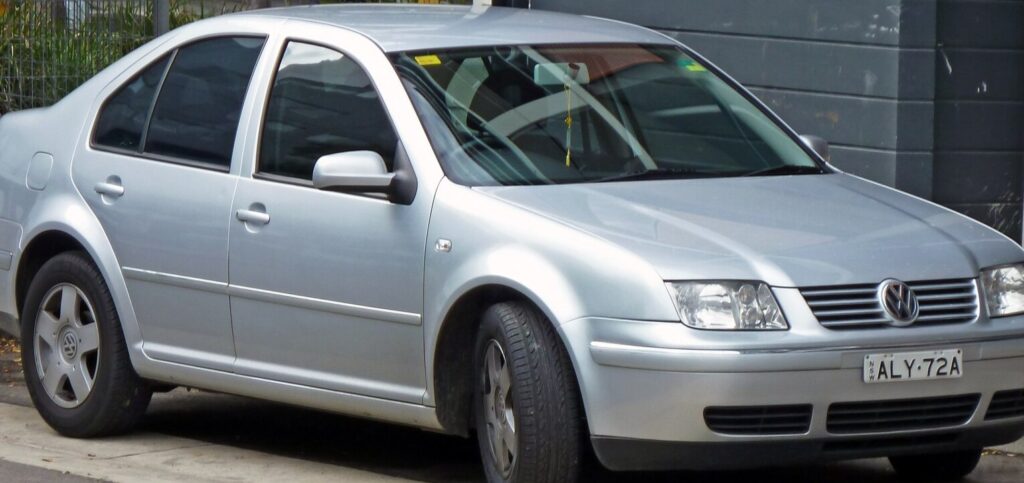
The Volkswagen Bora 1.9 TDI, produced between 1998 and 2002, represented a significant offering in the compact sedan segment, particularly in European markets. Positioned as a more affordable and fuel-efficient alternative to the Golf, the Bora (known as the Jetta in North America) aimed to provide practicality and comfort in a traditionally sensible package. This specific 1.9 TDI variant, generating 110 horsepower, was a mainstay of the lineup, appealing to drivers prioritizing economy and reliability over outright performance. It was built on the Volkswagen Group’s A4 (1J2) platform, shared with models like the Audi A3, SEAT Leon, and Škoda Octavia.
Technical Specifications
| Brand | Volkswagen |
| Model | Bora |
| Generation | Bora (1J2) |
| Type (Engine) | 1.9 TDI (110 Hp) |
| Start of production | 1998 |
| End of production | 2002 |
| Powertrain Architecture | Internal Combustion engine |
| Body type | Sedan |
| Seats | 5 |
| Doors | 4 |
| Fuel consumption (urban) | 6.6 l/100 km (35.6 US mpg, 42.8 UK mpg, 15.2 km/l) |
| Fuel consumption (extra urban) | 4.1 l/100 km (57.4 US mpg, 68.9 UK mpg, 24.4 km/l) |
| Fuel consumption (combined) | 4.7 l/100 km (50 US mpg, 60.1 UK mpg, 21.3 km/l) |
| CO2 emissions | 135 g/km |
| Fuel Type | Diesel |
| Acceleration 0 – 100 km/h | 10.9 sec |
| Acceleration 0 – 62 mph | 10.9 sec |
| Acceleration 0 – 60 mph | 10.4 sec |
| Maximum speed | 193 km/h (119.92 mph) |
| Weight-to-power ratio | 11.5 kg/Hp, 87 Hp/tonne |
| Weight-to-torque ratio | 5.4 kg/Nm, 185.8 Nm/tonne |
| Power | 110 Hp @ 4150 rpm |
| Power per litre | 58 Hp/l |
| Torque | 235 Nm @ 1900 rpm (173.33 lb.-ft. @ 1900 rpm) |
| Engine layout | Front, Transverse |
| Engine Model/Code | AHF, ASV |
| Engine displacement | 1896 cm3 (115.7 cu. in.) |
| Number of cylinders | 4 |
| Engine configuration | Inline |
| Cylinder Bore | 79.5 mm (3.13 in.) |
| Piston Stroke | 95.5 mm (3.76 in.) |
| Compression ratio | 19.5:1 |
| Number of valves per cylinder | 2 |
| Fuel injection system | Direct injection |
| Engine aspiration | Turbocharger, Intercooler |
| Valvetrain | OHC |
| Engine oil capacity | 4.5 l (4.76 US qt | 3.96 UK qt) |
| Coolant | 6 l (6.34 US qt | 5.28 UK qt) |
| Kerb Weight | 1265 kg (2788.85 lbs.) |
| Max. weight | 1820 kg (4012.41 lbs.) |
| Max load | 555 kg (1223.57 lbs.) |
| Trunk (boot) space – minimum | 455 l (16.07 cu. ft.) |
| Trunk (boot) space – maximum | 785 l (27.72 cu. ft.) |
| Fuel tank capacity | 55 l (14.53 US gal | 12.1 UK gal) |
| Length | 4376 mm (172.28 in.) |
| Width | 1735 mm (68.31 in.) |
| Width including mirrors | 2018 mm (79.45 in.) |
| Height | 1446 mm (56.93 in.) |
| Wheelbase | 2519 mm (99.17 in.) |
| Front track | 1513 mm (59.57 in.) |
| Rear (Back) track | 1494 mm (58.82 in.) |
| Minimum turning circle | 10.9 m (35.76 ft.) |
| Drivetrain Architecture | Front wheel drive |
| Number of gears and type of gearbox | 5 gears, manual transmission |
| Front suspension | Independent, type McPherson with coil spring and anti-roll bar |
| Rear suspension | Semi-independent, coil spring |
| Front brakes | Ventilated discs |
| Rear brakes | Disc |
| Assisting systems | ABS (Anti-lock braking system) |
| Steering type | Steering rack and pinion |
| Power steering | Hydraulic Steering |
| Tires size | 195/65 R15 |
| Wheel rims size | 6J x 15 |
Powertrain & Engine Architecture
The heart of the Bora 1.9 TDI was the 1896cc inline-four cylinder diesel engine, typically identified by engine codes AHF or ASV. These engines utilized direct injection technology, a hallmark of Volkswagen’s diesel development at the time. Direct injection, combined with a turbocharger and intercooler, allowed for a good balance of power and fuel efficiency. The engine featured an overhead camshaft (OHC) valvetrain with two valves per cylinder. The turbocharger provided a noticeable boost in power, particularly at lower RPMs, helping to overcome the inherent limitations of a relatively small displacement diesel engine. The 110 horsepower output was achieved at 4150 rpm, while peak torque of 235 Nm (173 lb-ft) was available from just 1900 rpm. This strong low-end torque was a key characteristic of the engine, making it well-suited for everyday driving. The engine was typically paired with a five-speed manual transmission, but a four-speed automatic transmission was also offered, though less common.
Driving Characteristics
The 1.9 TDI Bora with the automatic transmission offered a comfortable, if not particularly sporty, driving experience. Acceleration from 0-60 mph took around 10.4 seconds, which was adequate for most daily driving situations but noticeably slower than the manual transmission versions or higher-powered Bora models. The automatic transmission, while providing convenience, did detract from the engine’s responsiveness. Gear changes were generally smooth, but could feel somewhat hesitant during quick acceleration. The strong low-end torque of the engine meant that the transmission didn’t need to downshift frequently during normal cruising, contributing to good fuel economy. The suspension provided a comfortable ride, absorbing bumps and imperfections in the road well. However, the handling wasn’t particularly sharp, and the car exhibited some body roll during cornering.
Equipment & Trim Levels
The 1.9 TDI Bora typically came with a reasonable level of standard equipment. Base models included power windows, central locking, and an AM/FM radio. Higher trim levels, such as the Comfort or Trendline, added features like alloy wheels, air conditioning, a trip computer, and upgraded interior trim. Interior upholstery was typically cloth, with options for leather available on higher-spec models. Optional extras included a sunroof, heated seats, and a more advanced audio system. The dashboard layout was functional and straightforward, typical of Volkswagen’s design philosophy at the time.
Chassis & Braking
The Bora 1.9 TDI utilized an independent McPherson strut suspension at the front, providing good ride quality and handling. The rear suspension was a semi-independent torsion beam setup, which was a cost-effective solution that offered a reasonable compromise between comfort and handling. Braking was handled by ventilated discs at the front and solid discs at the rear. Anti-lock braking system (ABS) was standard equipment, enhancing safety. The steering was a rack-and-pinion system with hydraulic power assistance, providing a light and easy steering feel.
Market Reception & Comparison
The Bora 1.9 TDI was generally well-received by automotive critics for its fuel efficiency, reliability, and practicality. It was often praised as a sensible and economical choice for drivers who prioritized these qualities over performance. Compared to the higher-powered Bora variants, such as the 2.0 petrol or VR6 models, the 1.9 TDI offered significantly better fuel economy. However, it lacked the performance and refinement of those models. Compared to other diesel-powered compact sedans of the time, the Bora 1.9 TDI was considered to be a competitive offering, offering a good balance of features and value.
Legacy
The 1.9 TDI engine, in its various iterations, proved to be remarkably durable and reliable. Many examples of the Bora 1.9 TDI are still on the road today, testament to the engine’s robust construction and longevity. The engine’s simplicity and relatively low maintenance requirements have also contributed to its enduring popularity. In the used car market, the Bora 1.9 TDI remains a popular choice for buyers seeking an economical and reliable vehicle. However, potential buyers should be aware of the age-related issues common to older vehicles, such as wear and tear on suspension components and potential issues with the turbocharger.
