
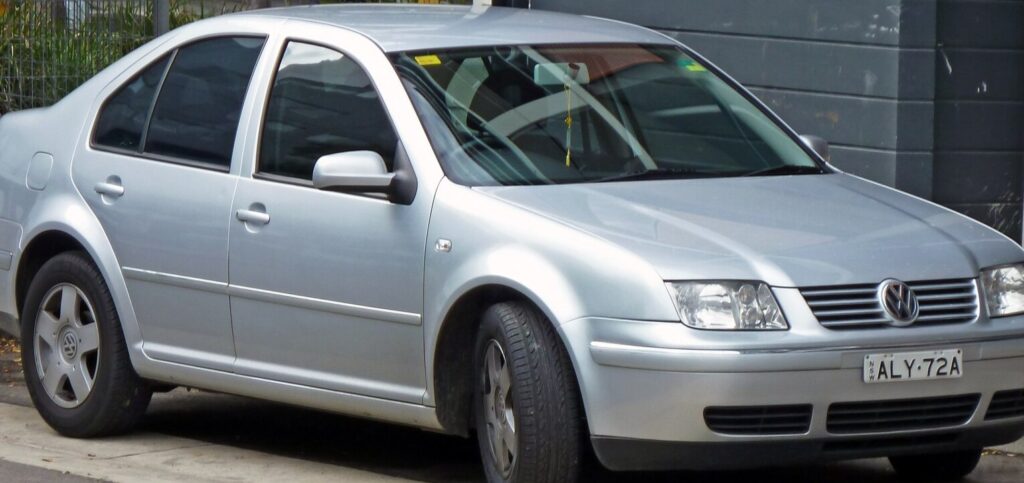
The Volkswagen Bora 1.9 TDI (150 hp) represents a significant offering within the Bora (1J2) range, produced between 2000 and 2005. Positioned as a practical and efficient sedan, the Bora, essentially the European version of the Jetta, aimed to provide a comfortable and economical driving experience. This particular variant, powered by the robust 1.9-liter turbocharged diesel engine, was a popular choice in European markets where diesel fuel was prevalent and fuel economy was highly valued. It sat in the mid-range of the Bora lineup, offering a balance between performance and affordability, appealing to drivers seeking a capable daily driver with reasonable running costs.
Technical Specifications
| Brand | Volkswagen |
| Model | Bora |
| Generation | Bora (1J2) |
| Type (Engine) | 1.9 TDI (150 Hp) |
| Start of production | 2000 year |
| End of production | 2005 year |
| Powertrain Architecture | Internal Combustion engine |
| Body type | Sedan |
| Seats | 5 |
| Doors | 4 |
| Fuel consumption (economy) – urban | 7.3 l/100 km (32.2 US mpg, 38.7 UK mpg, 13.7 km/l) |
| Fuel consumption (economy) – extra urban | 4.5 l/100 km (52.3 US mpg, 62.8 UK mpg, 22.2 km/l) |
| Fuel consumption (economy) – combined | 5.5 l/100 km (42.8 US mpg, 51.4 UK mpg, 18.2 km/l) |
| CO2 emissions | 149 g/km |
| Fuel Type | Diesel |
| Acceleration 0 – 100 km/h | 9 sec |
| Acceleration 0 – 62 mph | 9 sec |
| Acceleration 0 – 60 mph | 8.6 sec |
| Maximum speed | 216 km/h (134.22 mph) |
| Emission standard | Euro 3 |
| Weight-to-power ratio | 9.6 kg/Hp, 104 Hp/tonne |
| Weight-to-torque ratio | 4.5 kg/Nm, 221.9 Nm/tonne |
| Power | 150 Hp @ 4000 rpm |
| Power per litre | 79.1 Hp/l |
| Torque | 320 Nm @ 1900 rpm (236.02 lb.-ft. @ 1900 rpm) |
| Engine layout | Front, Transverse |
| Engine Model/Code | ARL |
| Engine displacement | 1896 cm3 (115.7 cu. in.) |
| Number of cylinders | 4 |
| Engine configuration | Inline |
| Cylinder Bore | 79.5 mm (3.13 in.) |
| Piston Stroke | 95.5 mm (3.76 in.) |
| Compression ratio | 18.5:1 |
| Number of valves per cylinder | 2 |
| Fuel injection system | Pump-nozzle (Unit Injector) |
| Engine aspiration | Turbocharger, Intercooler |
| Valvetrain | OHC |
| Engine oil capacity | 4.5 l (4.76 US qt | 3.96 UK qt) |
| Coolant | 6 l (6.34 US qt | 5.28 UK qt) |
| Kerb Weight | 1442 kg (3179.07 lbs.) |
| Max. weight | 1850 kg (4078.55 lbs.) |
| Max load | 408 kg (899.49 lbs.) |
| Trunk (boot) space – minimum | 455 l (16.07 cu. ft.) |
| Trunk (boot) space – maximum | 785 l (27.72 cu. ft.) |
| Fuel tank capacity | 55 l (14.53 US gal | 12.1 UK gal) |
| Max. roof load | 75 kg (165.35 lbs.) |
| Permitted trailer load with brakes (12%) | 1400 kg (3086.47 lbs.) |
| Permitted trailer load without brakes | 600 kg (1322.77 lbs.) |
| Permitted towbar download | 75 kg (165.35 lbs.) |
| Length | 4376 mm (172.28 in.) |
| Width | 1735 mm (68.31 in.) |
| Width including mirrors | 2018 mm (79.45 in.) |
| Height | 1446 mm (56.93 in.) |
| Wheelbase | 2519 mm (99.17 in.) |
| Front track | 1513 mm (59.57 in.) |
| Rear (Back) track | 1494 mm (58.82 in.) |
| Minimum turning circle | 10.9 m (35.76 ft.) |
| Drivetrain Architecture | The Internal combustion engine (ICE) drives the front wheels of the vehicle. |
| Drive wheel | Front wheel drive |
| Number of gears and type of gearbox | 6 gears, manual transmission |
| Front suspension | Independent, type McPherson with coil spring and anti-roll bar |
| Rear suspension | Semi-independent, coil spring |
| Front brakes | Ventilated discs |
| Rear brakes | Disc |
| Assisting systems | ABS (Anti-lock braking system) |
| Steering type | Steering rack and pinion |
| Power steering | Hydraulic Steering |
| Tires size | 205/55 R16 |
| Wheel rims size | 6.5J x 16 |
Powertrain & Engine Architecture
The heart of the Bora 1.9 TDI (150 hp) is the 1.9-liter (1896 cc) inline-four cylinder diesel engine, specifically the ARL engine code. This engine is a member of the Volkswagen Group’s well-regarded TDI family, known for its durability and efficiency. The ARL utilizes a pump-nozzle (unit injector) fuel injection system, a technology that delivers highly precise fuel delivery for optimized combustion and reduced emissions. The engine features a single overhead camshaft (OHC) operating two valves per cylinder. A turbocharger with an intercooler is employed to boost power output, providing increased air intake to the engine. The turbocharger contributes significantly to the engine’s torque characteristics, delivering a substantial 320 Nm (236 lb-ft) of torque at a relatively low 1900 rpm. This engine was known for its ability to provide strong pulling power from low engine speeds, making it well-suited for everyday driving and long-distance cruising. The engine’s robust construction and relatively simple design contributed to its longevity and ease of maintenance.
Driving Characteristics
The 1.9 TDI (150 hp) Bora offered a distinctly different driving experience compared to its gasoline-powered siblings or even the higher-output TDI variants. While not a sports car, the engine’s ample torque provided brisk acceleration, achieving 0-60 mph in around 8.6 seconds. The six-speed manual transmission, standard on this model, allowed drivers to effectively manage the engine’s powerband. The gear ratios were well-chosen to maximize fuel efficiency and provide responsive acceleration. Compared to the 1.8L gasoline engine, the TDI offered significantly more torque, resulting in stronger in-gear acceleration and a more relaxed driving experience, particularly when carrying passengers or cargo. The TDI’s power delivery was linear and predictable, making it easy to modulate. However, it lacked the high-revving enthusiasm of the gasoline engines. The suspension setup, tuned for comfort, provided a reasonably compliant ride, although it wasn’t particularly sporty.
Equipment & Trim Levels
The Bora 1.9 TDI (150 hp) typically came equipped with a reasonable level of standard features. These included power windows, central locking, power mirrors, and an air conditioning system. Interior upholstery was typically cloth, with options for upgraded materials available. The dashboard layout was functional and straightforward, prioritizing usability over aesthetics. Optional extras included alloy wheels, a sunroof, a CD stereo system, and upgraded interior trim. Safety features such as ABS (Anti-lock Braking System) and driver and passenger airbags were standard. The trim level often dictated the availability of these optional extras, with higher trims offering more features as standard.
Chassis & Braking
The Bora 1.9 TDI (150 hp) utilized an independent McPherson strut suspension setup at the front, providing good handling and ride comfort. The rear suspension was a semi-independent coil spring arrangement. The braking system consisted of ventilated discs at the front and solid discs at the rear, providing adequate stopping power for the vehicle’s weight and performance. ABS was standard, enhancing braking performance and stability, especially in adverse conditions. The steering was a hydraulic power-assisted rack and pinion system, offering precise and responsive steering feel.
Market Reception & Comparison
The Volkswagen Bora 1.9 TDI (150 hp) was generally well-received by automotive critics and consumers alike. It was praised for its fuel efficiency, strong torque, and comfortable ride. Critics noted that while not particularly exciting to drive, it was a practical and reliable vehicle. Compared to the gasoline-powered Bora models, the TDI offered significantly better fuel economy, making it a more economical choice for high-mileage drivers. Compared to other diesel-powered vehicles in its class, the Bora TDI was considered to be a refined and well-engineered option. However, some critics pointed to the slightly higher purchase price of diesel vehicles compared to their gasoline counterparts.
Legacy
The Volkswagen Bora 1.9 TDI (150 hp) has proven to be a durable and reliable vehicle over the long term. The ARL engine is known for its robustness and ability to withstand high mileage with proper maintenance. Today, these vehicles can be found on the used car market at relatively affordable prices. They remain a popular choice for those seeking a fuel-efficient and reliable sedan. However, potential buyers should be aware of the age-related issues common to older vehicles, such as wear and tear on suspension components and potential issues with the turbocharger. Despite its age, the Bora 1.9 TDI continues to be a testament to Volkswagen’s engineering prowess and a practical choice for budget-conscious drivers.
