
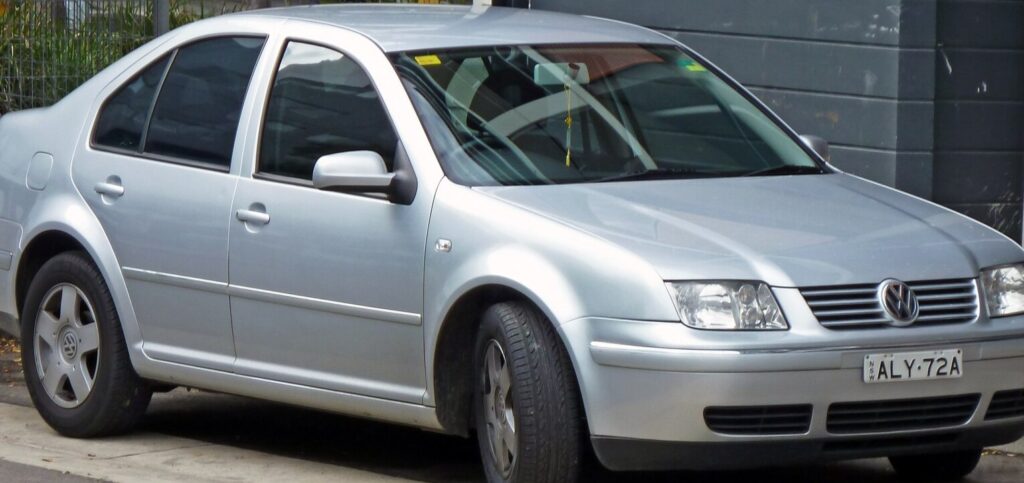
The Volkswagen Bora 1.9 TDI (90 hp) 4MOTION, produced between 1998 and 2002, represents a compelling blend of fuel efficiency, practicality, and all-weather capability within the first generation (1J2) Bora lineup. Positioned as a mid-range offering, it catered to buyers seeking a comfortable and economical sedan with the added security of Volkswagen’s 4MOTION all-wheel-drive system. The Bora itself was Volkswagen’s replacement for the Jetta in Europe, sharing its platform (the A4/1HX0 platform group) with the Golf, New Beetle, and Audi A3. This variant aimed to provide a more refined driving experience than the base models while remaining accessible to a broad customer base.
Technical Specifications
| Brand | Volkswagen |
| Model | Bora |
| Generation | Bora (1J2) |
| Type (Engine) | 1.9 TDI (90 Hp) 4MOTION |
| Start of production | 1998 |
| End of production | 2002 |
| Powertrain Architecture | Internal Combustion engine |
| Body type | Sedan |
| Seats | 5 |
| Doors | 4 |
| Fuel consumption (urban) | 6.6 l/100 km (35.6 US mpg, 42.8 UK mpg, 15.2 km/l) |
| Fuel consumption (extra urban) | 4.2 l/100 km (56 US mpg, 67.3 UK mpg, 23.8 km/l) |
| Fuel consumption (combined) | 4.8 l/100 km (49 US mpg, 58.9 UK mpg, 20.8 km/l) |
| Fuel Type | Diesel |
| Acceleration 0 – 100 km/h | 12.9 sec |
| Acceleration 0 – 62 mph | 12.9 sec |
| Acceleration 0 – 60 mph | 12.3 sec |
| Maximum speed | 180 km/h (111.85 mph) |
| Weight-to-power ratio | 15.2 kg/Hp, 65.8 Hp/tonne |
| Weight-to-torque ratio | 6.8 kg/Nm, 147.8 Nm/tonne |
| Power | 90 Hp @ 4000 rpm |
| Power per litre | 47.5 Hp/l |
| Torque | 202 Nm @ 1900 rpm (148.99 lb.-ft. @ 1900 rpm) |
| Engine layout | Front, Transverse |
| Engine Model/Code | AGR, ALH |
| Engine displacement | 1896 cm3 (115.7 cu. in.) |
| Number of cylinders | 4 |
| Engine configuration | Inline |
| Cylinder Bore | 79.5 mm (3.13 in.) |
| Piston Stroke | 95.5 mm (3.76 in.) |
| Compression ratio | 19.5:1 |
| Number of valves per cylinder | 2 |
| Fuel injection system | Direct injection |
| Engine aspiration | Turbocharger, Intercooler |
| Valvetrain | OHC |
| Engine oil capacity | 4.5 l (4.76 US qt | 3.96 UK qt) |
| Coolant | 6 l (6.34 US qt | 5.28 UK qt) |
| Kerb Weight | 1367 kg (3013.72 lbs.) |
| Max. weight | 1900 kg (4188.78 lbs.) |
| Max load | 533 kg (1175.06 lbs.) |
| Trunk (boot) space – minimum | 340 l (12.01 cu. ft.) |
| Trunk (boot) space – maximum | 670 l (23.66 cu. ft.) |
| Fuel tank capacity | 63 l (16.64 US gal | 13.86 UK gal) |
| Length | 4376 mm (172.28 in.) |
| Width | 1735 mm (68.31 in.) |
| Width including mirrors | 2018 mm (79.45 in.) |
| Height | 1446 mm (56.93 in.) |
| Wheelbase | 2519 mm (99.17 in.) |
| Front track | 1513 mm (59.57 in.) |
| Rear (Back) track | 1494 mm (58.82 in.) |
| Minimum turning circle | 10.9 m (35.76 ft.) |
| Drive wheel | All wheel drive (4×4) |
| Number of gears | 5 |
| Gearbox type | Manual transmission |
| Front suspension | Independent, type McPherson with coil spring and anti-roll bar |
| Rear suspension | Semi-independent, coil spring |
| Front brakes | Ventilated discs |
| Rear brakes | Disc |
| Assisting systems | ABS (Anti-lock braking system) |
| Steering type | Steering rack and pinion |
| Power steering | Hydraulic Steering |
| Tires size | 195/65 R15 |
| Wheel rims size | 6J x 15 |
Powertrain & Engine Architecture
The heart of the Bora 1.9 TDI 4MOTION is the 1.9-liter, inline-four cylinder diesel engine, typically identified by engine codes AGR or ALH. These engines are renowned for their durability and fuel efficiency. The AGR version, common in earlier models, utilized a distributor-type fuel injection pump, while the ALH, introduced later, featured a more advanced Bosch VE EDC (Electronic Diesel Control) pump. Both systems employed direct injection, injecting fuel directly into the combustion chamber for improved efficiency and reduced emissions. The engine utilizes a single overhead camshaft (OHC) operating two valves per cylinder. A turbocharger with an intercooler is standard, boosting power output to 90 horsepower and 202 Nm (148.99 lb-ft) of torque. The torque curve is notably flat, providing strong pulling power from low engine speeds. The 5-speed manual transmission was the standard offering, chosen for its robustness and efficiency. The transmission’s gear ratios were tuned to maximize fuel economy and provide adequate acceleration, though it wasn’t designed for outright performance.
Driving Characteristics
The 1.9 TDI 4MOTION Bora offered a composed and comfortable driving experience. While not a sports sedan, the 90 hp engine and manual transmission provided adequate performance for everyday driving. Acceleration from 0-60 mph took around 12.3 seconds, and top speed was limited to 111.85 mph. The 4MOTION all-wheel-drive system significantly enhanced traction, particularly in inclement weather conditions. The system operates as a viscous coupling, automatically distributing torque between the front and rear axles as needed. Compared to the standard front-wheel-drive Bora 1.9 TDI, the 4MOTION version offered noticeably improved stability and handling, especially on slippery surfaces. The manual transmission’s gear ratios were relatively long, prioritizing fuel economy over rapid acceleration. The engine’s strong low-end torque made it easy to drive in urban environments, requiring minimal gear changes.
Equipment & Trim Levels
The Bora 1.9 TDI 4MOTION typically came with a reasonable level of standard equipment. This included power windows, central locking, power steering, and an ABS anti-lock braking system. Interior upholstery was typically cloth, with a functional and durable design. Optional extras included alloy wheels, a sunroof, air conditioning, and a radio/CD player. Trim levels varied slightly depending on the market, but generally, the 4MOTION variant was positioned as a mid-range offering, bridging the gap between the base models and the more luxurious trims.
Chassis & Braking
The Bora 1.9 TDI 4MOTION utilized an independent McPherson strut suspension at the front, providing a comfortable ride and predictable handling. The rear suspension was a semi-independent torsion beam setup, which was cost-effective and space-efficient. Braking duties were handled by ventilated discs at the front and solid discs at the rear. The ABS system helped to maintain steering control during hard braking. The 4MOTION system added weight to the vehicle, necessitating slightly stiffer suspension settings compared to the front-wheel-drive models.
Market Reception & Comparison
The Bora 1.9 TDI 4MOTION was generally well-received by automotive critics. It was praised for its fuel efficiency, comfortable ride, and all-weather capability. However, some critics noted that the 90 hp engine felt underpowered, particularly when fully loaded or driving uphill. Compared to the higher-output TDI variants (such as the 110 hp or 130 hp versions), the 90 hp model offered less performance but significantly better fuel economy. The 4MOTION system added to the vehicle’s cost, making it a less attractive option for buyers prioritizing price over all-wheel-drive capability. Against competitors like the Ford Focus and Opel Astra, the Bora 1.9 TDI 4MOTION offered a more refined driving experience and a reputation for reliability.
Legacy
The Volkswagen Bora 1.9 TDI 4MOTION has proven to be a remarkably durable and reliable vehicle. The 1.9 TDI engine is known for its longevity, and many examples have exceeded 200,000 miles with proper maintenance. In the used car market, these Boras are sought after by buyers looking for an economical and dependable sedan with all-wheel-drive capability. While maintenance costs can increase with age, the availability of spare parts and the engine’s inherent robustness make it a relatively affordable vehicle to own and operate. The Bora, and specifically this variant, represents a solid and practical choice for those seeking a well-engineered and long-lasting vehicle.