
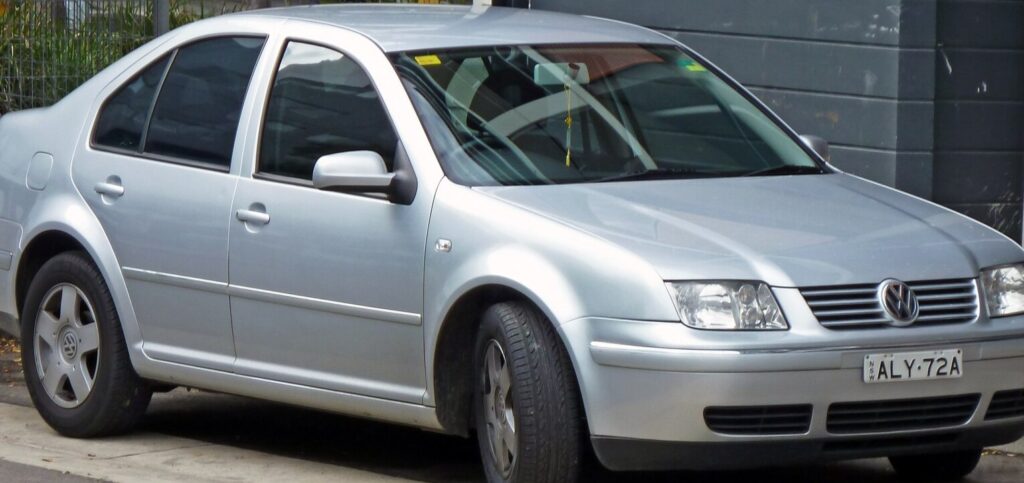
The Volkswagen Bora 2.0 (115 hp) was a popular variant of the Bora (1J2) model, produced between 1998 and 2001. Positioned as a mid-range offering within the Bora lineup, it aimed to provide a balance between affordability, fuel efficiency, and acceptable performance for everyday driving. The Bora itself was Volkswagen’s replacement for the Jetta in Europe, built on the A4 (1HX0) platform shared with the Golf Mk4, Audi A3, and SEAT Leon. It represented Volkswagen’s attempt to create a more globally appealing sedan, offering a more mature and refined alternative to the Golf hatchback, particularly in markets where sedans were preferred.
Technical Specifications
| Brand | Volkswagen |
| Model | Bora |
| Generation | Bora (1J2) |
| Type (Engine) | 2.0 (115 Hp) |
| Start of production | 1998 |
| End of production | 2001 |
| Powertrain Architecture | Internal Combustion engine |
| Body type | Sedan |
| Seats | 5 |
| Doors | 4 |
| Fuel consumption (urban) | 11.3 l/100 km (20.8 US mpg, 25 UK mpg, 8.8 km/l) |
| Fuel consumption (extra urban) | 6.2 l/100 km (37.9 US mpg, 45.6 UK mpg, 16.1 km/l) |
| Fuel consumption (combined) | 8.1 l/100 km (29 US mpg, 34.9 UK mpg, 12.3 km/l) |
| CO2 emissions | 194 g/km |
| Fuel Type | Petrol (Gasoline) |
| Acceleration 0 – 100 km/h | 11 sec |
| Acceleration 0 – 62 mph | 11 sec |
| Acceleration 0 – 60 mph | 10.5 sec |
| Maximum speed | 195 km/h (121.17 mph) |
| Emission standard | Euro 4 |
| Weight-to-power ratio | 12 kg/Hp, 83.5 Hp/tonne |
| Weight-to-torque ratio | 8.1 kg/Nm, 123.5 Nm/tonne |
| Power | 115 Hp @ 5200 rpm |
| Power per litre | 58 Hp/l |
| Torque | 170 Nm @ 2400 rpm (125.39 lb.-ft. @ 2400 rpm) |
| Engine layout | Front, Transverse |
| Engine Model/Code | APK, AQY |
| Engine displacement | 1984 cm3 (121.07 cu. in.) |
| Number of cylinders | 4 |
| Engine configuration | Inline |
| Cylinder Bore | 82.5 mm (3.25 in.) |
| Piston Stroke | 92.8 mm (3.65 in.) |
| Compression ratio | 10.5:1 |
| Number of valves per cylinder | 2 |
| Fuel injection system | Multi-port manifold injection |
| Engine aspiration | Naturally aspirated engine |
| Valvetrain | OHC |
| Engine oil capacity | 4 l (4.23 US qt | 3.52 UK qt) |
| Coolant | 5 l (5.28 US qt | 4.4 UK qt) |
| Kerb Weight | 1377 kg (3035.77 lbs.) |
| Max. weight | 1780 kg (3924.23 lbs.) |
| Max load | 403 kg (888.46 lbs.) |
| Trunk (boot) space – minimum | 455 l (16.07 cu. ft.) |
| Trunk (boot) space – maximum | 785 l (27.72 cu. ft.) |
| Fuel tank capacity | 55 l (14.53 US gal | 12.1 UK gal) |
| Max. roof load | 75 kg (165.35 lbs.) |
| Permitted trailer load with brakes (12%) | 1400 kg (3086.47 lbs.) |
| Permitted trailer load without brakes | 600 kg (1322.77 lbs.) |
| Permitted towbar download | 75 kg (165.35 lbs.) |
| Length | 4376 mm (172.28 in.) |
| Width | 1735 mm (68.31 in.) |
| Width including mirrors | 2018 mm (79.45 in.) |
| Height | 1446 mm (56.93 in.) |
| Wheelbase | 2519 mm (99.17 in.) |
| Front track | 1513 mm (59.57 in.) |
| Rear (Back) track | 1494 mm (58.82 in.) |
| Minimum turning circle | 10.9 m (35.76 ft.) |
| Drivetrain Architecture | The Internal combustion engine (ICE) drives the front wheels of the vehicle. |
| Drive wheel | Front wheel drive |
| Number of gears and type of gearbox | 5 gears, manual transmission |
| Front suspension | Independent, type McPherson with coil spring and anti-roll bar |
| Rear suspension | Semi-independent, coil spring |
| Front brakes | Ventilated discs |
| Rear brakes | Disc |
| Assisting systems | ABS (Anti-lock braking system) |
| Steering type | Steering rack and pinion |
| Power steering | Hydraulic Steering |
| Tires size | 195/65 R15 |
| Wheel rims size | 6J x 15 |
Powertrain & Engine Architecture
The Bora 2.0 utilized the Volkswagen Group’s 1.8 to 2.0-liter inline-four cylinder engine, specifically the APK or AQY engine codes depending on the market and year. These engines were naturally aspirated and featured multi-port fuel injection. The engine’s design emphasized reliability and ease of maintenance over outright performance. The 8-valve SOHC (Single Overhead Camshaft) valvetrain was a cost-effective solution, contributing to the vehicle’s affordability. The engine produced 115 horsepower at 5200 rpm and 170 Nm (125 lb-ft) of torque at 2400 rpm. The engine was transversely mounted, driving the front wheels. The five-speed manual transmission was the standard offering, providing a relatively direct connection between the engine and the wheels.
Driving Characteristics
The 2.0-liter engine in the Bora provided adequate, but not exhilarating, performance. Acceleration from 0 to 60 mph took around 10.5 seconds, and the top speed was approximately 121 mph. The engine felt relatively smooth at cruising speeds, but required downshifting for quicker acceleration, especially when overtaking. Compared to the more powerful VR6 variant, the 2.0 felt noticeably slower. However, it offered a more economical driving experience. The five-speed manual transmission was well-matched to the engine’s characteristics, providing a reasonable spread of gears for both city and highway driving. The steering was light and precise, making the Bora easy to maneuver.
Equipment & Trim Levels
The Bora 2.0 typically came equipped with features such as power windows, central locking, and an AM/FM radio. Air conditioning was often standard, but could be optional depending on the market. Interior upholstery was typically cloth, with options for upgraded materials. Higher trim levels offered features like alloy wheels, a sunroof, and upgraded audio systems. Safety features included dual front airbags and ABS brakes. The overall interior design was functional and understated, reflecting Volkswagen’s focus on practicality and build quality.
Chassis & Braking
The Bora utilized a McPherson strut front suspension and a semi-independent torsion beam rear suspension. This setup provided a comfortable ride, although it wasn’t particularly sporty. The front brakes were ventilated discs, while the rear brakes were solid discs. ABS (Anti-lock Braking System) was standard, enhancing braking performance and safety. The suspension was tuned for comfort, prioritizing ride quality over handling precision. Stabilizer bars were included to reduce body roll during cornering.
Market Reception & Comparison
The Bora 2.0 was generally well-received by automotive critics as a practical and reliable family sedan. It was praised for its comfortable ride, spacious interior, and build quality. However, it was often criticized for its lack of excitement and relatively modest performance compared to some of its competitors. Fuel economy was considered good for its class, averaging around 29 US mpg in combined driving. Compared to the more expensive VR6 model, the 2.0 offered a more affordable entry point into the Bora range, appealing to buyers who prioritized value and efficiency over performance.
Legacy
The Volkswagen Bora 2.0 has proven to be a relatively reliable vehicle, with many examples still on the road today. The engine is known for its durability, although regular maintenance is essential. Common issues include oil leaks and wear on the timing belt. The Bora’s simple design and readily available parts make it relatively easy to maintain and repair. In the used car market, the 2.0 variant represents a good value proposition, offering a comfortable and practical sedan at an affordable price. While it may not be the most exciting car to drive, its reliability and practicality have ensured its continued popularity among budget-conscious buyers.
