
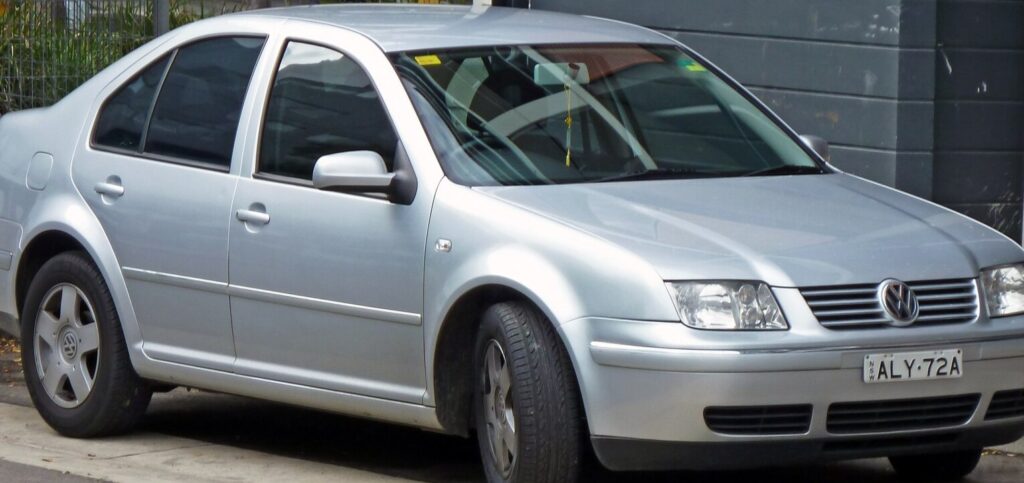
The Volkswagen Bora 2.0 (115 hp) Automatic, produced between 1998 and 2001, represented a key variant within the first generation (1J2) of Volkswagen’s globally-marketed compact sedan. Positioned as a mid-range offering, it aimed to provide a balance between affordability, comfort, and reasonable performance. The Bora, essentially the European equivalent of the Jetta sold in North America, was built on the Volkswagen Group’s A4 (or 1HX0) platform, shared with models like the Audi A3, SEAT Leon, and Škoda Octavia. This variant was particularly popular in Europe where automatic transmissions were gaining traction, offering a more relaxed driving experience compared to the standard manual options.
Technical Specifications
| Brand | Volkswagen |
| Model | Bora |
| Generation | Bora (1J2) |
| Type (Engine) | 2.0 (115 Hp) Automatic |
| Start of production | 1998 year |
| End of production | 2001 year |
| Powertrain Architecture | Internal Combustion engine |
| Body type | Sedan |
| Seats | 5 |
| Doors | 4 |
| Fuel consumption (economy) – urban | 12.6 l/100 km (18.7 US mpg, 22.4 UK mpg, 7.9 km/l) |
| Fuel consumption (economy) – extra urban | 6.8 l/100 km (34.6 US mpg, 41.5 UK mpg, 14.7 km/l) |
| Fuel consumption (economy) – combined | 8.9 l/100 km (26.4 US mpg, 31.7 UK mpg, 11.2 km/l) |
| CO2 emissions | 214 g/km |
| Fuel Type | Petrol (Gasoline) |
| Acceleration 0 – 100 km/h | 12.3 sec |
| Acceleration 0 – 62 mph | 12.3 sec |
| Acceleration 0 – 60 mph | 11.7 sec |
| Maximum speed | 192 km/h (119.3 mph) |
| Emission standard | Euro 4 |
| Weight-to-power ratio | 10.9 kg/Hp, 91.3 Hp/tonne |
| Weight-to-torque ratio | 7.4 kg/Nm, 135 Nm/tonne |
| Power | 115 Hp @ 5200 rpm |
| Power per litre | 58 Hp/l |
| Torque | 170 Nm @ 2400 rpm (125.39 lb.-ft. @ 2400 rpm) |
| Engine layout | Front, Transverse |
| Engine Model/Code | APK, AQY |
| Engine displacement | 1984 cm3 (121.07 cu. in.) |
| Number of cylinders | 4 |
| Engine configuration | Inline |
| Cylinder Bore | 82.5 mm (3.25 in.) |
| Piston Stroke | 92.8 mm (3.65 in.) |
| Compression ratio | 10.5:1 |
| Number of valves per cylinder | 2 |
| Fuel injection system | Multi-port manifold injection |
| Engine aspiration | Naturally aspirated engine |
| Valvetrain | OHC |
| Engine oil capacity | 4 l (4.23 US qt | 3.52 UK qt) |
| Coolant | 5 l (5.28 US qt | 4.4 UK qt) |
| Kerb Weight | 1259 kg (2775.62 lbs.) |
| Max. weight | 1810 kg (3990.37 lbs.) |
| Max load | 551 kg (1214.75 lbs.) |
| Trunk (boot) space – minimum | 455 l (16.07 cu. ft.) |
| Trunk (boot) space – maximum | 785 l (27.72 cu. ft.) |
| Fuel tank capacity | 55 l (14.53 US gal | 12.1 UK gal) |
| Max. roof load | 75 kg (165.35 lbs.) |
| Permitted trailer load with brakes (12%) | 1400 kg (3086.47 lbs.) |
| Permitted trailer load without brakes | 600 kg (1322.77 lbs.) |
| Permitted towbar download | 75 kg (165.35 lbs.) |
| Length | 4376 mm (172.28 in.) |
| Width | 1735 mm (68.31 in.) |
| Width including mirrors | 2018 mm (79.45 in.) |
| Height | 1446 mm (56.93 in.) |
| Wheelbase | 2519 mm (99.17 in.) |
| Front track | 1513 mm (59.57 in.) |
| Rear (Back) track | 1494 mm (58.82 in.) |
| Minimum turning circle (turning diameter) | 10.9 m (35.76 ft.) |
| Drivetrain Architecture | The Internal combustion engine (ICE) drives the front wheels of the vehicle. |
| Drive wheel | Front wheel drive |
| Number of gears and type of gearbox | 4 gears, automatic transmission |
| Front suspension | Independent, type McPherson with coil spring and anti-roll bar |
| Rear suspension | Semi-independent, coil spring |
| Front brakes | Ventilated discs |
| Rear brakes | Disc |
| Assisting systems | ABS (Anti-lock braking system) |
| Steering type | Steering rack and pinion |
| Power steering | Hydraulic Steering |
| Tires size | 205/55 R16 |
| Wheel rims size | 16 |
Powertrain & Engine Architecture
The Bora 2.0 Automatic was powered by the Volkswagen Group’s 1.8 to 2.0-liter inline-four cylinder gasoline engine, specifically the APK or AQY engine codes. These engines were known for their relatively simple, yet robust design. The engine featured a single overhead camshaft (SOHC) valvetrain operating two valves per cylinder. Fuel delivery was handled by a multi-port fuel injection system, providing adequate atomization for efficient combustion. The 115 horsepower output was achieved at 5200 rpm, with a torque figure of 170 Nm (125 lb-ft) available at 2400 rpm. Paired with this engine was a four-speed automatic transmission. This transmission, while providing convenience, wasn’t known for its sportiness or fuel efficiency compared to the available five-speed manual. It was a conventional hydraulic automatic, lacking the more advanced electronic controls found in later transmissions.
Driving Characteristics
The driving experience in the Bora 2.0 Automatic was characterized by smooth, if not particularly exhilarating, performance. The four-speed automatic transmission, while comfortable for daily commuting, resulted in noticeable gear changes and a less responsive feel compared to the manual versions. Acceleration from 0 to 100 km/h (0-62 mph) took around 12.3 seconds, making it adequate for everyday driving but not a performance leader. The gear ratios were tuned for fuel economy and comfort rather than outright speed. The engine provided sufficient power for highway cruising, but overtaking maneuvers required careful planning. Compared to the more powerful 2.3-liter V5 or the diesel variants, the 2.0 Automatic felt noticeably less potent.
Equipment & Trim Levels
The 2.0 Automatic trim level typically included features such as power windows, central locking, power steering, and an air conditioning system. Interior upholstery was usually cloth, with options for upgraded materials available. Dashboard design was functional and straightforward, typical of Volkswagen interiors of the period. Optional extras included alloy wheels, a sunroof, and a radio/cassette player (later upgraded to CD players). Safety features included ABS (Anti-lock Braking System) and driver and passenger airbags. The specific trim level could vary slightly depending on the market.
Chassis & Braking
The Bora 2.0 Automatic utilized an independent McPherson strut suspension setup at the front, providing a comfortable ride and decent handling. The rear suspension was a semi-independent torsion beam arrangement, a cost-effective solution that offered a reasonable balance between comfort and stability. Braking duties were handled by ventilated discs at the front and solid discs at the rear. The ABS system helped to maintain steering control during emergency braking situations. The suspension was tuned for comfort, prioritizing ride quality over sporty handling.
Market Reception & Comparison
The Bora 2.0 Automatic was generally well-received as a practical and comfortable family sedan. Critics praised its build quality and spacious interior, but noted that the automatic transmission detracted from the overall driving experience. Fuel economy was considered average for its class. Compared to the manual versions, the automatic suffered a slight penalty in fuel consumption. Against competitors like the Ford Focus, Opel Astra, and Peugeot 306, the Bora offered a more refined interior and a reputation for reliability, but often at a slightly higher price point.
Legacy
The Volkswagen Bora 2.0 Automatic, while not a particularly rare or sought-after variant today, remains a relatively reliable and affordable used car option. The engine and transmission, when properly maintained, are known to be durable. Common issues include wear and tear on suspension components and potential oil leaks. The availability of spare parts is generally good, thanks to the widespread use of these components across the Volkswagen Group. The Bora’s simple design and robust construction have contributed to its longevity, making it a viable choice for those seeking a practical and dependable compact sedan.
