
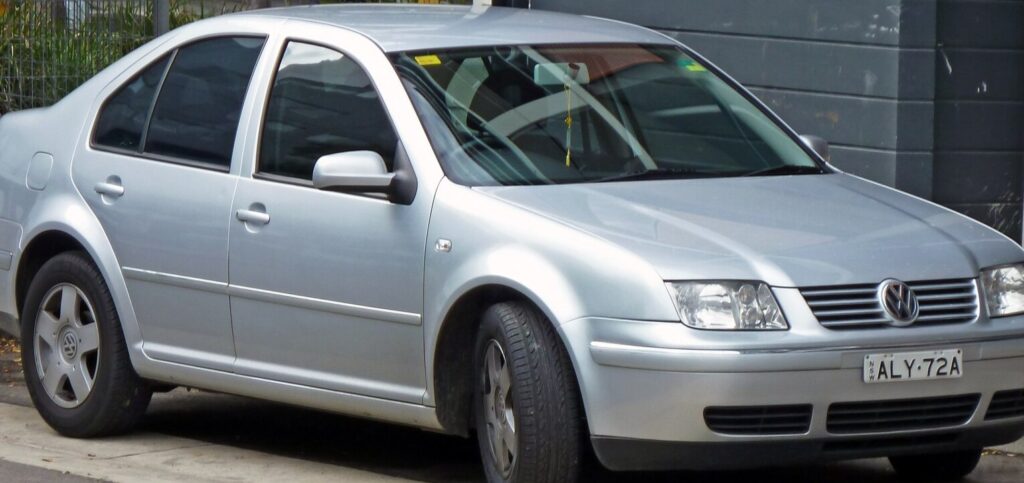
The Volkswagen Bora 2.3 VR5 (150 hp) was a variant of the first-generation Bora (1J2), produced between 1998 and 2001. Positioned as a mid-range offering within the Bora lineup, it aimed to provide a balance between performance and affordability. The Bora itself was Volkswagen’s replacement for the Jetta in Europe, built on the A4 (1HX0) platform shared with the Golf, Audi A3, and SEAT Leon. It represented Volkswagen’s attempt to create a more mature and sophisticated compact sedan, appealing to buyers seeking a step up from the Golf’s hatchback practicality.
Technical Specifications
| Brand | Volkswagen |
| Model | Bora |
| Generation | Bora (1J2) |
| Type (Engine) | 2.3 VR5 (150 Hp) |
| Start of production | 1998 |
| End of production | 2001 |
| Powertrain Architecture | Internal Combustion engine |
| Body type | Sedan |
| Seats | 5 |
| Doors | 4 |
| Fuel consumption (urban) | 14 l/100 km (16.8 US mpg, 20.2 UK mpg, 7.1 km/l) |
| Fuel consumption (extra urban) | 7 l/100 km (33.6 US mpg, 40.4 UK mpg, 14.3 km/l) |
| Fuel consumption (combined) | 10 l/100 km (23.5 US mpg, 28.2 UK mpg, 10 km/l) |
| Fuel Type | Petrol (Gasoline) |
| Acceleration 0 – 100 km/h | 9.1 sec |
| Acceleration 0 – 62 mph | 9.1 sec |
| Acceleration 0 – 60 mph | 8.6 sec |
| Maximum speed | 211 km/h (131.11 mph) |
| Emission standard | Euro 4 |
| Weight-to-power ratio | 8.7 kg/Hp, 115.2 Hp/tonne |
| Weight-to-torque ratio | 6.4 kg/Nm, 157.5 Nm/tonne |
| Power | 150 Hp @ 6000 rpm |
| Power per litre | 64.5 Hp/l |
| Torque | 205 Nm @ 3200 rpm (151.2 lb.-ft. @ 3200 rpm) |
| Engine layout | Front, Transverse |
| Engine Model/Code | AGZ |
| Engine displacement | 2324 cm3 (141.82 cu. in.) |
| Number of cylinders | 5 |
| Engine configuration | V-engine |
| Cylinder Bore | 81 mm (3.19 in.) |
| Piston Stroke | 90.2 mm (3.55 in.) |
| Compression ratio | 10:1 |
| Number of valves per cylinder | 2 |
| Fuel injection system | Multi-port manifold injection |
| Engine aspiration | Naturally aspirated engine |
| Valvetrain | OHC |
| Engine oil capacity | 3.9 l (4.12 US qt | 3.43 UK qt) |
| Coolant | 9 l (9.51 US qt | 7.92 UK qt) |
| Kerb Weight | 1302 kg (2870.42 lbs.) |
| Max. weight | 1935 kg (4265.94 lbs.) |
| Max load | 633 kg (1395.53 lbs.) |
| Trunk (boot) space – minimum | 455 l (16.07 cu. ft.) |
| Trunk (boot) space – maximum | 785 l (27.72 cu. ft.) |
| Fuel tank capacity | 55 l (14.53 US gal | 12.1 UK gal) |
| Length | 4376 mm (172.28 in.) |
| Width | 1735 mm (68.31 in.) |
| Width including mirrors | 2018 mm (79.45 in.) |
| Height | 1446 mm (56.93 in.) |
| Wheelbase | 2519 mm (99.17 in.) |
| Front track | 1513 mm (59.57 in.) |
| Rear (Back) track | 1494 mm (58.82 in.) |
| Minimum turning circle | 10.9 m (35.76 ft.) |
| Drivetrain Architecture | The Internal combustion engine (ICE) drives the front wheels of the vehicle. |
| Drive wheel | Front wheel drive |
| Number of gears and type of gearbox | 5 gears, manual transmission |
| Front suspension | Independent, type McPherson with coil spring and anti-roll bar |
| Rear suspension | Semi-independent, coil spring |
| Front brakes | Ventilated discs |
| Rear brakes | Disc |
| Assisting systems | ABS (Anti-lock braking system) |
| Steering type | Steering rack and pinion |
| Power steering | Hydraulic Steering |
| Tires size | 205/55 R16 |
| Wheel rims size | 6.5J x 16 |
Powertrain & Engine Architecture
The heart of the Bora 2.3 VR5 was the AGZ engine, a 2.3-liter naturally aspirated V5 engine. This engine was a unique design, essentially half of a VR6 engine, offering a smoother power delivery than an inline-four but with a more compact footprint than a full V6. It featured a 10:1 compression ratio and utilized multi-port fuel injection. The engine’s valvetrain employed a single overhead camshaft (OHC) per cylinder bank. The five-speed manual transmission was the standard offering, providing a relatively direct connection between the engine and the front wheels. The AGZ engine was known for its distinctive exhaust note, a characteristic that set it apart from other engines in the Bora range.
Driving Characteristics
The 150 hp VR5 offered a noticeable step up in performance compared to the base 1.6 and 1.8-liter four-cylinder Boras. While not a sports car, it provided adequate acceleration for everyday driving and comfortable highway cruising. The 0-60 mph time of around 8.6 seconds was respectable for the era. The five-speed manual transmission allowed drivers to make the most of the engine’s powerband, while the gear ratios were tuned for a balance of acceleration and fuel economy. Compared to the more economical but slower base models, the VR5 offered a more refined and engaging driving experience. It lacked the outright punch of the later VR6 versions, but provided a more accessible and affordable alternative.
Equipment & Trim Levels
The 2.3 VR5 Bora typically came with a reasonable level of standard equipment. This included power windows, central locking, power steering, and an ABS anti-lock braking system. Interior upholstery was usually cloth, though leather options were available. Dashboard trim was typically a more upscale plastic than found in the base models. Optional extras included alloy wheels, a sunroof, climate control, and a premium audio system. The VR5 trim often served as a base for adding these options, allowing buyers to customize their vehicle to a higher specification.
Chassis & Braking
The Bora 2.3 VR5 utilized an independent McPherson strut front suspension and a semi-independent coil spring rear suspension. This setup provided a comfortable ride while maintaining reasonable handling characteristics. The front brakes were ventilated discs, offering good stopping power, while the rear brakes were solid discs. The steering was a hydraulic rack and pinion system, providing precise and responsive control. The suspension was generally tuned for comfort, prioritizing ride quality over outright sportiness. Stabilizer bars were fitted front and rear to reduce body roll during cornering.
Market Reception & Comparison
The Bora 2.3 VR5 was generally well-received by automotive critics. It was praised for its smooth engine, comfortable ride, and relatively spacious interior. However, some critics noted that it wasn’t as engaging to drive as some of its rivals, such as the Ford Focus. Fuel economy was also a point of concern, with the 2.3-liter engine consuming more fuel than the smaller-displacement options. Compared to the 1.8T models, the VR5 offered less horsepower but a more linear power delivery. The VR5 was often seen as a good compromise for buyers who wanted more performance than the base models but didn’t want to pay the premium for the VR6.
Legacy
The Volkswagen Bora 2.3 VR5 has developed a modest following among enthusiasts. The AGZ engine is generally considered to be reliable, although regular maintenance is essential. Parts availability is generally good, as many components are shared with other Volkswagen and Audi models. Today, well-maintained examples of the Bora 2.3 VR5 can be found on the used car market, often at affordable prices. While not a particularly rare or collectible car, it represents a unique and interesting chapter in Volkswagen’s history, offering a blend of practicality, comfort, and distinctive engine character.
