
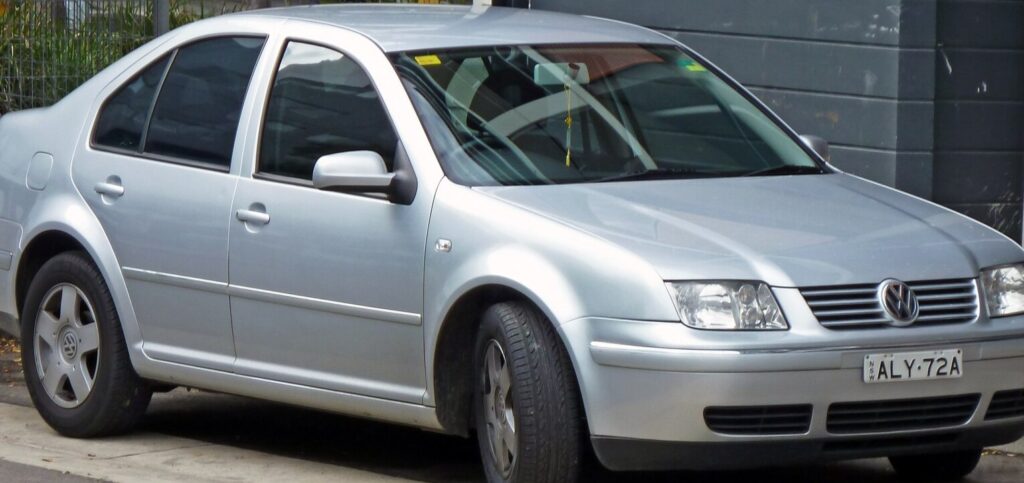
The Volkswagen Bora 2.3 VR5 4MOTION, produced between 1998 and 2001, represented a compelling blend of performance and all-weather capability within the Bora (1J2) lineup. Positioned as a mid-range to premium offering, it catered to drivers seeking a more engaging experience than the base models, while offering a more practical alternative to the Golf GTI-R. The Bora itself was Volkswagen’s replacement for the Jetta in many markets, built on the A4 (1J) platform, also known as the 1HX0 platform for the sedan variant. This generation aimed to provide a more sophisticated and refined experience compared to its predecessor, and the VR5 4MOTION variant exemplified this ambition.
Technical Specifications
| Brand | Volkswagen |
| Model | Bora |
| Generation | Bora (1J2) |
| Type (Engine) | 2.3 VR5 (150 Hp) 4MOTION |
| Start of production | 1998 |
| End of production | 2001 |
| Powertrain Architecture | Internal Combustion engine |
| Body type | Sedan |
| Seats | 5 |
| Doors | 4 |
| Fuel consumption (urban) | 14.8 l/100 km (15.9 US mpg, 19.1 UK mpg, 6.8 km/l) |
| Fuel consumption (extra urban) | 7.9 l/100 km (29.8 US mpg, 35.8 UK mpg, 12.7 km/l) |
| Fuel consumption (combined) | 10.4 l/100 km (22.6 US mpg, 27.2 UK mpg, 9.6 km/l) |
| CO2 emissions | 250 g/km |
| Fuel Type | Petrol (Gasoline) |
| Acceleration 0 – 100 km/h | 10.1 sec |
| Acceleration 0 – 62 mph | 10.1 sec |
| Acceleration 0 – 60 mph | 9.6 sec |
| Maximum speed | 211 km/h (131.11 mph) |
| Weight-to-power ratio | 9.9 kg/Hp, 100.9 Hp/tonne |
| Weight-to-torque ratio | 7.2 kg/Nm, 138 Nm/tonne |
| Power | 150 Hp @ 6000 rpm |
| Power per litre | 64.5 Hp/l |
| Torque | 205 Nm @ 3200 rpm (151.2 lb.-ft. @ 3200 rpm) |
| Engine layout | Front, Transverse |
| Engine Model/Code | AGZ |
| Engine displacement | 2324 cm3 (141.82 cu. in.) |
| Number of cylinders | 5 |
| Engine configuration | V-engine |
| Cylinder Bore | 81 mm (3.19 in.) |
| Piston Stroke | 90.2 mm (3.55 in.) |
| Compression ratio | 10:1 |
| Number of valves per cylinder | 2 |
| Fuel injection system | Multi-port manifold injection |
| Engine aspiration | Naturally aspirated engine |
| Valvetrain | OHC |
| Engine oil capacity | 3.9 l (4.12 US qt | 3.43 UK qt) |
| Coolant | 9 l (9.51 US qt | 7.92 UK qt) |
| Kerb Weight | 1486 kg (3276.07 lbs.) |
| Max. weight | 1935 kg (4265.94 lbs.) |
| Max load | 449 kg (989.88 lbs.) |
| Trunk (boot) space – minimum | 340 l (12.01 cu. ft.) |
| Trunk (boot) space – maximum | 670 l (23.66 cu. ft.) |
| Fuel tank capacity | 55 l (14.53 US gal | 12.1 UK gal) |
| Length | 4376 mm (172.28 in.) |
| Width | 1735 mm (68.31 in.) |
| Width including mirrors | 2018 mm (79.45 in.) |
| Height | 1446 mm (56.93 in.) |
| Wheelbase | 2519 mm (99.17 in.) |
| Front track | 1513 mm (59.57 in.) |
| Rear (Back) track | 1494 mm (58.82 in.) |
| Minimum turning circle | 10.9 m (35.76 ft.) |
| Drive wheel | All wheel drive (4×4) |
| Number of gears and type of gearbox | 6 gears, manual transmission |
| Front suspension | Independent, type McPherson with coil spring and anti-roll bar |
| Rear suspension | Semi-independent, coil spring |
| Front brakes | Ventilated discs |
| Rear brakes | Disc |
| Assisting systems | ABS (Anti-lock braking system) |
| Steering type | Steering rack and pinion |
| Power steering | Hydraulic Steering |
| Tires size | 195/65 R15 |
| Wheel rims size | 6J x 15 |
Powertrain & Engine Architecture
The heart of the Bora 2.3 VR5 4MOTION is the AGZ engine code, a 2.3-liter naturally aspirated V5 engine. This engine is a unique design, featuring a narrow-angle V configuration – essentially a VR engine – that allows for a relatively compact engine bay footprint while providing a smoother power delivery than an inline-five. The AGZ utilizes multi-port fuel injection, delivering fuel directly into the intake ports, and a single overhead camshaft (OHC) per cylinder bank controls the valves. The engine produces 150 horsepower at 6000 rpm and 205 Nm (151.2 lb-ft) of torque at 3200 rpm. The 6-speed manual transmission was standard, providing well-spaced gear ratios for both spirited driving and comfortable highway cruising. The 4MOTION all-wheel-drive system employs a viscous coupling, distributing power between the front and rear axles as needed, enhancing traction in adverse conditions.
Driving Characteristics
The 2.3 VR5 4MOTION offered a noticeably more refined driving experience compared to the lower-displacement engines available in the Bora range. While not a sports car, the 150 hp engine provided adequate power for confident acceleration and overtaking. The 4MOTION system significantly improved grip, particularly on slippery surfaces, making it a capable all-weather vehicle. The manual transmission, with its six forward gears, allowed drivers to keep the engine in its optimal power band. Compared to the 1.8L 20V models, the VR5 offered a more robust torque curve and a distinctive exhaust note. However, it wasn’t as fuel-efficient, and its added weight slightly impacted handling agility compared to the lighter front-wheel-drive variants.
Equipment & Trim Levels
The VR5 4MOTION typically came well-equipped, reflecting its position as a premium trim level. Standard features often included air conditioning, power windows and locks, central locking, and an upgraded audio system. Interior upholstery was typically cloth, but leather options were available. Depending on the market and optional packages, features like heated front seats, a sunroof, and alloy wheels could be added. The dashboard layout was typical of the Bora, with a functional and ergonomic design. The instrument cluster featured clear, easy-to-read gauges, and the center console housed the radio and climate control systems.
Chassis & Braking
The Bora 2.3 VR5 4MOTION utilized an independent McPherson strut suspension at the front, providing good ride comfort and handling. The rear suspension was a semi-independent torsion beam setup, which was a cost-effective solution that still offered acceptable handling characteristics. The braking system consisted of ventilated discs at the front and solid discs at the rear, providing adequate stopping power for the vehicle’s weight and performance. Anti-lock braking system (ABS) was standard, enhancing safety by preventing wheel lockup during hard braking.
Market Reception & Comparison
The Bora 2.3 VR5 4MOTION was generally well-received by automotive critics. It was praised for its refined engine, all-weather capability, and comfortable ride. However, some critics noted its relatively high price compared to other compact sedans. Fuel economy was also a point of concern, as the VR5 engine was not particularly efficient. Compared to the 1.8T models, the VR5 offered a different character – more torque and a smoother power delivery, but less outright performance. Against the diesel-powered TDIs, the VR5 provided a more engaging driving experience but suffered in terms of fuel efficiency.
Legacy
The Volkswagen Bora 2.3 VR5 4MOTION has developed a loyal following among enthusiasts. The AGZ engine is known for its reliability, provided it is properly maintained. The 4MOTION system remains a valuable asset in regions with harsh winters or challenging road conditions. Today, well-maintained examples are sought after by collectors and drivers who appreciate the unique combination of performance, practicality, and all-weather capability that this variant offered. While parts availability can be a concern for some components, the VR5 engine benefits from a relatively robust design and a dedicated community of owners who share knowledge and resources.
