
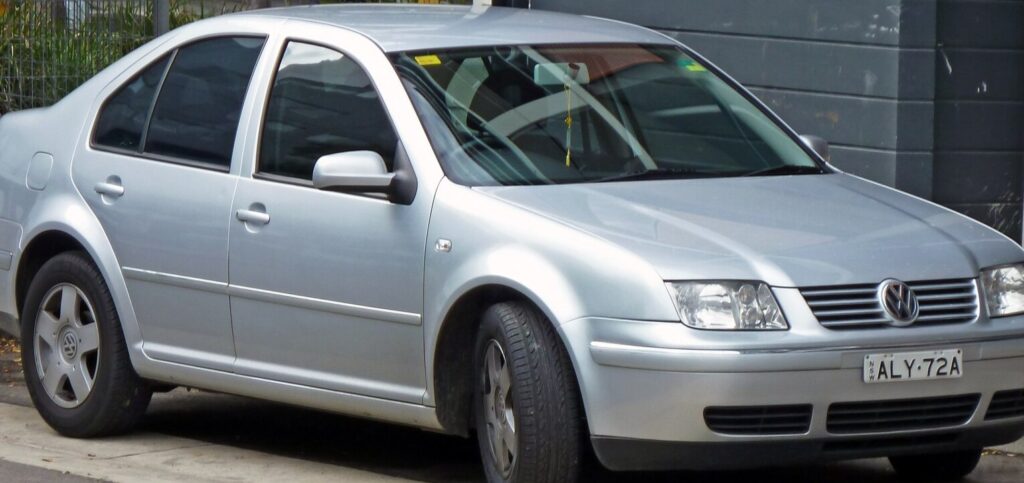
The Volkswagen Bora 2.3 VR5 Tiptronic, produced between 1998 and 2001, represented a compelling mid-range offering within the first generation (1J2) Bora lineup. Positioned above the base 1.6 and 1.8 liter four-cylinder models, but below the potent 1.8T, the VR5 aimed to deliver a blend of refinement, performance, and practicality to the compact sedan segment. The Bora itself was Volkswagen’s replacement for the Jetta in Europe, sharing its platform (the A4/1HX0 platform group) with the Golf, New Beetle, and Audi A3. This variant, with its unique five-cylinder engine and automatic transmission, catered to buyers seeking a more sophisticated driving experience without the added cost or sportiness of the turbocharged models.
Technical Specifications
| Brand | Volkswagen |
| Model | Bora |
| Generation | Bora (1J2) |
| Type (Engine) | 2.3 VR5 (150 Hp) Tiptronic |
| Start of production | 1998 |
| End of production | 2001 |
| Powertrain Architecture | Internal Combustion engine |
| Body type | Sedan |
| Seats | 5 |
| Doors | 4 |
| Fuel consumption (combined) | 9.9 l/100 km |
| Fuel consumption (US mpg) | 23.8 US mpg |
| Fuel consumption (UK mpg) | 28.5 UK mpg |
| Fuel consumption (km/l) | 10.1 km/l |
| Fuel Type | Petrol (Gasoline) |
| Acceleration 0 – 100 km/h | 9.1 sec |
| Acceleration 0 – 62 mph | 9.1 sec |
| Acceleration 0 – 60 mph | 8.6 sec |
| Maximum speed | 211 km/h (131.11 mph) |
| Emission standard | Euro 4 |
| Weight-to-power ratio | 8.7 kg/Hp |
| Power | 150 Hp @ 6000 rpm |
| Power per litre | 64.5 Hp/l |
| Torque | 205 Nm @ 3200 rpm (151.2 lb.-ft. @ 3200 rpm) |
| Engine layout | Front, Transverse |
| Engine Model/Code | AGZ |
| Engine displacement | 2324 cm3 (141.82 cu. in.) |
| Number of cylinders | 5 |
| Engine configuration | V-engine |
| Cylinder Bore | 81 mm (3.19 in.) |
| Piston Stroke | 90.2 mm (3.55 in.) |
| Compression ratio | 10:1 |
| Number of valves per cylinder | 2 |
| Fuel injection system | Multi-port manifold injection |
| Engine aspiration | Naturally aspirated engine |
| Valvetrain | OHC |
| Engine oil capacity | 3.9 l (4.12 US qt | 3.43 UK qt) |
| Coolant capacity | 9 l (9.51 US qt | 7.92 UK qt) |
| Kerb Weight | 1302 kg (2870.42 lbs.) |
| Max. weight | 1935 kg (4265.94 lbs.) |
| Max load | 633 kg (1395.53 lbs.) |
| Trunk (boot) space – minimum | 455 l (16.07 cu. ft.) |
| Trunk (boot) space – maximum | 785 l (27.72 cu. ft.) |
| Fuel tank capacity | 55 l (14.53 US gal | 12.1 UK gal) |
| Length | 4376 mm (172.28 in.) |
| Width | 1735 mm (68.31 in.) |
| Width including mirrors | 2018 mm (79.45 in.) |
| Height | 1446 mm (56.93 in.) |
| Wheelbase | 2519 mm (99.17 in.) |
| Front track | 1513 mm (59.57 in.) |
| Rear track | 1494 mm (58.82 in.) |
| Minimum turning circle | 10.9 m (35.76 ft.) |
| Drivetrain Architecture | Front wheel drive |
| Number of gears | 5 |
| Gearbox type | Automatic transmission Tiptronic |
| Front suspension | Independent, McPherson with coil spring and anti-roll bar |
| Rear suspension | Semi-independent, coil spring |
| Front brakes | Ventilated discs |
| Rear brakes | Disc |
| Assisting systems | ABS (Anti-lock braking system) |
| Steering type | Steering rack and pinion |
| Power steering | Hydraulic |
| Tires size | 205/55 R16 |
| Wheel rims size | 6.5J x 16 |
INTRODUCTION
The Volkswagen Bora 2.3 VR5 Tiptronic, launched in 1998, was a key variant in the early years of the Bora model range. Designed to appeal to buyers seeking a step up in performance and refinement from the base models, it offered a unique engine configuration and the convenience of an automatic transmission. The Bora, intended as a more mature and conventionally styled alternative to the Golf, was primarily marketed in Europe and other regions where sedans were preferred over hatchbacks. The VR5 engine, a Volkswagen hallmark, provided a distinctive exhaust note and smooth power delivery, setting it apart from the more common inline-four engines found in its competitors.
Powertrain & Engine Architecture
The heart of the Bora 2.3 VR5 Tiptronic is the AGZ engine code, a 2.3-liter naturally aspirated V5 engine. This engine is notable for its narrow-angle V configuration – essentially two inline-two cylinder banks sharing a common cylinder head, with a 15-degree angle between them. This design allowed for a relatively compact engine while still providing five cylinders and a smoother power delivery than a comparable four-cylinder. The AGZ utilizes multi-port fuel injection and a single overhead camshaft (OHC) per cylinder bank. The engine produces 150 horsepower at 6000 rpm and 205 Nm (151.2 lb-ft) of torque at 3200 rpm. Paired with the engine is a five-speed Tiptronic automatic transmission, which allowed for both fully automatic operation and driver-selectable gear changes. The Tiptronic system used a torque converter and electronic control to provide smooth and responsive shifts.
Driving Characteristics
The 2.3 VR5 Tiptronic offered a comfortable and refined driving experience. While not overtly sporty, the engine provided adequate acceleration, achieving 0-60 mph in around 8.6 seconds and a top speed of 131 mph. The Tiptronic transmission, while convenient, did result in some power loss compared to the available five-speed manual transmission. Gear ratios were tuned for comfortable cruising rather than outright performance. The engine’s torque curve was relatively flat, providing good responsiveness in everyday driving situations. Compared to the 1.8T models, the VR5 lacked the turbocharged punch, but offered a more linear and predictable power delivery. The automatic transmission, while smooth, wasn’t as engaging for enthusiastic drivers as the manual option.
Equipment & Trim Levels
The Bora 2.3 VR5 Tiptronic typically came with a reasonably well-equipped specification. Standard features often included air conditioning, power windows, central locking, and an upgraded audio system. Interior upholstery was typically cloth, although leather options were available. Dashboard trim could vary, with woodgrain or metallic finishes offered depending on the specific market and optional packages. Common optional extras included alloy wheels, a sunroof, and upgraded sound systems. Safety features such as ABS were standard, and airbags were typically included as well.
Chassis & Braking
The Bora 2.3 VR5 Tiptronic utilized a McPherson strut front suspension with coil springs and an anti-roll bar. The rear suspension was a semi-independent torsion beam setup. This configuration provided a good balance between ride comfort and handling. Braking was handled by ventilated discs at the front and solid discs at the rear, with ABS as standard. The suspension was tuned for comfort, resulting in a slightly softer ride compared to the sportier 1.8T models. Steering was rack and pinion with hydraulic power assistance.
Market Reception & Comparison
The Bora 2.3 VR5 Tiptronic was generally well-received by automotive critics. It was praised for its refined engine, comfortable ride, and well-equipped interior. However, some reviewers noted that the automatic transmission dulled the engine’s performance somewhat. Compared to the 1.8T models, the VR5 offered a different character – less about outright speed and more about smooth, effortless cruising. Fuel economy was reasonable for its class, averaging around 23.8 US mpg. Reliability was generally good, although the Tiptronic transmission could be prone to issues if not properly maintained.
Legacy
The Volkswagen Bora 2.3 VR5 Tiptronic remains a relatively sought-after model among enthusiasts today. The unique VR5 engine and comfortable driving experience have earned it a loyal following. While not as common as the four-cylinder models, well-maintained examples command a premium in the used car market. The AGZ engine is generally considered reliable, but regular maintenance, including oil changes and timing belt replacements, is crucial. The Tiptronic transmission requires careful attention to fluid levels and condition to ensure long-term reliability. The Bora 2.3 VR5 Tiptronic represents a distinctive and refined offering from Volkswagen’s early 2000s lineup, offering a blend of performance, comfort, and practicality that continues to appeal to drivers today.
