
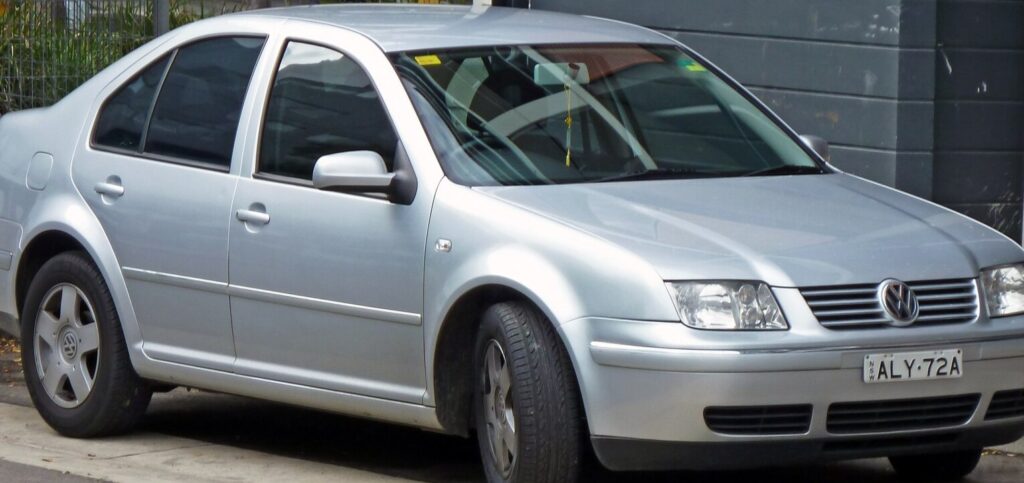
The Volkswagen Bora 2.3 VR5 20V, produced between 2000 and 2005, represented a compelling mid-range offering within the Bora (1J2) lineup. Positioned above the base 1.6 and 1.8 liter models, but below the performance-oriented GTI and diesel variants, the VR5 aimed to deliver a blend of refinement, performance, and practicality. The Bora itself was Volkswagen’s replacement for the Jetta in Europe, sharing its platform (the A4/1J) with the Golf, Audi A3, and SEAT Leon. This particular variant, with its unique five-cylinder engine, offered a distinctive driving experience and catered to buyers seeking something beyond the typical four-cylinder compact sedan.
Technical Specifications
| Brand | Volkswagen |
| Model | Bora |
| Generation | Bora (1J2) |
| Type (Engine) | 2.3 VR5 20V (170 Hp) |
| Start of production | 2000 year |
| End of production | 2005 year |
| Powertrain Architecture | Internal Combustion engine |
| Body type | Sedan |
| Seats | 5 |
| Doors | 4 |
| Fuel consumption (economy) – urban | 12.6 l/100 km (18.7 US mpg, 22.4 UK mpg, 7.9 km/l) |
| Fuel consumption (economy) – extra urban | 6.8 l/100 km (34.6 US mpg, 41.5 UK mpg, 14.7 km/l) |
| Fuel consumption (economy) – combined | 8.9 l/100 km (26.4 US mpg, 31.7 UK mpg, 11.2 km/l) |
| CO2 emissions | 214 g/km |
| Fuel Type | Petrol (Gasoline) |
| Acceleration 0 – 100 km/h | 8.5 sec |
| Acceleration 0 – 62 mph | 8.5 sec |
| Acceleration 0 – 60 mph | 8.1 sec |
| Maximum speed | 224 km/h (139.19 mph) |
| Weight-to-power ratio | 8.4 kg/Hp, 118.6 Hp/tonne |
| Weight-to-torque ratio | 6.5 kg/Nm, 153.5 Nm/tonne |
| Power | 170 Hp @ 6200 rpm |
| Power per litre | 73.1 Hp/l |
| Torque | 220 Nm @ 3200 rpm (162.26 lb.-ft. @ 3200 rpm) |
| Engine layout | Front, Transverse |
| Engine Model/Code | AQN |
| Engine displacement | 2324 cm3 (141.82 cu. in.) |
| Number of cylinders | 5 |
| Engine configuration | V-engine |
| Cylinder Bore | 81 mm (3.19 in.) |
| Piston Stroke | 90.2 mm (3.55 in.) |
| Compression ratio | 10.8:1 |
| Number of valves per cylinder | 4 |
| Fuel injection system | Multi-port manifold injection |
| Engine aspiration | Naturally aspirated engine |
| Valvetrain | SOHC |
| Engine oil capacity | 3.9 l (4.12 US qt | 3.43 UK qt) |
| Coolant | 9 l (9.51 US qt | 7.92 UK qt) |
| Kerb Weight | 1433 kg (3159.22 lbs.) |
| Max. weight | 1840 kg (4056.51 lbs.) |
| Max load | 407 kg (897.28 lbs.) |
| Trunk (boot) space – minimum | 455 l (16.07 cu. ft.) |
| Trunk (boot) space – maximum | 785 l (27.72 cu. ft.) |
| Fuel tank capacity | 55 l (14.53 US gal | 12.1 UK gal) |
| Max. roof load | 75 kg (165.35 lbs.) |
| Permitted trailer load with brakes (12%) | 1500 kg (3306.93 lbs.) |
| Permitted trailer load without brakes | 650 kg (1433 lbs.) |
| Permitted towbar download | 75 kg (165.35 lbs.) |
| Length | 4376 mm (172.28 in.) |
| Width | 1735 mm (68.31 in.) |
| Width including mirrors | 2018 mm (79.45 in.) |
| Height | 1446 mm (56.93 in.) |
| Wheelbase | 2519 mm (99.17 in.) |
| Front track | 1513 mm (59.57 in.) |
| Rear (Back) track | 1494 mm (58.82 in.) |
| Minimum turning circle (turning diameter) | 10.9 m (35.76 ft.) |
| Drivetrain Architecture | The Internal combustion engine (ICE) drives the front wheels of the vehicle. |
| Drive wheel | Front wheel drive |
| Number of gears and type of gearbox | 5 gears, manual transmission |
| Front suspension | Independent, type McPherson with coil spring and anti-roll bar |
| Rear suspension | Semi-independent, coil spring |
| Front brakes | Ventilated discs |
| Rear brakes | Disc |
| Assisting systems | ABS (Anti-lock braking system) |
| Steering type | Steering rack and pinion |
| Power steering | Hydraulic Steering |
| Tires size | 205/55 R16 |
| Wheel rims size | 6.5J x 16 |
Powertrain & Engine Architecture
The heart of the Bora 2.3 VR5 20V is the AQN engine code, a 2.3-liter naturally aspirated V5 engine. This engine is a unique design, essentially half of a VR6 engine, offering a smoother power delivery than a typical inline-five. It features a 10.8:1 compression ratio and utilizes multi-port fuel injection. The 20-valve cylinder head (four valves per cylinder) contributes to improved breathing and higher-end power. The engine’s layout is front-transverse, common for front-wheel-drive Volkswagen models. The five-cylinder configuration provides a distinctive exhaust note and a relatively balanced engine operation. The engine was typically paired with a five-speed manual transmission, but a four-speed automatic transmission was also available, impacting performance and fuel economy.
Driving Characteristics
The 170 horsepower and 220 Nm (162 lb-ft) of torque offered by the VR5 engine provided a noticeable step up in performance compared to the base Bora models. Acceleration from 0-60 mph took around 8.1 to 8.5 seconds, making it a reasonably quick car for its time. The automatic transmission, while offering convenience, did slightly diminish acceleration times and responsiveness compared to the manual version. Gear ratios were tuned for a balance of fuel efficiency and everyday drivability. The VR5 engine delivered a broad torque curve, making it feel responsive in most driving situations. However, it lacked the outright punch of the turbocharged GTI models. The engine’s smoothness and relatively quiet operation contributed to a refined driving experience.
Equipment & Trim Levels
The Bora 2.3 VR5 20V typically came equipped with features such as air conditioning, power windows, power mirrors, and a basic audio system. Higher trim levels offered options like alloy wheels, upgraded upholstery, a sunroof, and a more sophisticated audio system. Interior trim generally featured cloth upholstery, with leather options available as an upgrade. The dashboard layout was typical of early 2000s Volkswagens, with a functional and straightforward design. Safety features included ABS brakes and front airbags, with side airbags often available as an option.
Chassis & Braking
The Bora’s chassis featured an independent McPherson strut front suspension and a semi-independent coil spring rear suspension. This setup provided a comfortable ride and decent handling characteristics. The VR5 models generally received slightly thicker stabilizer bars compared to the base models to reduce body roll. Braking duties were handled by ventilated discs at the front and solid discs at the rear. ABS was standard, providing enhanced braking control in emergency situations. The suspension tuning was geared towards comfort and everyday usability rather than outright sportiness.
Market Reception & Comparison
The Bora 2.3 VR5 20V was generally well-received by automotive critics as a competent and refined mid-range sedan. It was praised for its smooth engine, comfortable ride, and practical interior. However, some critics noted that it lacked the excitement of the GTI models and that the automatic transmission could feel somewhat sluggish. Compared to the 1.8T models, the VR5 offered a different character – less about outright speed and more about smooth, usable power. Fuel economy was reasonable for its class, but not exceptional. Reliability was generally good, although the VR5 engine’s more complex design could potentially lead to higher maintenance costs compared to the simpler four-cylinder engines.
Legacy
Today, the Volkswagen Bora 2.3 VR5 20V is considered a desirable classic among Volkswagen enthusiasts. The unique VR5 engine and its distinctive sound have earned it a loyal following. While not as common as the GTI or TDI models, well-maintained VR5 Boras command a reasonable price in the used car market. The engine is generally considered reliable, but regular maintenance is crucial, particularly regarding oil changes and timing belt replacements. Parts availability is generally good, although some specific VR5 components may be harder to find than those for more common models. The Bora 2.3 VR5 20V represents a unique and enjoyable driving experience, offering a blend of refinement, performance, and practicality that continues to appeal to enthusiasts today.
