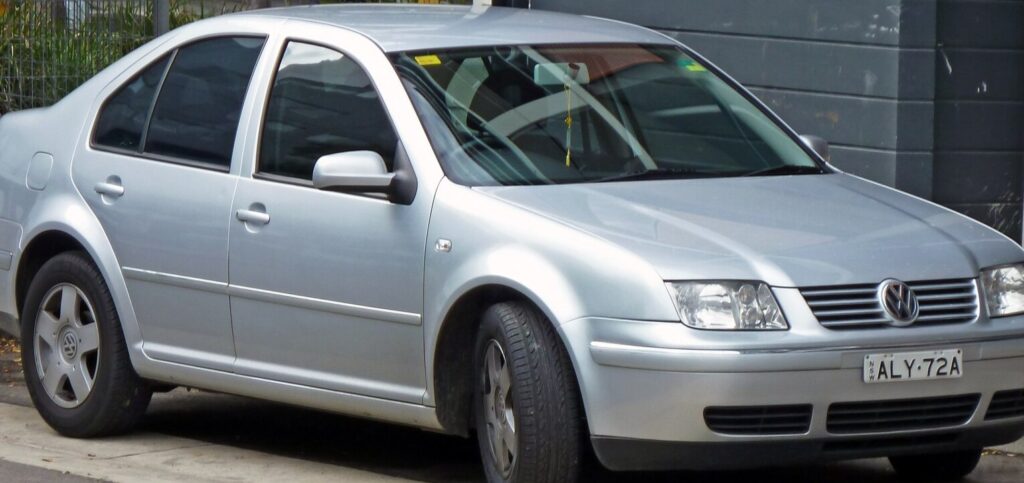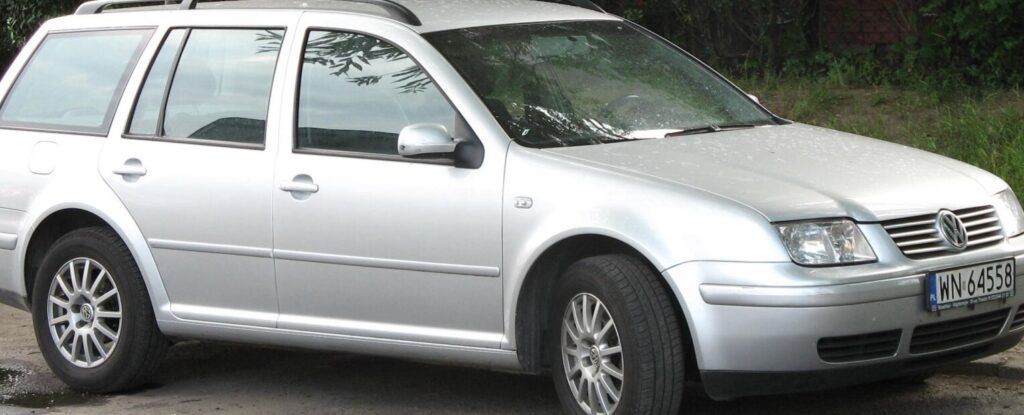
The Volkswagen Bora Variant 1.6 FSI, produced between 2002 and 2005, represents a practical and fuel-efficient offering within the Bora (Jetta in North America) lineup. Positioned as a mid-range trim level, particularly in European markets, this variant combined a relatively modest 110 horsepower engine with the versatility of a station wagon (estate) body style. It was part of the 1J6 series, built on the Volkswagen Group’s A4 platform, also known as the 1HX0 platform, shared with models like the Golf, Audi A3, and SEAT Leon. The Bora Variant aimed to provide a balance between affordability, practicality, and reasonable performance for families and individuals needing ample cargo space.
Technical Specifications
| Brand | Volkswagen |
| Model | Bora |
| Generation | Bora Variant (1J6) |
| Type (Engine) | 1.6 FSI (110 Hp) |
| Start of production | 2002 |
| End of production | 2005 |
| Powertrain Architecture | Internal Combustion engine |
| Body type | Station wagon (estate) |
| Seats | 5 |
| Doors | 5 |
| Fuel consumption (urban) | 8.1 l/100 km (29 US mpg, 34.9 UK mpg, 12.3 km/l) |
| Fuel consumption (extra urban) | 5.3 l/100 km (44.4 US mpg, 53.3 UK mpg, 18.9 km/l) |
| Fuel Type | Petrol (Gasoline) |
| Acceleration 0 – 100 km/h | 11.7 sec |
| Acceleration 0 – 62 mph | 11.7 sec |
| Acceleration 0 – 60 mph | 11.1 sec |
| Maximum speed | 194 km/h (120.55 mph) |
| Weight-to-power ratio | 11.7 kg/Hp, 85.3 Hp/tonne |
| Weight-to-torque ratio | 8.3 kg/Nm, 120.2 Nm/tonne |
| Power | 110 Hp @ 5800 rpm |
| Power per litre | 68.8 Hp/l |
| Torque | 155 Nm @ 4500 rpm (114.32 lb.-ft. @ 4500 rpm) |
| Engine layout | Front, Transverse |
| Engine Model/Code | BAD |
| Engine displacement | 1598 cm3 (97.52 cu. in.) |
| Number of cylinders | 4 |
| Engine configuration | Inline |
| Cylinder Bore | 76.5 mm (3.01 in.) |
| Piston Stroke | 86.9 mm (3.42 in.) |
| Compression ratio | 12:1 |
| Number of valves per cylinder | 4 |
| Fuel injection system | Direct injection |
| Engine aspiration | Naturally aspirated engine |
| Engine oil capacity | 3.5 l (3.7 US qt | 3.08 UK qt) |
| Coolant | 6 l (6.34 US qt | 5.28 UK qt) |
| Kerb Weight | 1290 kg (2843.96 lbs.) |
| Max. weight | 1840 kg (4056.51 lbs.) |
| Max load | 550 kg (1212.54 lbs.) |
| Trunk (boot) space – minimum | 460 l (16.24 cu. ft.) |
| Trunk (boot) space – maximum | 1470 l (51.91 cu. ft.) |
| Fuel tank capacity | 55 l (14.53 US gal | 12.1 UK gal) |
| Length | 4409 mm (173.58 in.) |
| Width | 1735 mm (68.31 in.) |
| Height | 1485 mm (58.46 in.) |
| Wheelbase | 2515 mm (99.02 in.) |
| Front track | 1513 mm (59.57 in.) |
| Rear (Back) track | 1495 mm (58.86 in.) |
| Drivetrain Architecture | The Internal combustion engine (ICE) drives the front wheels of the vehicle. |
| Drive wheel | Front wheel drive |
| Number of gears and type of gearbox | 5 gears, manual transmission |
| Front suspension | Independent, type McPherson with coil spring and anti-roll bar |
| Rear suspension | Semi-independent, coil spring |
| Front brakes | Ventilated discs |
| Rear brakes | Disc |
| Assisting systems | ABS (Anti-lock braking system) |
| Steering type | Steering rack and pinion |
| Power steering | Hydraulic Steering |
| Tires size | 195/65 R15 |
| Wheel rims size | 15 |
Powertrain & Engine Architecture
The heart of the Bora Variant 1.6 FSI is the BAD engine code, a 1.6-liter inline-four cylinder powerplant. This engine utilizes Volkswagen’s Fuel Stratified Injection (FSI) technology, a form of direct injection. FSI allows for precise fuel delivery directly into the combustion chamber, resulting in improved fuel efficiency and increased power output compared to traditional multi-point injection systems. The engine features a dual overhead camshaft (DOHC) valvetrain with four valves per cylinder, contributing to its relatively high specific output. The 1.6 FSI engine produces 110 horsepower at 5800 rpm and 155 Nm (114 lb-ft) of torque at 4500 rpm. The engine is transversely mounted, driving the front wheels. The standard transmission for this variant was a five-speed manual gearbox, although an optional four-speed automatic transmission was also available, albeit less common.
Driving Characteristics
The 1.6 FSI engine, paired with the five-speed manual transmission, provided adequate, though not exhilarating, performance. Acceleration from 0 to 60 mph took approximately 11.1 seconds, and the top speed was around 120 mph. The engine felt responsive enough for everyday driving, but lacked the punch of the larger 1.8T or VR6 engines offered in the Bora lineup. The automatic transmission, while offering convenience, further diminished acceleration and responsiveness. The gear ratios were tuned for fuel economy rather than outright performance. The 1.6 FSI was best suited for relaxed cruising and city driving, where its fuel efficiency and comfortable ride were more appreciated than its acceleration capabilities.
Equipment & Trim Levels
The Bora Variant 1.6 FSI typically came equipped with a reasonable level of standard features. These included power windows, central locking, power steering, and an ABS anti-lock braking system. Interior upholstery was typically cloth, with a functional, if somewhat basic, dashboard layout. Optional extras included alloy wheels, a sunroof, air conditioning, and a CD stereo system. Trim levels varied depending on the market, but generally, the 1.6 FSI variant occupied a mid-range position, offering a step up from the base models in terms of equipment but falling short of the more luxurious trims.
Chassis & Braking
The Bora Variant’s chassis featured an independent McPherson strut suspension at the front and a semi-independent coil spring suspension at the rear. This setup provided a comfortable ride quality, although it wasn’t particularly sporty. The front brakes were ventilated discs, while the rear brakes were solid discs. The braking system was adequate for the vehicle’s weight and performance, with ABS providing enhanced stopping power and stability. Stabilizer bars were fitted to both the front and rear axles to reduce body roll during cornering.
Market Reception & Comparison
The Bora Variant 1.6 FSI was generally well-received as a practical and economical family car. Critics praised its fuel efficiency, spacious interior, and comfortable ride. However, some reviewers found the engine to be underpowered, particularly when fully loaded or driving on inclines. Compared to the 1.8T and VR6 variants, the 1.6 FSI offered significantly lower performance but also lower running costs. The 1.8T provided a noticeable performance boost, while the VR6 offered a more refined driving experience. The 1.6 FSI was often seen as a sensible choice for buyers prioritizing fuel economy and practicality over outright performance.
Legacy
The 1.6 FSI engine, while not known for being particularly robust, generally proved to be reliable with regular maintenance. Common issues included occasional problems with the fuel injectors and the ignition coils. The Bora Variant, as a whole, has maintained a reasonable reputation for durability. Today, the 1.6 FSI variant can be found on the used car market at relatively affordable prices. It remains a viable option for buyers seeking a practical and economical station wagon, but potential buyers should be aware of the potential for age-related issues and ensure a thorough inspection before purchase. The FSI technology, while innovative for its time, requires careful maintenance to prevent long-term problems.