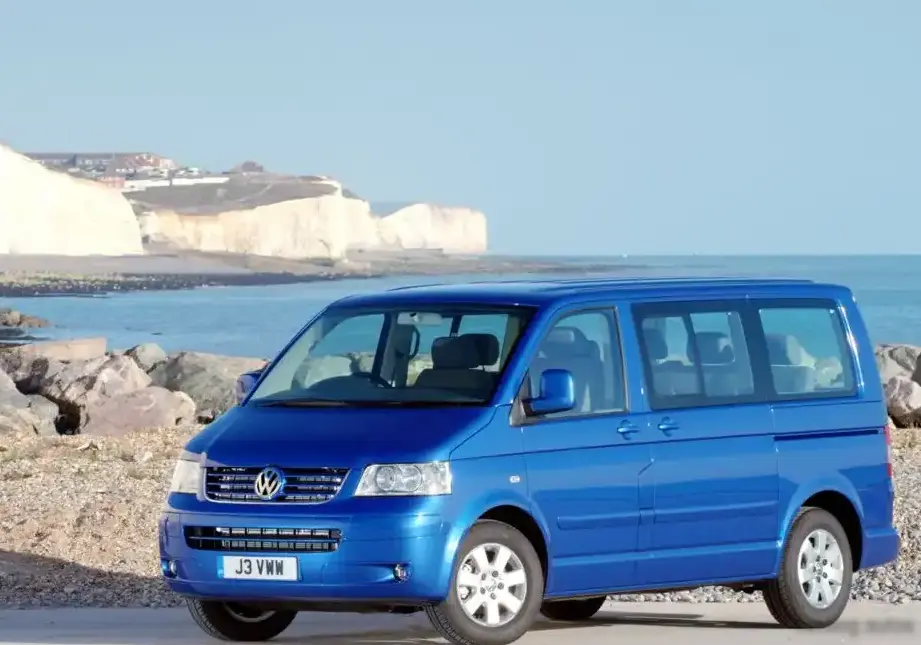
The Volkswagen Caravelle (T5) 2.5 TDI, producing 130 horsepower, was a popular variant of the fifth-generation Caravelle, manufactured between 2003 and 2006. Positioned as a mid-range option within the T5 lineup, it offered a balance between practicality, fuel efficiency, and affordability for families and commercial users. The T5 generation, built on the Volkswagen Group’s 1HX0/A3 platform, represented a significant step forward in terms of space, comfort, and driving dynamics compared to its predecessor, the T4. This particular engine and transmission combination aimed to provide a capable and economical people-mover for the European market, where the Caravelle was primarily sold.
Technical Specifications
| Brand | Volkswagen |
| Model | Caravelle |
| Generation | Caravelle (T5) |
| Type (Engine) | 2.5 TDI (130 Hp) |
| Start of production | 2003 |
| End of production | 2006 |
| Powertrain Architecture | Internal Combustion engine |
| Body type | Van |
| Seats | 5-9 |
| Doors | 4-5 |
| Fuel consumption (economy) – urban (NEDC) | 11-11.2 l/100 km (21.4 – 21 US mpg, 25.7 – 25.2 UK mpg, 9.1 – 8.9 km/l) |
| Fuel consumption (economy) – extra urban (NEDC) | 6.8-7 l/100 km (34.6 – 33.6 US mpg, 41.5 – 40.4 UK mpg, 14.7 – 14.3 km/l) |
| Fuel consumption (economy) – combined (NEDC) | 8.3-8.5 l/100 km (28.3 – 27.7 US mpg, 34 – 33.2 UK mpg, 12 – 11.8 km/l) |
| CO2 emissions (NEDC) | 224-230 g/km |
| Fuel Type | Diesel |
| Acceleration 0 – 100 km/h | 15.3 sec |
| Acceleration 0 – 62 mph | 15.3 sec |
| Acceleration 0 – 60 mph | 14.5 sec |
| Maximum speed | 168 km/h (104.39 mph) |
| Emission standard | Euro 3 |
| Weight-to-power ratio | 14.9 kg/Hp, 67 Hp/tonne |
| Weight-to-torque ratio | 5.7 kg/Nm, 175.3 Nm/tonne |
| Power | 130 Hp @ 3500 rpm |
| Power per litre | 52.8 Hp/l |
| Torque | 340 Nm @ 2000-2300 rpm (250.77 lb.-ft. @ 2000-2300 rpm) |
| Engine layout | Front, Transverse |
| Engine Model/Code | EA153 / AXD |
| Engine displacement | 2460 cm3 (150.12 cu. in.) |
| Number of cylinders | 5 |
| Engine configuration | Inline |
| Cylinder Bore | 81 mm (3.19 in.) |
| Piston Stroke | 95.5 mm (3.76 in.) |
| Compression ratio | 18.5:1 |
| Number of valves per cylinder | 2 |
| Fuel injection system | Pump-nozzle (Unit Injector) |
| Engine aspiration | Turbocharger, Intercooler |
| Valvetrain | SOHC |
| Engine oil capacity | 7.4 l (7.82 US qt | 6.51 UK qt) |
| Coolant | 7.1 l (7.5 US qt | 6.25 UK qt) |
| Kerb Weight | 1940-2179 kg (4276.97 – 4803.87 lbs.) |
| Max. weight | 3000-3200 kg (6613.87 – 7054.79 lbs.) |
| Max load | 1021-1060 kg (2250.92 – 2336.9 lbs.) |
| Trunk (boot) space – maximum | 5800 l (204.83 cu. ft.) |
| Fuel tank capacity | 80 l (21.13 US gal | 17.6 UK gal) |
| Max. roof load | 100 kg (220.46 lbs.) |
| Permitted trailer load with brakes (12%) | 2500 kg (5511.56 lbs.) |
| Permitted trailer load without brakes | 750 kg (1653.47 lbs.) |
| Permitted towbar download | 100 kg (220.46 lbs.) |
| Length | 4890 mm (192.52 in.) |
| Width | 1904 mm (74.96 in.) |
| Width including mirrors | 2242 mm (88.27 in.) |
| Height | 1959 mm (77.13 in.) |
| Wheelbase | 3000 mm (118.11 in.) |
| Front track | 1628 mm (64.09 in.) |
| Rear (Back) track | 1628 mm (64.09 in.) |
| Front overhang | 894 mm (35.2 in.) |
| Rear overhang | 996 mm (39.21 in.) |
| Ride height (ground clearance) | 165 mm (6.5 in.) |
| Minimum turning circle (turning diameter) | 11.9 m (39.04 ft.) |
| Drivetrain Architecture | The Internal combustion engine (ICE) drives the front wheels of the vehicle. |
| Drive wheel | Front wheel drive |
| Number of gears and type of gearbox | 6 gears, manual transmission |
| Front suspension | Independent, type McPherson with coil spring and anti-roll bar |
| Rear suspension | Independent coil spring, Transverse stabilizer, Trailing arm |
| Front brakes | Ventilated discs, 308×29.5 mm |
| Rear brakes | Ventilated discs, 294×22 mm |
| Assisting systems | ABS (Anti-lock braking system) |
| Steering type | Steering rack and pinion |
| Power steering | Hydraulic Steering |
| Tires size | 215/65 R16 |
| Wheel rims size | 6.5J x 16 |
Powertrain & Engine Architecture
The heart of the Caravelle 2.5 TDI (130 Hp) is the EA153 series inline-five cylinder diesel engine, specifically the AXD engine code. This engine, a mainstay of the Volkswagen Group during the early 2000s, featured a robust cast iron block and aluminum cylinder head. It employed a pump-nozzle (unit injector) fuel injection system, a technology known for its high injection pressures and precise fuel delivery, contributing to improved combustion efficiency and reduced emissions compared to older diesel injection systems. The engine utilized a single overhead camshaft (SOHC) valvetrain operating two valves per cylinder. A turbocharger with an intercooler was standard, boosting power output and improving throttle response. The 2.5-liter displacement provided a good balance between power and fuel economy. The engine was transversely mounted in the front of the vehicle, driving the front wheels.
Driving Characteristics
The 130 hp 2.5 TDI engine, paired with a six-speed manual transmission, delivered adequate performance for the Caravelle’s size and weight. Acceleration was not its strong suit, with a 0-60 mph time of around 14.5 seconds. However, the engine’s 340 Nm (250.77 lb-ft) of torque, available from 2000-2300 rpm, provided sufficient pulling power for carrying passengers and cargo. The six-speed gearbox helped to keep engine speeds reasonable at highway speeds, contributing to improved fuel economy and reduced noise levels. Compared to the more powerful 174 hp version of the 2.5 TDI, the 130 hp variant felt noticeably slower, particularly when fully loaded. However, it offered a more relaxed driving experience and better fuel consumption. The manual transmission provided more driver control than the optional automatic, allowing for better utilization of the engine’s torque.
Equipment & Trim Levels
The Caravelle 2.5 TDI (130 Hp) typically came equipped with a respectable level of standard features. These included power windows, central locking, air conditioning, and an adjustable steering wheel. Interior upholstery was usually cloth, with options for upgraded materials. The dashboard layout was functional and straightforward, prioritizing practicality over luxury. Optional extras included alloy wheels, a CD stereo system, parking sensors, and upgraded seating configurations. The Caravelle was available in various trim levels, with the 2.5 TDI (130 Hp) generally positioned as a mid-range offering, bridging the gap between the base models and the more luxurious, higher-powered variants.
Chassis & Braking
The Caravelle T5 featured an independent suspension setup, with McPherson struts at the front and a trailing arm arrangement at the rear. This provided a comfortable ride quality, even when the vehicle was fully loaded. A stabilizer bar was fitted to both the front and rear axles to reduce body roll during cornering. Braking duties were handled by ventilated discs on all four wheels, providing adequate stopping power. An Anti-lock Braking System (ABS) was standard, enhancing safety and stability. The hydraulic power steering offered a reasonable level of assistance, making the Caravelle relatively easy to maneuver.
Market Reception & Comparison
The Caravelle 2.5 TDI (130 Hp) was generally well-received by critics as a practical and versatile people-carrier. It was praised for its spacious interior, comfortable ride, and relatively good fuel economy. However, some reviewers noted its lack of outright performance compared to more powerful alternatives. Compared to the 1.9 TDI variants, the 2.5 TDI offered more power and torque, but at the expense of slightly higher fuel consumption. The 174 hp version of the 2.5 TDI provided significantly more performance but was also more expensive to purchase and operate. The Caravelle’s main competitors included the Mercedes-Benz Vito and the Ford Transit.
Legacy
The Volkswagen Caravelle T5 2.5 TDI (130 Hp) has proven to be a relatively reliable vehicle, with many examples still on the road today. The AXD engine, while not without its potential issues (such as injector wear and turbocharger failure), is generally considered to be durable and long-lasting when properly maintained. In the used car market, these Caravelles represent a good value proposition for those seeking a spacious and practical vehicle. However, potential buyers should be aware of the age-related issues common to vehicles of this era, such as corrosion and wear and tear on suspension components. The 2.5 TDI engine’s reputation for fuel efficiency and reliability has contributed to its continued popularity among families and commercial operators.