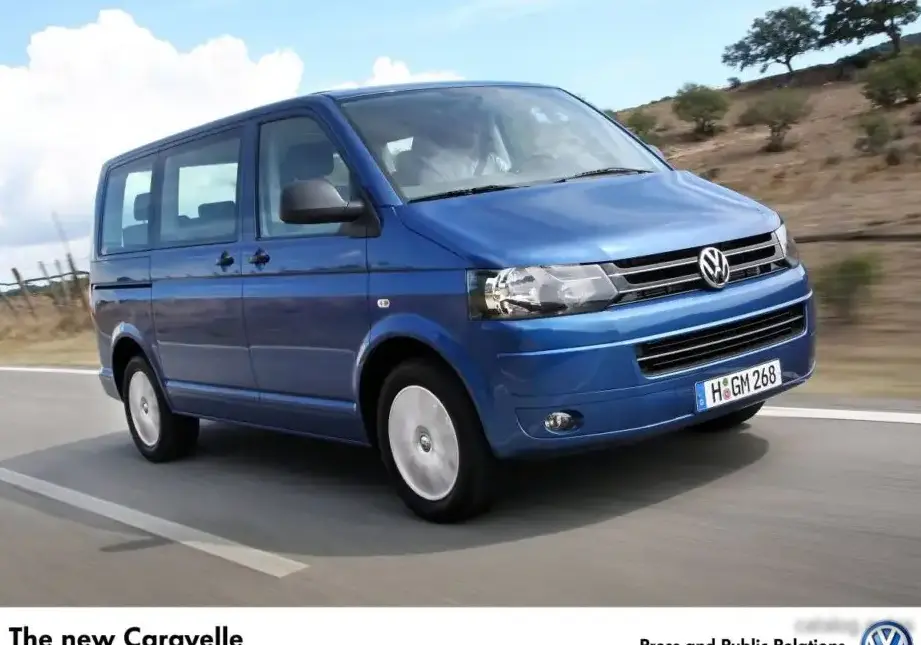
The Volkswagen Caravelle (T5, facelift 2009) 2.0 TDI 180 hp 4MOTION DSG represents a significant iteration of Volkswagen’s popular multi-purpose vehicle, produced from 2009 to 2015. Positioned as a premium offering within the T5 range, this variant combined a powerful turbodiesel engine with Volkswagen’s advanced 4MOTION all-wheel-drive system and a dual-clutch DSG transmission. It catered to buyers seeking a versatile vehicle capable of both comfortable long-distance travel and confident all-weather performance. The Caravelle, in general, served as the more luxurious passenger-carrying version of the Transporter, aimed at families, executives, and shuttle services. This specific 2.0 TDI 4MOTION DSG trim occupied a mid-to-high range position in the lineup, offering a balance of performance, features, and practicality.
Technical Specifications
| Brand | Volkswagen |
| Model | Caravelle |
| Generation | Caravelle (T5, facelift 2009) |
| Type (Engine) | 2.0 TDI (180 Hp) 4MOTION DSG |
| Start of production | 2009 |
| End of production | 2015 |
| Powertrain Architecture | Internal Combustion engine |
| Body type | Van |
| Seats | 4-9 |
| Doors | 4-5 |
| Fuel consumption (economy) – urban (NEDC) | 11.1 l/100 km (21.2 US mpg, 25.4 UK mpg, 9 km/l) |
| Fuel consumption (economy) – extra urban (NEDC) | 7.5 l/100 km (31.4 US mpg, 37.7 UK mpg, 13.3 km/l) |
| Fuel consumption (economy) – combined (NEDC) | 8.8 l/100 km (26.7 US mpg, 32.1 UK mpg, 11.4 km/l) |
| CO2 emissions (NEDC) | 232 g/km |
| Fuel Type | Diesel |
| Acceleration 0 – 100 km/h | 12.1 sec |
| Acceleration 0 – 62 mph | 12.1 sec |
| Acceleration 0 – 60 mph | 11.5 sec |
| Maximum speed | 188 km/h (116.82 mph) |
| Emission standard | Euro 5 |
| Weight-to-power ratio | 11.8 kg/Hp, 84.8 Hp/tonne |
| Weight-to-torque ratio | 5.3 kg/Nm, 188.4 Nm/tonne |
| Power | 180 Hp @ 4000 rpm |
| Power per litre | 91.5 Hp/l |
| Torque | 400 Nm @ 1500-2000 rpm (295.02 lb.-ft. @ 1500-2000 rpm) |
| Engine layout | Front, Transverse |
| Engine Model/Code | EA189 / CFCA |
| Engine displacement | 1968 cm3 (120.09 cu. in.) |
| Number of cylinders | 4 |
| Engine configuration | Inline |
| Cylinder Bore | 81 mm (3.19 in.) |
| Piston Stroke | 95.5 mm (3.76 in.) |
| Compression ratio | 16.5:1 |
| Number of valves per cylinder | 4 |
| Fuel injection system | Diesel Commonrail |
| Engine aspiration | BiTurbo, Intercooler |
| Valvetrain | DOHC |
| Engine oil capacity | 7 l (7.4 US qt | 6.16 UK qt) |
| Coolant | 11 l (11.62 US qt | 9.68 UK qt) |
| Kerb Weight | 2123-2312 kg (4680.41 – 5097.09 lbs.) |
| Max. weight | 3000-3200 kg (6613.87 – 7054.79 lbs.) |
| Max load | 877-888 kg (1933.45 – 1957.7 lbs.) |
| Trunk (boot) space – maximum | 5800 l (204.83 cu. ft.) |
| Fuel tank capacity | 80 l (21.13 US gal | 17.6 UK gal) |
| Max. roof load | 100 kg (220.46 lbs.) |
| Permitted trailer load with brakes (12%) | 2500 kg (5511.56 lbs.) |
| Permitted trailer load without brakes | 750 kg (1653.47 lbs.) |
| Permitted towbar download | 100 kg (220.46 lbs.) |
| Length | 4892 mm (192.6 in.) |
| Width | 1904 mm (74.96 in.) |
| Width including mirrors | 2283 mm (89.88 in.) |
| Height | 1970-1990 mm (77.56 – 78.35 in.) |
| Wheelbase | 3000 mm (118.11 in.) |
| Front overhang | 896 mm (35.28 in.) |
| Rear overhang | 996 mm (39.21 in.) |
| Ride height (ground clearance) | 165 mm (6.5 in.) |
| Minimum turning circle (turning diameter) | 11.9 m (39.04 ft.) |
| Drivetrain Architecture | The Internal combustion engine (ICE) drives the front wheels permanently, and the rear wheels are driven through an electrically or mechanically operated clutch if necessary. |
| Drive wheel | All wheel drive (4×4) |
| Number of gears and type of gearbox | 7 gears, automatic transmission DSG |
| Front suspension | Independent, type McPherson with coil spring and anti-roll bar |
| Rear suspension | Independent coil spring, Transverse stabilizer, Trailing arm |
| Front brakes | Ventilated discs, 340×32.5 mm |
| Rear brakes | Ventilated discs, 294×22 mm |
| Tires size | 235/55 R17; 255/45 R18 |
| Wheel rims size | 7J x 17; 8J x 18 |
Powertrain & Engine Architecture
The heart of this Caravelle variant is the 2.0-liter TDI engine, specifically the EA189 series, identified by the engine code CFCA. This engine is a four-cylinder, inline diesel featuring common rail direct injection and a sophisticated bi-turbocharger system. The bi-turbo setup employs two turbochargers – a smaller one for quick response at low engine speeds and a larger one for increased power at higher RPMs. An intercooler further enhances performance by cooling the compressed intake air. The engine utilizes a double overhead camshaft (DOHC) valvetrain with four valves per cylinder, optimizing gas flow for improved efficiency and power output. The 4MOTION system is a permanent all-wheel-drive system, utilizing a viscous coupling to distribute power between the front and rear axles as needed. The 7-speed DSG (Direct-Shift Gearbox) is a dual-clutch transmission that provides quick, smooth gear changes and contributes to improved fuel economy compared to a traditional automatic transmission.
Driving Characteristics
The 180 hp 2.0 TDI engine, coupled with the DSG transmission and 4MOTION system, delivers a refined and capable driving experience. While not overtly sporty, the Caravelle offers ample power for everyday driving and comfortable highway cruising. The DSG transmission provides responsive shifts, and the 4MOTION system ensures excellent traction in various weather conditions. Compared to lower-powered versions of the T5, this variant offers noticeably improved acceleration and passing power. However, it doesn’t match the performance of the more powerful 2.0 BiTDI models. The DSG transmission’s gear ratios are tuned for a balance of fuel efficiency and performance, with relatively short lower gears for quick acceleration and taller higher gears for relaxed cruising. The 4MOTION system adds weight, but the enhanced stability and grip are a worthwhile trade-off for many drivers.
Equipment & Trim Levels
The Caravelle 2.0 TDI 4MOTION DSG typically came well-equipped, reflecting its position as a premium trim level. Standard features often included air conditioning, power windows and mirrors, a multi-function steering wheel, and an upgraded audio system. Interior upholstery was typically cloth or a combination of cloth and leatherette. Optional extras included features like navigation systems, parking sensors, heated seats, and upgraded interior trim. The Caravelle’s interior was designed with practicality and comfort in mind, offering flexible seating configurations and ample storage space. The dashboard layout was functional and user-friendly, with clear instrumentation and intuitive controls.
Chassis & Braking
The Caravelle T5 utilizes an independent suspension setup on both the front and rear axles. The front suspension employs McPherson struts with coil springs and an anti-roll bar, while the rear suspension features a trailing arm configuration with coil springs and a transverse stabilizer. This setup provides a comfortable ride and good handling characteristics. Braking duties are handled by ventilated disc brakes on all four wheels, providing ample stopping power. The Caravelle also incorporates ABS (Anti-lock Braking System) and other electronic stability control systems to enhance safety.
Market Reception & Comparison
The Caravelle 2.0 TDI 4MOTION DSG was generally well-received by automotive critics. It was praised for its versatility, comfortable ride, and strong performance. The 4MOTION system was particularly appreciated for its ability to provide confident all-weather traction. Compared to the base-model Caravelles with less powerful engines, this variant offered a significant upgrade in performance and refinement. However, it was more expensive to purchase and maintain. Fuel economy was respectable for a vehicle of its size and weight, but not class-leading. Reliability was generally good, although some owners reported issues with the DSG transmission and the diesel particulate filter.
Legacy
The Volkswagen Caravelle T5 2.0 TDI 4MOTION DSG remains a popular choice in the used car market. The 2.0 TDI engine, while having some known issues with the DPF (Diesel Particulate Filter) and potential turbocharger wear, is generally considered durable and reliable when properly maintained. The DSG transmission requires regular servicing, including fluid changes, to ensure longevity. The 4MOTION system adds to the vehicle’s appeal, particularly in regions with harsh winters or challenging road conditions. Today, these Caravelles are often sought after by families, adventure enthusiasts, and those needing a versatile and reliable vehicle for both work and leisure.