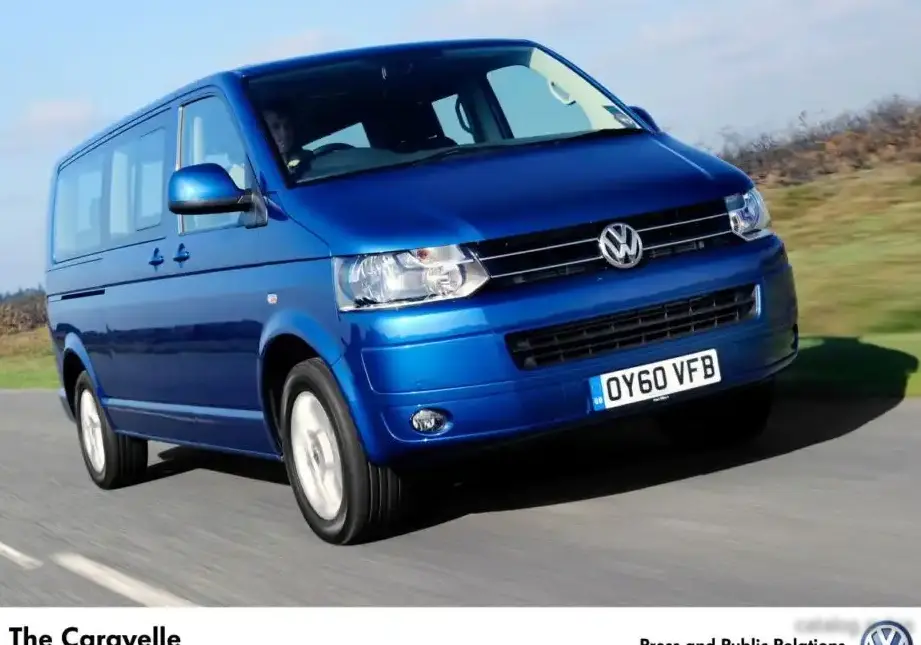
The Volkswagen Caravelle (T5, facelift 2009) Long 2.0 TDI, producing 140 horsepower, represents a significant iteration of Volkswagen’s popular multi-purpose vehicle. Introduced as part of the T5 facelift in 2009 and continuing through 2015, this variant occupied a middle ground within the Caravelle lineup, offering a balance between fuel efficiency, practicality, and affordability. Positioned above the base engine options but below the more powerful TDI variants, the 140 hp model catered to families and businesses seeking a versatile vehicle for both passenger transport and light commercial duties. The “Long” designation indicates an extended wheelbase, providing increased interior space and cargo capacity compared to the standard Caravelle T5.
Technical Specifications
| Brand | Volkswagen |
| Model | Caravelle |
| Generation | Caravelle (T5, facelift 2009) Long |
| Type (Engine) | 2.0 TDI (140 Hp) |
| Start of production | 2009 |
| End of production | 2015 |
| Powertrain Architecture | Internal Combustion engine |
| Body type | Van |
| Seats | 4-9 |
| Doors | 4-5 |
| Fuel consumption (economy) – urban (NEDC) | 9.6 l/100 km (24.5 US mpg, 29.4 UK mpg, 10.4 km/l) |
| Fuel consumption (economy) – extra urban (NEDC) | 6.3 l/100 km (37.3 US mpg, 44.8 UK mpg, 15.9 km/l) |
| Fuel consumption (economy) – combined (NEDC) | 7.5 l/100 km (31.4 US mpg, 37.7 UK mpg, 13.3 km/l) |
| CO2 emissions (NEDC) | 198 g/km |
| Fuel Type | Diesel |
| Acceleration 0 – 100 km/h | 14.2 sec |
| Acceleration 0 – 62 mph | 14.2 sec |
| Acceleration 0 – 60 mph | 13.5 sec |
| Maximum speed | 173 km/h (107.5 mph) |
| Emission standard | Euro 5 |
| Weight-to-power ratio | 14.3 kg/Hp, 70 Hp/tonne |
| Weight-to-torque ratio | 5.9 kg/Nm, 170 Nm/tonne |
| Power | 140 Hp @ 3500 rpm |
| Power per litre | 71.1 Hp/l |
| Torque | 340 Nm @ 1750-2500 rpm (250.77 lb.-ft. @ 1750-2500 rpm) |
| Engine layout | Front, Transverse |
| Engine Model/Code | EA189 / CCHA |
| Engine displacement | 1968 cm3 (120.09 cu. in.) |
| Number of cylinders | 4 |
| Engine configuration | Inline |
| Cylinder Bore | 81 mm (3.19 in.) |
| Piston Stroke | 95.5 mm (3.76 in.) |
| Compression ratio | 16.5:1 |
| Number of valves per cylinder | 4 |
| Fuel injection system | Diesel Commonrail |
| Engine aspiration | Turbocharger, Intercooler |
| Valvetrain | DOHC |
| Engine oil capacity | 7 l (7.4 US qt | 6.16 UK qt) |
| Coolant | 11 l (11.62 US qt | 9.68 UK qt) |
| Kerb Weight | 2000-2254 kg (4409.25 – 4969.22 lbs.) |
| Max. weight | 3000-3200 kg (6613.87 – 7054.79 lbs.) |
| Max load | 946-1000 kg (2085.57 – 2204.62 lbs.) |
| Trunk (boot) space – maximum | 6700 l (236.61 cu. ft.) |
| Fuel tank capacity | 80 l (21.13 US gal | 17.6 UK gal) |
| Max. roof load | 100 kg (220.46 lbs.) |
| Permitted trailer load with brakes (12%) | 2500 kg (5511.56 lbs.) |
| Permitted trailer load without brakes | 750 kg (1653.47 lbs.) |
| Permitted towbar download | 100 kg (220.46 lbs.) |
| Length | 5292 mm (208.35 in.) |
| Width | 1904 mm (74.96 in.) |
| Width including mirrors | 2283 mm (89.88 in.) |
| Height | 1990 mm (78.35 in.) |
| Wheelbase | 3400 mm (133.86 in.) |
| Front overhang | 896 mm (35.28 in.) |
| Rear overhang | 996 mm (39.21 in.) |
| Ride height (ground clearance) | 165 mm (6.5 in.) |
| Minimum turning circle (turning diameter) | 13.2 m (43.31 ft.) |
| Drivetrain Architecture | The Internal combustion engine (ICE) drives the front wheels of the vehicle. |
| Drive wheel | Front wheel drive |
| Number of gears and type of gearbox | 6 gears, manual transmission |
| Front suspension | Independent, type McPherson with coil spring and anti-roll bar |
| Rear suspension | Independent coil spring, Transverse stabilizer, Trailing arm |
| Front brakes | Ventilated discs, 308×29.5 mm |
| Rear brakes | Ventilated discs, 294×22 mm |
| Assisting systems | ABS (Anti-lock braking system) |
| Steering type | Steering rack and pinion |
| Power steering | Hydraulic Steering |
| Tires size | 215/60 R16; 215/65 R16 |
| Wheel rims size | 6.5J x 16 |
Powertrain & Engine Architecture
The heart of this Caravelle variant is the 2.0-liter TDI engine, specifically the EA189 series, identified by the engine code CCHA. This engine is a four-cylinder, inline diesel featuring common rail direct injection and a turbocharger with intercooling. The common rail system, operating at high pressure, ensures precise fuel delivery for optimized combustion and reduced emissions. The DOHC (Double Overhead Camshaft) valvetrain, with four valves per cylinder, further enhances breathing and contributes to the engine’s power output. The turbocharger boosts power and torque, providing a noticeable improvement over naturally aspirated engines. The 6-speed manual transmission was standard, offering a good balance between fuel economy and driver control. While an automatic transmission was available as an option, it was less common with this engine due to its impact on fuel consumption and performance.
Driving Characteristics
The 140 hp 2.0 TDI engine in the Caravelle Long provides adequate, though not exhilarating, performance. Acceleration from 0-60 mph takes around 13.5 seconds, and top speed is approximately 107.5 mph. The engine’s strength lies in its mid-range torque of 340 Nm (250.77 lb-ft), available from 1750-2500 rpm. This makes it well-suited for carrying passengers and cargo, providing sufficient pulling power for highway driving and moderate inclines. Compared to the more powerful TDI variants (like the 170 hp or 180 hp versions), the 140 hp model feels less responsive, particularly when fully loaded. The manual transmission’s gear ratios are geared towards fuel efficiency, meaning the engine needs to be revved slightly to access its peak power. The long wheelbase contributes to a comfortable ride, but also results in noticeable body roll during cornering.
Equipment & Trim Levels
The Caravelle (T5, facelift 2009) Long 2.0 TDI typically came equipped with a reasonable level of standard features. These included air conditioning, power windows, central locking, and an audio system. Interior upholstery was typically cloth, though leather options were available. The dashboard layout was functional and straightforward, prioritizing practicality over luxury. Optional extras included features like parking sensors, a navigation system, upgraded audio systems, and various interior trim upgrades. The Caravelle was often configured with multiple rows of seating, accommodating up to nine passengers depending on the specific layout chosen.
Chassis & Braking
The Caravelle T5 utilizes an independent suspension setup, with McPherson struts at the front and a trailing arm arrangement at the rear. This provides a relatively comfortable ride, although the vehicle’s weight and size can be felt on uneven surfaces. Braking duties are handled by ventilated discs on all four wheels, providing adequate stopping power. ABS (Anti-lock Braking System) is standard. The Caravelle’s chassis is designed to handle the demands of carrying passengers and cargo, with a reinforced structure and a robust suspension system.
Market Reception & Comparison
The 140 hp 2.0 TDI Caravelle Long was generally well-received as a practical and economical option. Critics praised its fuel efficiency and spacious interior, but noted that its performance was not as exciting as some of the more powerful variants. Compared to the 170 hp or 180 hp TDI models, the 140 hp version offered lower running costs but sacrificed some performance. The 1.9 TDI engine, available in earlier T5 models, was known for its robustness but was less refined and offered lower power output. The 2.0 TDI provided a good compromise between performance, economy, and refinement.
Legacy
The EA189 engine family, including the CCHA code used in this Caravelle, has a mixed reputation. While generally reliable, some engines were affected by issues related to the diesel particulate filter (DPF) and injector problems. Proper maintenance, including regular oil changes and DPF regeneration, is crucial for ensuring long-term reliability. Today, the Caravelle T5 (2009-2015) Long 2.0 TDI remains a popular choice in the used car market, particularly for those seeking a versatile and spacious vehicle for family or business use. Its relatively simple mechanicals and readily available parts contribute to its continued appeal.