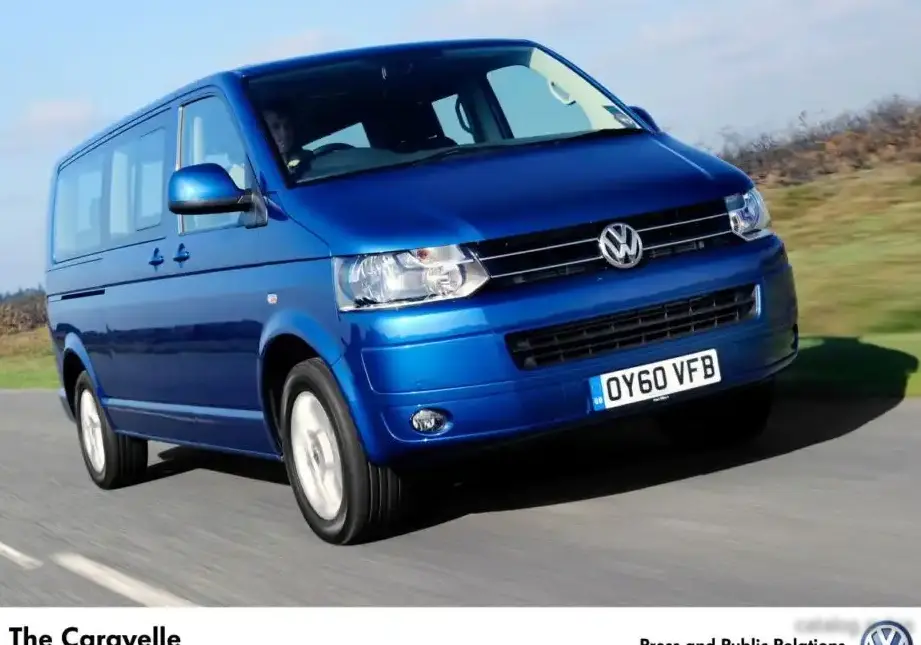
The Volkswagen Caravelle (T5, facelift 2009) Long 2.0 TSI (204 Hp) represents a significant iteration of Volkswagen’s popular multi-purpose vehicle, produced from 2011 to 2015. Positioned as a premium offering within the T5 Caravelle range, this variant combined a potent turbocharged gasoline engine with a spacious, versatile interior. The “Long” designation indicates an extended wheelbase, providing increased passenger and cargo capacity compared to the standard-length T5. This model primarily served the European market, catering to families and businesses requiring a comfortable and practical vehicle for both transportation and leisure activities.
Technical Specifications
| Brand | Volkswagen |
| Model | Caravelle |
| Generation | Caravelle (T5, facelift 2009) Long |
| Type (Engine) | 2.0 TSI (204 Hp) |
| Start of production | 2011 |
| End of production | 2015 |
| Powertrain Architecture | Internal Combustion engine |
| Body type | Van |
| Seats | 4-9 |
| Doors | 4-5 |
| Fuel consumption (economy) – urban (NEDC) | 13 l/100 km (18.1 US mpg, 21.7 UK mpg, 7.7 km/l) |
| Fuel consumption (economy) – extra urban (NEDC) | 8 l/100 km (29.4 US mpg, 35.3 UK mpg, 12.5 km/l) |
| Fuel consumption (economy) – combined (NEDC) | 9.8 l/100 km (24 US mpg, 28.8 UK mpg, 10.2 km/l) |
| CO2 emissions (NEDC) | 228 g/km |
| Fuel Type | Petrol (Gasoline) |
| Acceleration 0 – 100 km/h | 9.5 sec |
| Acceleration 0 – 62 mph | 9.5 sec |
| Acceleration 0 – 60 mph | 9 sec |
| Maximum speed | 200 km/h (124.27 mph) |
| Emission standard | Euro 5 |
| Weight-to-power ratio | 10 kg/Hp, 100.3 Hp/tonne |
| Weight-to-torque ratio | 5.8 kg/Nm, 172.2 Nm/tonne |
| Power | 204 Hp @ 4200-6000 rpm |
| Power per litre | 102.8 Hp/l |
| Torque | 350 Nm @ 1500-4000 rpm (258.15 lb.-ft. @ 1500-4000 rpm) |
| Engine layout | Front, Transverse |
| Engine Model/Code | EA888 / CJKA |
| Engine displacement | 1984 cm3 (121.07 cu. in.) |
| Number of cylinders | 4 |
| Engine configuration | Inline |
| Cylinder Bore | 82.5 mm (3.25 in.) |
| Piston Stroke | 92.8 mm (3.65 in.) |
| Compression ratio | 9.8:1 |
| Number of valves per cylinder | 4 |
| Fuel injection system | Direct injection |
| Engine aspiration | Turbocharger, Intercooler |
| Valvetrain | DOHC |
| Engine oil capacity | 5.7 l (6.02 US qt | 5.02 UK qt) |
| Kerb Weight | 2033 kg (4482 lbs.) |
| Max. weight | 3000-3200 kg (6613.87 – 7054.79 lbs.) |
| Max load | 967-1167 kg (2131.87 – 2572.79 lbs.) |
| Trunk (boot) space – maximum | 6700 l (236.61 cu. ft.) |
| Fuel tank capacity | 80 l (21.13 US gal | 17.6 UK gal) |
| Max. roof load | 100 kg (220.46 lbs.) |
| Permitted trailer load with brakes (12%) | 2500 kg (5511.56 lbs.) |
| Permitted trailer load without brakes | 750 kg (1653.47 lbs.) |
| Permitted towbar download | 100 kg (220.46 lbs.) |
| Length | 5292 mm (208.35 in.) |
| Width | 1904 mm (74.96 in.) |
| Width including mirrors | 2283 mm (89.88 in.) |
| Height | 1990 mm (78.35 in.) |
| Wheelbase | 3400 mm (133.86 in.) |
| Front overhang | 896 mm (35.28 in.) |
| Rear overhang | 996 mm (39.21 in.) |
| Ride height (ground clearance) | 201 mm (7.91 in.) |
| Minimum turning circle (turning diameter) | 13.2 m (43.31 ft.) |
| Approach angle | 21° |
| Departure angle | 17° |
| Ramp-over (brakeover) angle | 12° |
| Drivetrain Architecture | The Internal combustion engine (ICE) drives the front wheels of the vehicle. |
| Drive wheel | Front wheel drive |
| Number of gears and type of gearbox | 6 gears, manual transmission |
| Front suspension | Independent, type McPherson with coil spring and anti-roll bar |
| Rear suspension | Independent coil spring, Transverse stabilizer, Trailing arm |
| Front brakes | Ventilated discs, 340×32.5 mm |
| Rear brakes | Ventilated discs, 294×22 mm |
| Assisting systems | ABS (Anti-lock braking system) |
| Steering type | Steering rack and pinion |
| Power steering | Hydraulic Steering |
| Tires size | 215/60 R17; 235/55 R17; 255/45 R18 |
| Wheel rims size | 7J x 17; 8J x 18 |
INTRODUCTION
The Volkswagen Caravelle T5, facelifted in 2009, built upon the success of its predecessor, offering a blend of practicality, comfort, and refinement. The 2.0 TSI (204 Hp) Long variant, introduced in 2011, represented a step up in performance and features. Built on the 1HX0/A3 platform, the Caravelle served as a more luxurious and versatile alternative to the Transporter panel van, targeting families, shuttle services, and executive transport. The “Long” wheelbase version provided significantly more space for passengers and luggage, making it ideal for long journeys and larger groups. This particular engine and configuration was positioned as a mid-range option, offering a balance between performance and fuel efficiency.
Powertrain & Engine Architecture
At the heart of the Caravelle 2.0 TSI Long lies the EA888 engine, specifically the CJKA variant. This 1984cc, inline-four cylinder engine utilizes direct fuel injection and a turbocharger with an intercooler to deliver 204 horsepower at 4200-6000 rpm and 350 Nm (258 lb-ft) of torque between 1500-4000 rpm. The direct injection system ensures precise fuel delivery, optimizing combustion efficiency and power output. The engine features a double overhead camshaft (DOHC) valvetrain with four valves per cylinder, further enhancing its breathing and performance. The engine is transversely mounted in the front of the vehicle. The standard transmission for this variant was a 6-speed manual gearbox, although a 6-speed automatic transmission was also available as an option. The automatic transmission was designed to provide smooth and efficient gear changes, complementing the engine’s torque characteristics.
Driving Characteristics
The 204 hp 2.0 TSI engine provided a noticeable performance upgrade compared to lower-powered Caravelle variants. Acceleration from 0-100 km/h (0-62 mph) took approximately 9.5 seconds, and the vehicle could reach a top speed of 200 km/h (124 mph). While not a sports car, the Caravelle 2.0 TSI offered ample power for overtaking and cruising on highways. The turbocharger provided a surge of torque at lower engine speeds, making it easy to maintain momentum. The 6-speed manual transmission allowed for precise control over gear selection, while the optional automatic transmission offered convenience, particularly in urban driving. Compared to the diesel-powered Caravelles, the 2.0 TSI offered a more responsive and refined driving experience, albeit with slightly higher fuel consumption.
Equipment & Trim Levels
The Caravelle 2.0 TSI Long typically came equipped with a generous array of standard features, including air conditioning, power windows, central locking, and an audio system. Higher trim levels offered additional features such as leather upholstery, heated seats, a navigation system, and parking sensors. The interior was designed with comfort and practicality in mind, with flexible seating arrangements and ample storage space. The “Long” wheelbase version provided increased legroom for passengers in the rear seats. Optional extras included a sunroof, upgraded audio systems, and various customization options for the interior trim.
Chassis & Braking
The Caravelle 2.0 TSI Long featured an independent suspension system, with McPherson struts at the front and a trailing arm setup at the rear. This configuration provided a comfortable ride and good handling characteristics. The vehicle was equipped with ventilated disc brakes on all four wheels, providing ample stopping power. An anti-lock braking system (ABS) was standard, enhancing safety and stability during emergency braking. The steering was rack and pinion with hydraulic power assistance, offering precise and responsive steering feel.
Market Reception & Comparison
The Caravelle 2.0 TSI Long was generally well-received by critics, who praised its spacious interior, comfortable ride, and strong performance. The 2.0 TSI engine was considered a good compromise between power and fuel efficiency, although some reviewers noted that it wasn’t as economical as the diesel alternatives. Compared to the diesel-powered Caravelles, the 2.0 TSI offered a more refined driving experience and a quieter cabin. However, the gasoline engine typically commanded a higher price and had slightly higher running costs. Against competitors like the Mercedes-Benz V-Class and the Ford Galaxy, the Caravelle offered a compelling combination of practicality, comfort, and value.
Legacy
The Volkswagen Caravelle T5 2.0 TSI Long remains a popular choice in the used car market, appreciated for its versatility, reliability, and spacious interior. The EA888 engine, while requiring regular maintenance, is generally considered a robust and durable unit. Common issues include oil consumption and occasional turbocharger problems, but these are typically addressed with proper servicing. The Caravelle’s reputation for build quality and practicality ensures continued demand, making it a solid investment for families and businesses seeking a versatile and comfortable multi-purpose vehicle.