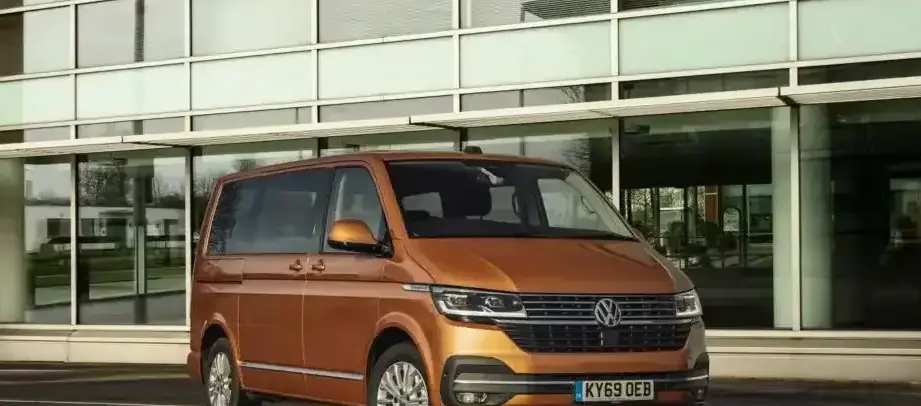
The Volkswagen Caravelle (T6.1), specifically the 2.0 TDI 150 horsepower (HP) variant equipped with a dual-clutch gearbox (DSG), represents a mid-cycle refresh of the popular T6 Transporter platform. Introduced in 2019 and continuing through 2020, this version of the Caravelle aimed to balance practicality, fuel efficiency, and a more refined driving experience within the Volkswagen commercial vehicle lineup. Positioned as a versatile people-carrier, the T6.1 Caravelle served as a step up from the base Transporter Shuttle, offering increased comfort and features geared towards family and leisure use. It slotted below the more luxurious Multivan, offering a compelling alternative for those seeking a spacious and adaptable vehicle without the premium price tag.
Technical Specifications
| Brand | Volkswagen |
| Model | Caravelle |
| Generation | Caravelle (T6.1, facelift 2019) |
| Type (Engine) | 2.0 TDI (150 Hp) DSG |
| Start of production | 2019 |
| End of production | 2020 |
| Powertrain Architecture | Internal Combustion engine |
| Body type | Van |
| Seats | 4-9 |
| Doors | 4-5 |
| Fuel consumption (economy) – urban | 6.6-7.7 l/100 km (35.6 – 30.5 US mpg, 42.8 – 36.7 UK mpg, 15.2 – 13 km/l) |
| Fuel consumption (economy) – extra urban | 5.5-6.4 l/100 km (42.8 – 36.8 US mpg, 51.4 – 44.1 UK mpg, 18.2 – 15.6 km/l) |
| Fuel consumption (economy) – combined | 5.9-6.8 l/100 km (39.9 – 34.6 US mpg, 47.9 – 41.5 UK mpg, 16.9 – 14.7 km/l) |
| CO2 emissions | 156-180 g/km |
| Fuel Type | Diesel |
| Acceleration 0 – 100 km/h | 12 sec |
| Acceleration 0 – 62 mph | 12 sec |
| Acceleration 0 – 60 mph | 11.4 sec |
| Maximum speed | 182 km/h (113.09 mph) |
| Emission standard | Euro 6d TEMP-EVAP-ISC |
| Weight-to-power ratio | 13.4 kg/Hp, 74.6 Hp/tonne |
| Weight-to-torque ratio | 5.9 kg/Nm, 169.2 Nm/tonne |
| Power | 150 Hp @ 3250-3750 rpm |
| Torque | 340 Nm @ 1500-3000 rpm (250.77 lb.-ft. @ 1500-3000 rpm) |
| Engine layout | Front, Transverse |
| Engine Model/Code | EA288 / CXFA, CXHA |
| Engine displacement | 1968 cm3 (120.09 cu. in.) |
| Number of cylinders | 4 |
| Engine configuration | Inline |
| Cylinder Bore | 81 mm (3.19 in.) |
| Piston Stroke | 95.5 mm (3.76 in.) |
| Compression ratio | 15.5:1 |
| Number of valves per cylinder | 4 |
| Fuel injection system | Diesel Commonrail |
| Engine aspiration | Turbocharger, Intercooler |
| Valvetrain | DOHC |
| Engine oil capacity | 7.4 l (7.82 US qt | 6.51 UK qt) |
| Kerb Weight | 2010-2362 kg (4431.29 – 5207.32 lbs.) |
| Max. weight | 3080-3200 kg (6790.24 – 7054.79 lbs.) |
| Max load | 838-1070 kg (1847.47 – 2358.95 lbs.) |
| Trunk (boot) space – maximum | 5800 l (204.83 cu. ft.) |
| Fuel tank capacity | 70 l (18.49 US gal | 15.4 UK gal) |
| AdBlue tank | 13 l (3.43 US gal | 2.86 UK gal) |
| Max. roof load | 100 kg (220.46 lbs.) |
| Permitted trailer load with brakes (12%) | 2500 kg (5511.56 lbs.) |
| Permitted trailer load without brakes | 750 kg (1653.47 lbs.) |
| Permitted towbar download | 100 kg (220.46 lbs.) |
| Length | 4904 mm (193.07 in.) |
| Width | 1904 mm (74.96 in.) |
| Width including mirrors | 2297 mm (90.43 in.) |
| Height | 1970-1990 mm (77.56 – 78.35 in.) |
| Wheelbase | 3000 mm (118.11 in.) |
| Front overhang | 906 mm (35.67 in.) |
| Rear overhang | 998 mm (39.29 in.) |
| Ride height (ground clearance) | 193-201 mm (7.6 – 7.91 in.) |
| Minimum turning circle (turning diameter) | 11.9 m (39.04 ft.) |
| Drivetrain Architecture | The Internal combustion engine (ICE) drives the front wheels of the vehicle. |
| Drive wheel | Front wheel drive |
| Number of gears and type of gearbox | 7 gears, automatic transmission DSG |
| Front suspension | Independent, type McPherson with coil spring and anti-roll bar |
| Rear suspension | Independent coil spring, Wishbone, Transverse stabilizer |
| Front brakes | Ventilated discs, 308×29.5 mm |
| Rear brakes | Ventilated discs, 294×22 mm |
| Tires size | 205/65 R16; 215/65 R16; 215/60 R17; 235/55 R17; 255/45 R18 |
| Wheel rims size | 6.5J x 16; 7J x 17; 8J x 18 |
Powertrain & Engine Architecture
The heart of this Caravelle variant is the EA288 series 2.0-liter four-cylinder diesel engine. Specifically, the CXFA or CXHA engine code designates this particular iteration. This engine utilizes a common-rail direct injection system, delivering fuel at extremely high pressure for optimized combustion. A turbocharger with an intercooler is employed to boost power output and improve efficiency. The engine features a double overhead camshaft (DOHC) valvetrain with four valves per cylinder, contributing to its relatively high specific output. The 150 HP peak power is achieved between 3250 and 3750 rpm, while the 340 Nm (250.77 lb.-ft.) of torque is readily available from 1500 to 3000 rpm. Paired with this engine is the 7-speed dual-clutch transmission (DSG). This gearbox offers quick and smooth shifts, enhancing both performance and fuel economy compared to a traditional automatic transmission. The DSG’s programming is tuned for comfort and efficiency in the Caravelle, prioritizing smooth transitions over aggressive shifts.
Driving Characteristics
The 150 HP 2.0 TDI with the DSG transmission delivers a competent, if not exhilarating, driving experience. Acceleration from 0-60 mph takes around 11.4 seconds, and 0-100 km/h in 12 seconds. While not a sports van, the engine provides sufficient power for everyday driving and highway cruising, even when fully loaded with passengers and luggage. The DSG transmission effectively manages the engine’s torque, providing responsive acceleration in most situations. Compared to the more powerful 180 or 204 HP versions of the 2.0 TDI, this variant feels less strained during uphill climbs or overtaking maneuvers. However, it offers a noticeable improvement in fuel economy. The gear ratios in the DSG are well-chosen for maximizing efficiency, keeping the engine within its optimal operating range during typical driving conditions. Compared to a manual transmission, the DSG offers greater convenience, particularly in urban environments.
Equipment & Trim Levels
The Caravelle typically came equipped with a respectable level of standard features. This included air conditioning, power windows, central locking, and an infotainment system with a touchscreen display. Interior upholstery was typically cloth, though leather options were available. The dashboard layout was functional and well-designed, with clear instrumentation. Optional extras included features like parking sensors, a rearview camera, navigation system, heated seats, and upgraded audio systems. The Caravelle also offered a degree of customization, allowing buyers to choose from a range of interior configurations and exterior colors.
Chassis & Braking
The T6.1 Caravelle utilizes an independent suspension setup on both the front and rear axles. The front suspension employs McPherson struts with coil springs and an anti-roll bar, while the rear features a multi-link setup with coil springs and a transverse stabilizer. This suspension configuration provides a comfortable ride quality, even on uneven surfaces. Braking duties are handled by ventilated discs on all four wheels, providing ample stopping power. Anti-lock braking system (ABS) is standard, enhancing safety and control during emergency braking situations.
Market Reception & Comparison
The 1.8L Automatic Caravelle was generally well-received by critics as a practical and versatile vehicle. It was praised for its comfortable ride, spacious interior, and good fuel economy. However, some reviewers noted that the engine could feel underpowered when fully loaded or driving uphill. Compared to the higher-output TDI variants, this version offered a more affordable entry point into the Caravelle range, making it attractive to budget-conscious buyers. Its fuel economy was a key selling point, particularly for those who frequently cover long distances. Reliability was generally good, although like any diesel vehicle, it’s important to ensure regular maintenance and use high-quality fuel.
Legacy
The 2.0 TDI 150 HP DSG powertrain in the T6.1 Caravelle has proven to be relatively reliable over the long term. The EA288 engine is known for its durability, and the DSG transmission, while requiring occasional maintenance, is generally robust. In the used car market, these Caravelles represent a good value proposition, offering a lot of space and practicality for the price. However, potential buyers should be aware of the importance of regular servicing, particularly for the DSG transmission, and should check for any signs of wear and tear. The T6.1 Caravelle continues to be a popular choice for families, businesses, and anyone needing a versatile and spacious vehicle.