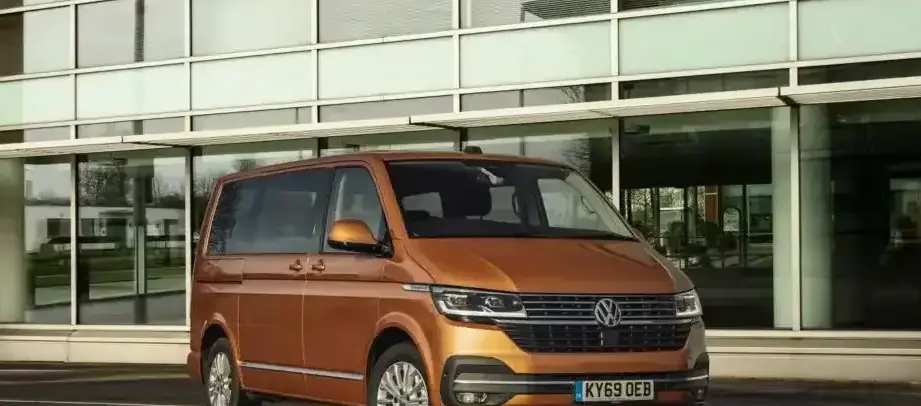
The Volkswagen Caravelle (T6.1), specifically the facelifted version introduced in 2019, represents a significant evolution of Volkswagen’s popular multi-purpose vehicle (MPV). This variant, equipped with a 2.0-liter TDI engine producing 199 horsepower and paired with a 4MOTION all-wheel-drive system and a 7-speed DSG (Direct-Shift Gearbox) transmission, occupied a premium position within the Caravelle lineup. Production of this specific configuration ran from 2019 to 2021, catering to buyers seeking a blend of performance, practicality, and all-weather capability in a spacious package. The T6.1 generation itself was a comprehensive refresh of the T6, bringing updated styling, improved technology, and enhanced efficiency.
Technical Specifications
| Brand | Volkswagen |
| Model | Caravelle |
| Generation | Caravelle (T6.1, facelift 2019) |
| Type (Engine) | 2.0 TDI (199 Hp) 4MOTION DSG |
| Start of production | 2019 |
| End of production | 2021 |
| Powertrain Architecture | Internal Combustion engine |
| Body type | Van |
| Seats | 4-9 |
| Doors | 4-5 |
| Fuel consumption (urban) | 8.2-9.1 l/100 km (28.7 – 25.8 US mpg, 34.4 – 31 UK mpg, 12.2 – 11 km/l) |
| Fuel consumption (extra urban) | 6.2-7.3 l/100 km (37.9 – 32.2 US mpg, 45.6 – 38.7 UK mpg, 16.1 – 13.7 km/l) |
| Fuel consumption (combined) | 7-7.9 l/100 km (33.6 – 29.8 US mpg, 40.4 – 35.8 UK mpg, 14.3 – 12.7 km/l) |
| CO2 emissions | 184-208 g/km |
| Fuel Type | Diesel |
| Acceleration 0 – 100 km/h | 9.8 sec |
| Acceleration 0 – 62 mph | 9.8 sec |
| Acceleration 0 – 60 mph | 9.3 sec |
| Maximum speed | 198 km/h (123.03 mph) |
| Emission standard | Euro 6d TEMP-EVAP-ISC |
| Weight-to-power ratio | 10.9 kg/Hp, 91.9 Hp/tonne |
| Weight-to-torque ratio | 4.8 kg/Nm, 207.8 Nm/tonne |
| Power | 199 Hp @ 3800-4000 rpm |
| Torque | 450 Nm @ 1400-2400 rpm (331.9 lb.-ft. @ 1400-2400 rpm) |
| Engine layout | Front, Transverse |
| Engine Model/Code | EA288 / CXEC |
| Engine displacement | 1968 cm3 (120.09 cu. in.) |
| Number of cylinders | 4 |
| Engine configuration | Inline |
| Cylinder Bore | 81 mm (3.19 in.) |
| Piston Stroke | 95.5 mm (3.76 in.) |
| Compression ratio | 15.5:1 |
| Number of valves per cylinder | 4 |
| Fuel injection system | Diesel Commonrail |
| Engine aspiration | BiTurbo, Intercooler |
| Valvetrain | DOHC |
| Engine oil capacity | 7.4 l (7.82 US qt | 6.51 UK qt) |
| Kerb Weight | 2166-2404 kg (4775.21 – 5299.91 lbs.) |
| Max. weight | 3080-3200 kg (6790.24 – 7054.79 lbs.) |
| Max load | 796-914 kg (1754.88 – 2015.03 lbs.) |
| Trunk (boot) space – maximum | 5800 l (204.83 cu. ft.) |
| Fuel tank capacity | 70 l (18.49 US gal | 15.4 UK gal) |
| AdBlue tank | 13 l (3.43 US gal | 2.86 UK gal) |
| Max. roof load | 100 kg (220.46 lbs.) |
| Permitted trailer load with brakes (12%) | 2500 kg (5511.56 lbs.) |
| Permitted trailer load without brakes | 750 kg (1653.47 lbs.) |
| Permitted towbar download | 100 kg (220.46 lbs.) |
| Length | 4904 mm (193.07 in.) |
| Width | 1904 mm (74.96 in.) |
| Width including mirrors | 2297 mm (90.43 in.) |
| Height | 1970-1990 mm (77.56 – 78.35 in.) |
| Wheelbase | 3000 mm (118.11 in.) |
| Front overhang | 906 mm (35.67 in.) |
| Rear overhang | 998 mm (39.29 in.) |
| Ride height (ground clearance) | 193-201 mm (7.6 – 7.91 in.) |
| Minimum turning circle (turning diameter) | 11.9 m (39.04 ft.) |
| Drivetrain Architecture | All wheel drive (4×4). Internal Combustion engine. |
| Number of gears and type of gearbox | 7 gears, automatic transmission DSG |
| Front suspension | Independent, type McPherson with coil spring and anti-roll bar |
| Rear suspension | Independent coil spring, Wishbone, Transverse stabilizer |
| Front brakes | Ventilated discs, 340×32.5 mm |
| Rear brakes | Ventilated discs, 294×22 mm |
| Tires size | 215/60 R17; 235/55 R17; 255/45 R18 |
| Wheel rims size | 7J x 17; 8J x 18 |
Powertrain & Engine Architecture
At the heart of this Caravelle variant lies the EA288 series 2.0-liter turbocharged diesel engine, specifically the CXEC code. This engine is a four-cylinder, inline configuration featuring a common-rail direct injection system and a sophisticated bi-turbocharger setup. The bi-turbo design employs two turbochargers – a smaller, more responsive unit for low-end torque and a larger one for high-end power. This configuration delivers a broad torque curve, peaking at 450 Nm (331.9 lb-ft) between 1400 and 2400 rpm, and a maximum power output of 199 horsepower at 3800-4000 rpm. The engine also incorporates an intercooler to further enhance efficiency and power. The 7-speed DSG transmission provides quick and smooth gear changes, optimizing performance and fuel economy. The 4MOTION all-wheel-drive system utilizes a Haldex clutch to distribute power between the front and rear axles as needed, providing enhanced traction and stability in various driving conditions.
Driving Characteristics
The 199 hp 2.0 TDI engine, coupled with the DSG transmission and 4MOTION system, delivers a refined and capable driving experience. While not overtly sporty, the Caravelle offers ample power for comfortable highway cruising and effortless overtaking. The DSG transmission’s quick shifts contribute to a responsive feel, and the 4MOTION system provides confident handling in inclement weather. Compared to lower-powered Caravelle variants, this version offers significantly improved acceleration and overall performance. The gear ratios are tuned for a balance between fuel efficiency and responsiveness, with the DSG intelligently selecting the optimal gear for the driving situation. It’s a noticeable step up from the base engine options, offering a more relaxed and confident driving experience, especially when fully loaded with passengers and luggage.
Equipment & Trim Levels
The 2.0 TDI 4MOTION DSG Caravelle typically came well-equipped, positioning it as a mid-to-high-range trim level. Standard features often included climate control, a touchscreen infotainment system with navigation, Bluetooth connectivity, and a multi-function steering wheel. Interior upholstery was typically a combination of cloth and leatherette, with options for full leather available. Additional features could include parking sensors, adaptive cruise control, and a panoramic sunroof. The Caravelle’s modular interior allowed for flexible seating configurations, accommodating up to nine passengers depending on the arrangement. Optional extras often included upgraded sound systems, rear entertainment systems, and various driver-assistance technologies.
Chassis & Braking
The Caravelle T6.1 utilizes an independent suspension setup on both the front and rear axles, providing a comfortable ride quality. The front suspension employs McPherson struts with coil springs and an anti-roll bar, while the rear features a multi-link setup with coil springs and a transverse stabilizer. This configuration helps to minimize body roll and maintain stability during cornering. Braking duties are handled by ventilated disc brakes on all four wheels, providing ample stopping power. The Caravelle also incorporates ABS (Anti-lock Braking System) and electronic stability control as standard safety features.
Market Reception & Comparison
The 2.0 TDI 4MOTION DSG Caravelle was generally well-received by automotive critics and buyers alike. It was praised for its blend of practicality, performance, and all-weather capability. Compared to the lower-powered diesel variants, this version offered a significant improvement in driving experience, making it a popular choice for those who frequently travel long distances or require a vehicle capable of handling challenging road conditions. Fuel economy was considered respectable for a vehicle of its size and weight, and the DSG transmission contributed to a smooth and efficient driving experience. Reliability was generally good, although, like any modern diesel, it was susceptible to issues with the diesel particulate filter (DPF) if not properly maintained.
Legacy
The 2.0 TDI engine in the Caravelle T6.1 has proven to be a relatively robust and reliable powertrain when properly maintained. The DSG transmission, while complex, is generally durable if serviced according to Volkswagen’s recommendations. On the used car market, these Caravelles hold their value reasonably well, particularly those with a full service history and low mileage. The combination of practicality, comfort, and all-wheel-drive capability continues to make them a desirable option for families and businesses seeking a versatile and dependable MPV. However, potential buyers should be aware of the potential for DPF issues and ensure that the vehicle has been regularly serviced to maintain optimal performance and longevity.