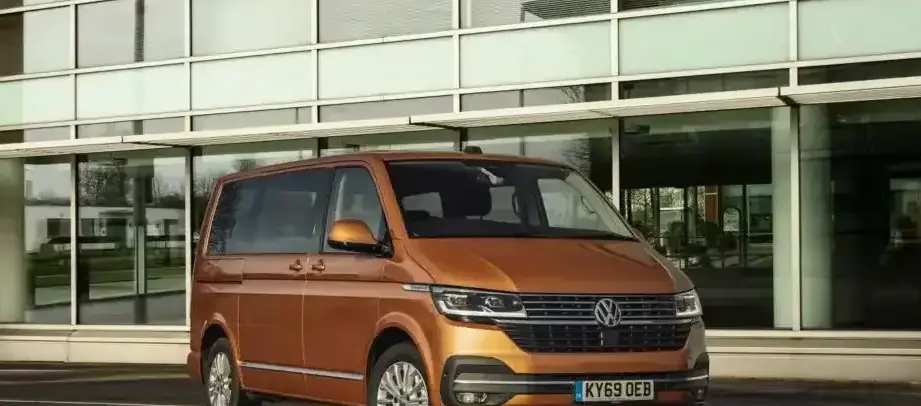
The Volkswagen Caravelle (T6.1), specifically the 2.0 TDI 199 horsepower variant equipped with a dual-clutch gearbox (DSG), represents a significant iteration of Volkswagen’s popular multi-purpose vehicle. Produced from 2019 to 2021, this version of the Caravelle falls within the T6.1 generation, a facelift of the T6, bringing updated styling, technology, and improved efficiency. Positioned as a mid-to-upper range offering within the Caravelle lineup, it catered to buyers seeking a balance of performance, comfort, and practicality for both family and commercial use. The T6.1 Caravelle continued Volkswagen’s tradition of providing a versatile vehicle suitable for passenger transport, leisure activities, and even light commercial applications, primarily in the European market.
Technical Specifications
| Brand | Volkswagen |
| Model | Caravelle |
| Generation | Caravelle (T6.1, facelift 2019) |
| Type (Engine) | 2.0 TDI (199 Hp) DSG |
| Start of production | 2019 |
| End of production | 2021 |
| Powertrain Architecture | Internal Combustion engine |
| Body type | Van |
| Seats | 4-9 |
| Doors | 4-5 |
| Fuel consumption (urban) | 7.3-8.2 l/100 km (32.2 – 28.7 US mpg) |
| Fuel consumption (extra urban) | 5.5-6.4 l/100 km (42.8 – 36.8 US mpg) |
| Fuel consumption (combined) | 6.2-7.1 l/100 km (37.9 – 33.1 US mpg) |
| CO2 emissions | 162-186 g/km |
| Fuel Type | Diesel |
| Acceleration 0 – 100 km/h | 9.3 sec |
| Acceleration 0 – 62 mph | 9.3 sec |
| Acceleration 0 – 60 mph | 8.8 sec |
| Maximum speed | 201 km/h (124.9 mph) |
| Emission standard | Euro 6d TEMP-EVAP-ISC |
| Weight-to-power ratio | 10.3 kg/Hp |
| Weight-to-torque ratio | 4.6 kg/Nm |
| Power | 199 Hp @ 3800-4000 rpm |
| Torque | 450 Nm @ 1400-2400 rpm (331.9 lb.-ft. @ 1400-2400 rpm) |
| Engine layout | Front, Transverse |
| Engine Model/Code | EA288 / CXEC |
| Engine displacement | 1968 cm3 (120.09 cu. in.) |
| Number of cylinders | 4 |
| Engine configuration | Inline |
| Cylinder Bore | 81 mm (3.19 in.) |
| Piston Stroke | 95.5 mm (3.76 in.) |
| Compression ratio | 15.5:1 |
| Number of valves per cylinder | 4 |
| Fuel injection system | Diesel Commonrail |
| Engine aspiration | BiTurbo, Intercooler |
| Valvetrain | DOHC |
| Engine oil capacity | 7.4 l (7.82 US qt | 6.51 UK qt) |
| Kerb Weight | 2056-2404 kg (4532.7 – 5299.91 lbs.) |
| Max. weight | 3080-3200 kg (6790.24 – 7054.79 lbs.) |
| Max load | 796-1024 kg (1754.88 – 2257.53 lbs.) |
| Trunk (boot) space – maximum | 5800 l (204.83 cu. ft.) |
| Fuel tank capacity | 70 l (18.49 US gal | 15.4 UK gal) |
| AdBlue tank | 13 l (3.43 US gal | 2.86 UK gal) |
| Max. roof load | 100 kg (220.46 lbs.) |
| Permitted trailer load with brakes (12%) | 2500 kg (5511.56 lbs.) |
| Permitted trailer load without brakes | 750 kg (1653.47 lbs.) |
| Permitted towbar download | 100 kg (220.46 lbs.) |
| Length | 4904 mm (193.07 in.) |
| Width | 1904 mm (74.96 in.) |
| Width including mirrors | 2297 mm (90.43 in.) |
| Height | 1970-1990 mm (77.56 – 78.35 in.) |
| Wheelbase | 3000 mm (118.11 in.) |
| Front overhang | 906 mm (35.67 in.) |
| Rear overhang | 998 mm (39.29 in.) |
| Ride height (ground clearance) | 193-201 mm (7.6 – 7.91 in.) |
| Minimum turning circle | 11.9 m (39.04 ft.) |
| Drivetrain Architecture | Front wheel drive |
| Number of gears and type of gearbox | 7 gears, automatic transmission DSG |
| Front suspension | Independent, type McPherson with coil spring and anti-roll bar |
| Rear suspension | Independent coil spring, Wishbone, Transverse stabilizer |
| Front brakes | Ventilated discs, 340×32.5 mm |
| Rear brakes | Ventilated discs, 294×22 mm |
| Tires size | 215/60 R17; 235/55 R17; 255/45 R18 |
| Wheel rims size | 7J x 17; 8J x 18 |
Powertrain & Engine Architecture
The heart of this Caravelle variant is the EA288 series 2.0-liter four-cylinder diesel engine, specifically the CXEC code. This engine utilizes a bi-turbocharger setup – a low-pressure turbo and a high-pressure turbo – working in tandem to deliver a broad torque curve and minimize turbo lag. The engine employs a common rail direct injection system, injecting fuel at extremely high pressures for optimized combustion. The DOHC (Double Overhead Camshaft) valvetrain, with four valves per cylinder, further enhances breathing and efficiency. The engine’s 15.5:1 compression ratio is typical for modern diesel engines, contributing to thermal efficiency. Paired with the engine is a 7-speed dual-clutch transmission (DSG). This transmission offers quick, smooth shifts and contributes to improved fuel economy compared to a traditional automatic transmission. The DSG’s programming is tuned for a balance between performance and efficiency, prioritizing smooth operation in everyday driving conditions.
Driving Characteristics
The 199 horsepower and 450 Nm (331.9 lb-ft) of torque provide the Caravelle with adequate performance for its size and weight. Acceleration from 0-60 mph takes approximately 8.8 seconds, and it reaches a top speed of 124.9 mph. While not a sports van, the engine delivers strong pulling power, making it comfortable for highway cruising and overtaking. The DSG transmission contributes to a responsive driving experience, with quick gear changes. Compared to lower-powered Caravelle variants, such as those with the 102 hp engine, this 199 hp version offers a significantly more relaxed and confident driving experience, especially when fully loaded with passengers and luggage. Compared to the higher-performance Caravelle models equipped with more powerful engines, this variant prioritizes fuel efficiency and refinement over outright speed.
Equipment & Trim Levels
The Caravelle T6.1 2.0 TDI 199 hp DSG typically came equipped with a generous level of standard features. These included air conditioning, power windows, central locking, and an infotainment system with a touchscreen display. Higher trim levels offered features such as navigation, parking sensors, adaptive cruise control, and leather upholstery. Interior appointments generally featured durable, high-quality materials. Optional extras included a panoramic sunroof, upgraded sound system, and various driver-assistance systems. The Caravelle’s modular seating arrangement allowed for flexible configurations, accommodating up to nine passengers depending on the chosen layout.
Chassis & Braking
The Caravelle T6.1 utilizes an independent suspension setup on both the front and rear axles. The front suspension employs McPherson struts with coil springs and an anti-roll bar, while the rear features a multi-link setup with coil springs and a transverse stabilizer. This suspension configuration provides a comfortable ride quality and good handling characteristics. Braking duties are handled by ventilated disc brakes on all four wheels, providing ample stopping power. Anti-lock braking system (ABS) is standard, enhancing safety and stability during emergency braking situations.
Market Reception & Comparison
The Caravelle T6.1 2.0 TDI 199 hp DSG was generally well-received by automotive critics. It was praised for its comfortable ride, spacious interior, and efficient engine. Fuel economy figures of 37.9 – 33.1 US mpg combined were considered respectable for a vehicle of its size and weight. Compared to the lower-powered Caravelle variants, this version offered a noticeable improvement in performance and refinement. However, some critics noted that the DSG transmission could occasionally feel hesitant at low speeds. Compared to petrol-powered alternatives, the diesel engine offered superior fuel economy and torque, making it a popular choice for long-distance travel.
Legacy
The EA288 engine, in its various iterations, has proven to be a reliable and durable powertrain. While diesel engines, in general, have faced increased scrutiny regarding emissions, the Caravelle T6.1 2.0 TDI 199 hp DSG remains a popular choice in the used car market. Regular maintenance, including timely oil changes and filter replacements, is crucial for ensuring the longevity of the engine and transmission. The DSG transmission, while generally reliable, may require servicing at specific intervals to prevent potential issues. Overall, this Caravelle variant represents a well-rounded and practical vehicle that continues to offer a compelling combination of space, comfort, and efficiency.