Technical Specifications
| Brand | Volkswagen |
| Model | Caravelle |
| Generation | Caravelle (T7) |
| Type (Engine) | 2.0 TDI (110 Hp) |
| Start of production | August, 2024 |
| Powertrain Architecture | Internal Combustion engine |
| Body type | Van |
| Seats | 8-9 |
| Doors | 4-5 |
| Combined fuel consumption (WLTP) | 7.2-7.4 l/100 km |
| Combined fuel consumption (US mpg) | 32.7 – 31.8 |
| Combined fuel consumption (UK mpg) | 39.2 – 38.2 |
| Combined fuel consumption (km/l) | 13.9 – 13.5 |
| CO2 emissions (WLTP) | 189-193 g/km |
| Fuel Type | Diesel |
| Acceleration 0 – 100 km/h | 16.9 sec |
| Acceleration 0 – 62 mph | 16.9 sec |
| Acceleration 0 – 60 mph | 16.1 sec |
| Maximum speed | 155 km/h (96.31 mph) |
| Emission standard | Euro 6e |
| Weight-to-power ratio | 19.2 kg/Hp, 52 Hp/tonne |
| Weight-to-torque ratio | 6.8 kg/Nm, 146.5 Nm/tonne |
| Power | 110 Hp |
| Power per litre | 55.1 Hp/l |
| Torque | 310 Nm (228.64 lb.-ft.) |
| Engine layout | Front, Transverse |
| Engine Model/Code | Panther |
| Engine displacement | 1996 cm3 (121.8 cu. in.) |
| Number of cylinders | 4 |
| Engine configuration | Inline |
| Cylinder Bore | 84.01 mm (3.31 in.) |
| Piston Stroke | 90.03 mm (3.54 in.) |
| Number of valves per cylinder | 4 |
| Fuel injection system | Diesel Commonrail |
| Engine aspiration | Turbocharger, Intercooler |
| Valvetrain | DOHC |
| Engine systems | Start & Stop System, Particulate filter |
| Kerb Weight | 2116-2178 kg (4664.98 – 4801.67 lbs.) |
| Max. weight | 3100-3110 kg (6834.33 – 6856.38 lbs.) |
| Max load | 932-984 kg (2054.71 – 2169.35 lbs.) |
| Fuel tank capacity | 55 l (14.53 US gal | 12.1 UK gal) |
| AdBlue tank | 20 l (5.28 US gal | 4.4 UK gal) |
| Max. roof load | 170 kg (374.79 lbs.) |
| Permitted trailer load with brakes (12%) | 2000 kg (4409.25 lbs.) |
| Permitted trailer load without brakes | 750 kg (1653.47 lbs.) |
| Permitted towbar download | 100 kg (220.46 lbs.) |
| Length | 5050 mm (198.82 in.) |
| Width | 2032 mm (80 in.) |
| Width including mirrors | 2275 mm (89.57 in.) |
| Height | 1980 mm (77.95 in.) |
| Wheelbase | 3100 mm (122.05 in.) |
| Front overhang | 958 mm (37.72 in.) |
| Rear overhang | 992 mm (39.06 in.) |
| Minimum turning circle | 12.5 m (41.01 ft.) |
| Approach angle | 16.5° |
| Departure angle | 16.4° |
| Ramp-over angle | 13.1° |
| Drivetrain Architecture | ICE, Front wheel drive |
| Number of gears | 6 |
| Gearbox type | Manual transmission |
| Assisting systems | ABS (Anti-lock braking system) |
| Steering type | Steering rack and pinion |
| Power steering | Electric Steering |
| Tires size | 215/65 R16; 215/60 R17 |
| Wheel rims size | 6.5J x 16; 6.5J x 17 |
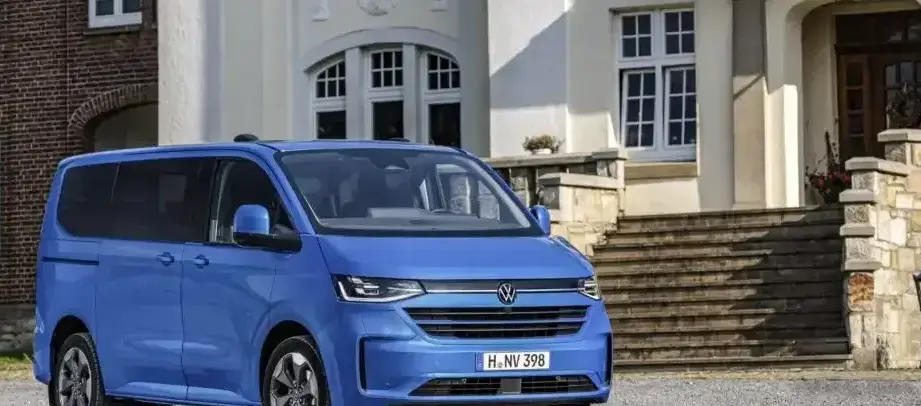
The Volkswagen Caravelle (T7) 2.0 TDI 110 hp represents an entry-level configuration within the seventh generation of Volkswagen’s popular multi-purpose vehicle (MPV), launched in August 2024. Positioned as a practical and economical option for families and commercial use, this variant focuses on fuel efficiency and affordability within the T7 range. The T7 Caravelle builds upon the foundation of the Volkswagen Transporter/Caravelle/Multivan lineage, offering a blend of passenger comfort and cargo versatility. It shares its platform with other Volkswagen Group vehicles, leveraging modular construction for cost-effectiveness and adaptability.
Powertrain & Engine Architecture
The Caravelle T7 2.0 TDI 110 hp utilizes the Volkswagen Group’s Panther engine, a 2.0-liter inline four-cylinder diesel engine. This engine is a member of the EA288 family, known for its robust construction and efficiency. The engine employs a turbocharger with an intercooler to enhance power output and improve combustion efficiency. Fuel is delivered via a common rail direct injection system, allowing for precise fuel metering and optimized combustion. The engine features a Double Overhead Camshaft (DOHC) valvetrain with four valves per cylinder, contributing to improved breathing and power delivery. A diesel particulate filter (DPF) and a Start/Stop system are standard, aligning with Euro 6e emission standards. The engine is transversely mounted at the front of the vehicle. This specific 110 hp variant is paired with a 6-speed manual transmission, prioritizing fuel economy over outright performance.
Driving Characteristics
The 110 hp 2.0 TDI engine, coupled with the manual transmission, delivers adequate performance for everyday driving and moderate loads. Acceleration is not its strong suit, with a 0-60 mph time of around 16.1 seconds. However, the engine provides a usable 310 Nm (228.64 lb-ft) of torque, which is available from relatively low engine speeds. This torque makes it suitable for carrying passengers and cargo, even on inclines. The manual gearbox allows for driver control and optimization of fuel efficiency. Compared to higher-output TDI variants (like the 150 hp or 200 hp versions), this configuration prioritizes fuel economy and lower running costs. The gear ratios are tuned for efficiency, resulting in a comfortable cruising experience but requiring more frequent gear changes during acceleration.
Equipment & Trim Levels
The Caravelle T7 2.0 TDI 110 hp typically comes with a base level of equipment focused on practicality. Standard features generally include air conditioning, power windows, central locking, and a basic audio system. Interior upholstery is typically cloth, with durable and easy-to-clean materials. The dashboard layout is functional and straightforward. Optional extras available for this trim level often include upgraded infotainment systems with touchscreen displays, navigation, parking sensors, cruise control, and alloy wheels. Higher trim levels within the T7 range offer more luxurious features like leather upholstery, heated seats, and advanced driver-assistance systems.
Chassis & Braking
The T7 Caravelle utilizes a front-wheel-drive layout with a MacPherson strut front suspension and a semi-independent rear suspension. The rear suspension often features coil springs and shock absorbers. Braking systems typically consist of disc brakes on the front wheels and drum brakes on the rear wheels, although some configurations may feature rear disc brakes. Anti-lock Braking System (ABS) is standard. Stabilizer bars are included to reduce body roll during cornering. The suspension is tuned for a balance between comfort and handling, prioritizing ride quality for passengers.
Market Reception & Comparison
The Caravelle T7 2.0 TDI 110 hp variant is generally viewed as a sensible and economical choice for those prioritizing fuel efficiency and practicality. Critics acknowledge its adequate performance for everyday use but note its lack of outright speed compared to more powerful versions. Fuel economy is a key strength, with combined consumption figures ranging from 7.2 to 7.4 l/100 km. Compared to the higher-output TDI models, this variant offers a lower purchase price and running costs, making it attractive to budget-conscious buyers. The manual transmission is appreciated by drivers who prefer more control, but some may find it less convenient than an automatic gearbox.
Legacy
The EA288 engine family, including the Panther engine used in the Caravelle T7 2.0 TDI 110 hp, has a reputation for reliability when properly maintained. Regular servicing, including oil changes and DPF maintenance, is crucial for long-term durability. In the used car market, this variant is likely to appeal to buyers seeking a practical and affordable MPV with reasonable fuel economy. Its relatively simple mechanical design may also make it easier and less expensive to repair compared to more complex, higher-tech models. The T7 Caravelle continues Volkswagen’s tradition of providing versatile and dependable multi-purpose vehicles for families and businesses.