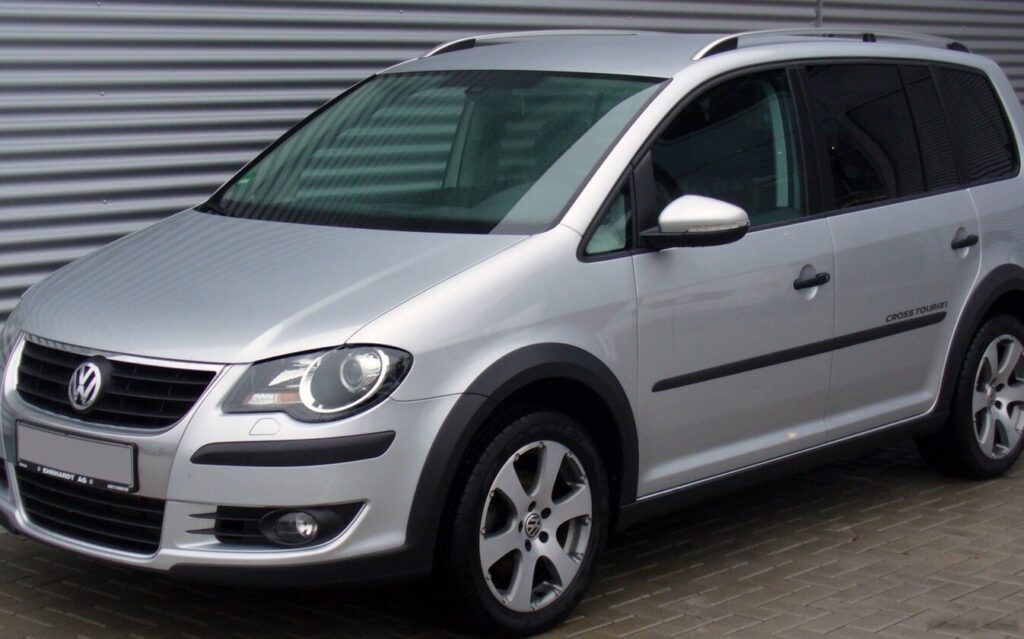
The Volkswagen Cross Touran I 1.4 TSI (140 hp) 7-Speed DSG, produced from 2009 to 2010, represented a key variant within the first generation of the Cross Touran line. Positioned as a mid-range offering, it aimed to bridge the gap between the more economical base models and the higher-performance versions. Built on the Volkswagen Group’s A5 (1HX0) platform – shared with the Golf Mk5 and Touran – the Cross Touran sought to blend the practicality of a compact minivan with a slightly more rugged aesthetic and enhanced versatility. This particular engine and transmission combination was popular in European markets, offering a balance of fuel efficiency and acceptable performance for family transport.
Technical Specifications
| Brand | Volkswagen |
| Model | Touran |
| Generation | Cross Touran I |
| Type (Engine) | 1.4 TSI (140 Hp) 7 DSG |
| Start of production | 2009 |
| End of production | 2010 |
| Powertrain Architecture | Internal Combustion engine |
| Body type | Minivan |
| Seats | 5 |
| Doors | 5 |
| Fuel consumption (urban) | 8.6 l/100 km (27.4 US mpg, 32.8 UK mpg, 11.6 km/l) |
| Fuel consumption (extra urban) | 6.1 l/100 km (38.6 US mpg, 46.3 UK mpg, 16.4 km/l) |
| Fuel consumption (combined) | 7.1 l/100 km (33.1 US mpg, 39.8 UK mpg, 14.1 km/l) |
| CO2 emissions | 163 g/km |
| Fuel Type | Petrol (Gasoline) |
| Acceleration 0 – 100 km/h | 9.9 sec |
| Acceleration 0 – 62 mph | 9.9 sec |
| Acceleration 0 – 60 mph | 9.4 sec |
| Maximum speed | 192 km/h (119.3 mph) |
| Emission standard | Euro 5 |
| Weight-to-power ratio | 10.9 kg/Hp, 91.4 Hp/tonne |
| Weight-to-torque ratio | 7 kg/Nm, 143.6 Nm/tonne |
| Power | 140 Hp @ 5600 rpm |
| Power per litre | 100.7 Hp/l |
| Torque | 220 Nm @ 1250-4000 rpm (162.26 lb.-ft. @ 1250-4000 rpm) |
| Engine layout | Front, Transverse |
| Engine Model/Code | CAVC |
| Engine displacement | 1390 cm3 (84.82 cu. in.) |
| Number of cylinders | 4 |
| Engine configuration | Inline |
| Cylinder Bore | 76.5 mm (3.01 in.) |
| Piston Stroke | 75.6 mm (2.98 in.) |
| Compression ratio | 10.1:1 |
| Number of valves per cylinder | 4 |
| Fuel injection system | Direct injection |
| Engine aspiration | Turbocharging and Supercharger, Intercooler |
| Valvetrain | DOHC |
| Engine oil capacity | 3.6 l (3.8 US qt | 3.17 UK qt) |
| Kerb Weight | 1532 kg (3377.48 lbs.) |
| Max. weight | 2150 kg (4739.94 lbs.) |
| Max load | 618 kg (1362.46 lbs.) |
| Trunk (boot) space – minimum | 695 l (24.54 cu. ft.) |
| Trunk (boot) space – maximum | 1989 l (70.24 cu. ft.) |
| Fuel tank capacity | 60 l (15.85 US gal | 13.2 UK gal) |
| Max. roof load | 100 kg (220.46 lbs.) |
| Permitted trailer load with brakes (8%) | 1700 kg (3747.86 lbs.) |
| Permitted trailer load with brakes (12%) | 1500 kg (3306.93 lbs.) |
| Permitted trailer load without brakes | 750 kg (1653.47 lbs.) |
| Permitted towbar download | 75 kg (165.35 lbs.) |
| Length | 4407 mm (173.5 in.) |
| Width | 1799 mm (70.83 in.) |
| Width including mirrors | 2047 mm (80.59 in.) |
| Height | 1670 mm (65.75 in.) |
| Wheelbase | 2677 mm (105.39 in.) |
| Front track | 1550 mm (61.02 in.) |
| Rear track | 1531 mm (60.28 in.) |
| Minimum turning circle | 11.2 m (36.75 ft.) |
| Front brakes | Ventilated discs |
| Rear brakes | Disc |
| Number of gears | 7 |
| Gearbox type | automatic transmission DSG |
Powertrain & Engine Architecture
The heart of the Cross Touran I 1.4 TSI was the CAVC engine code, a 1.4-liter turbocharged and supercharged four-cylinder gasoline engine. This engine was a marvel of engineering for its time, employing both a turbocharger and a supercharger to deliver a broad torque curve and minimize turbo lag. The supercharger provided instant boost at low engine speeds, while the turbocharger took over at higher RPMs for sustained power. Direct fuel injection further enhanced efficiency and performance. The engine produced 140 horsepower at 5600 rpm and 220 Nm (162 lb-ft) of torque between 1250 and 4000 rpm. This power was channeled through a 7-speed dual-clutch gearbox (DSG), known for its quick and smooth shifts. The DSG transmission offered both automatic and manual shift modes, providing drivers with flexibility.
Driving Characteristics
The 1.4 TSI with the 7-speed DSG offered a reasonably sprightly driving experience for a minivan. Acceleration from 0 to 60 mph took around 9.4 seconds, and top speed was rated at 119.3 mph. While not a performance vehicle, the engine provided sufficient power for everyday driving and overtaking maneuvers. The DSG transmission contributed to a smooth and responsive feel, and the wide gear ratios helped to keep the engine in its optimal power band. Compared to the more powerful 1.8 TSI or diesel variants, the 1.4 TSI felt less effortless, particularly when fully loaded with passengers and luggage. However, it offered a noticeable improvement in fuel economy.
Equipment & Trim Levels
The Cross Touran I 1.4 TSI typically came with a decent level of standard equipment. This included air conditioning, alloy wheels, a CD stereo system, and electric windows. Safety features such as ABS, traction control, and multiple airbags were also standard. Optional extras included a sunroof, parking sensors, upgraded audio systems, and leather upholstery. The “Cross” designation added some visual differentiation with plastic cladding around the wheel arches and sills, giving it a slightly more rugged appearance. Interior trim levels varied, but generally featured cloth upholstery and a functional, if not luxurious, dashboard layout.
Chassis & Braking
The Cross Touran I featured an independent suspension setup, with McPherson struts at the front and a multi-link suspension at the rear. This provided a comfortable ride quality, although it wasn’t particularly sporty. Stabilizer bars were fitted to both axles to reduce body roll. The braking system consisted of ventilated discs at the front and solid discs at the rear. ABS (Anti-lock Braking System) was standard, providing enhanced stopping power and control.
Market Reception & Comparison
The Cross Touran I 1.4 TSI was generally well-received by automotive critics as a practical and versatile family vehicle. It was praised for its fuel efficiency, comfortable ride, and spacious interior. However, some reviewers noted that the 1.4 TSI engine could feel strained when carrying a full load or tackling steep hills. Compared to the 1.8 TSI, the 1.4 TSI offered lower running costs but less outright performance. The diesel variants (typically 1.9 TDI or 2.0 TDI) provided even better fuel economy and torque, but at the expense of refinement and potential maintenance costs associated with diesel particulate filters.
Legacy
The 1.4 TSI engine, particularly in its earlier iterations, had a reputation for occasional issues with carbon buildup on the intake valves, which could lead to rough running and reduced performance. Regular servicing and the use of quality fuel were essential to mitigate this risk. The DSG transmission, while generally reliable, also required regular fluid changes to ensure smooth operation. Despite these potential issues, the Cross Touran I 1.4 TSI remains a popular choice in the used car market, offering a good balance of practicality, fuel efficiency, and affordability. Its robust construction and relatively simple mechanicals make it a reasonably reliable option for families seeking a versatile and economical minivan.