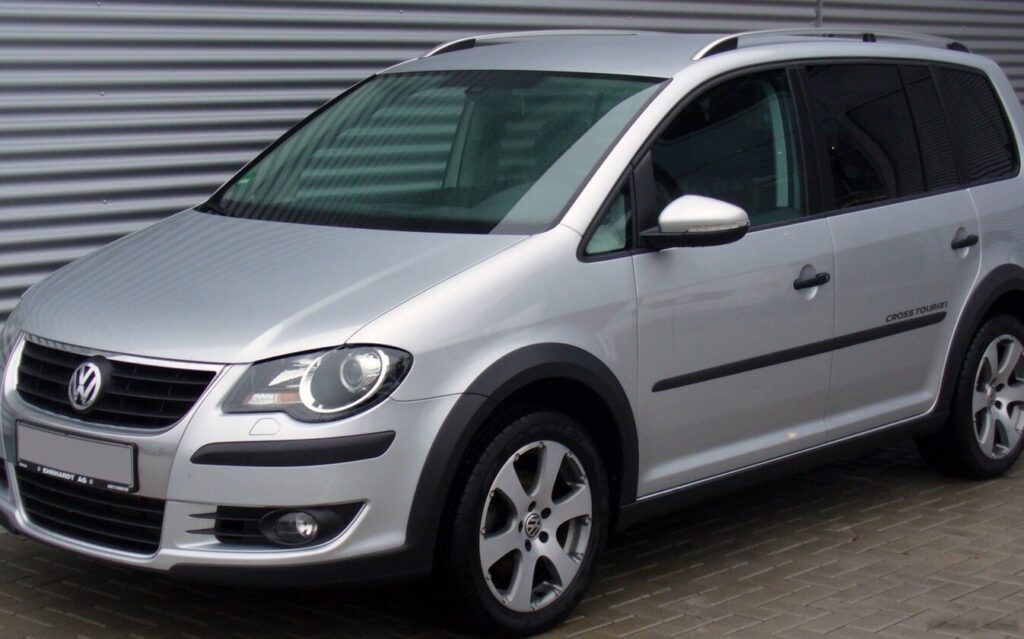
The Volkswagen Cross Touran I 1.4 TSI (170 hp) 7-Speed DSG, produced from 2009 to 2010, represented a versatile offering within the first generation of the Cross Touran line. Positioned as a mid-range trim, it aimed to bridge the gap between more economical engine options and the higher-performance variants. Built on the Volkswagen Group’s A5 (1HX0) platform, shared with models like the Touran, Golf, and Audi A3, the Cross Touran sought to combine the practicality of a compact minivan with a slightly more rugged aesthetic and enhanced driving dynamics. This variant was primarily marketed in Europe, where compact MPVs were highly popular, offering a blend of space, fuel efficiency, and modern technology.
Technical Specifications
| Brand | Volkswagen |
| Model | Touran |
| Generation | Cross Touran I |
| Type (Engine) | 1.4 TSI (170 Hp) 7 DSG |
| Start of production | 2009 |
| End of production | 2010 |
| Powertrain Architecture | Internal Combustion engine |
| Body type | Minivan |
| Seats | 5 |
| Doors | 5 |
| Fuel consumption (urban) | 8.6 l/100 km (27.4 US mpg) |
| Fuel consumption (extra urban) | 6.1 l/100 km (38.6 US mpg) |
| Fuel consumption (combined) | 7.1 l/100 km (33.1 US mpg) |
| CO2 emissions | 163 g/km |
| Fuel Type | Petrol (Gasoline) |
| Acceleration 0 – 100 km/h | 8.7 sec |
| Acceleration 0 – 62 mph | 8.7 sec |
| Acceleration 0 – 60 mph | 8.3 sec |
| Maximum speed | 206 km/h (128 mph) |
| Emission standard | Euro 5 |
| Weight-to-power ratio | 9 kg/Hp |
| Weight-to-torque ratio | 6.4 kg/Nm |
| Power | 170 Hp @ 6000 rpm |
| Torque | 240 Nm @ 1500-4500 rpm (177.01 lb.-ft.) |
| Engine layout | Front, Transverse |
| Engine Model/Code | CAVB, CTHB |
| Engine displacement | 1390 cm3 (84.82 cu. in.) |
| Number of cylinders | 4 |
| Engine configuration | Inline |
| Cylinder Bore | 76.5 mm (3.01 in.) |
| Piston Stroke | 75.6 mm (2.98 in.) |
| Number of valves per cylinder | 4 |
| Fuel injection system | Direct injection |
| Engine aspiration | Turbocharging and Supercharger, Intercooler |
| Valvetrain | DOHC |
| Engine oil capacity | 3.6 l (3.8 US qt | 3.17 UK qt) |
| Kerb Weight | 1536 kg (3386.3 lbs.) |
| Max. weight | 2150 kg (4739.94 lbs.) |
| Max load | 614 kg (1353.64 lbs.) |
| Trunk (boot) space – minimum | 695 l (24.54 cu. ft.) |
| Trunk (boot) space – maximum | 1989 l (70.24 cu. ft.) |
| Fuel tank capacity | 60 l (15.85 US gal | 13.2 UK gal) |
| Max. roof load | 100 kg (220.46 lbs.) |
| Permitted trailer load with brakes (8%) | 1700 kg (3747.86 lbs.) |
| Permitted trailer load with brakes (12%) | 1500 kg (3306.93 lbs.) |
| Permitted trailer load without brakes | 750 kg (1653.47 lbs.) |
| Permitted towbar download | 75 kg (165.35 lbs.) |
| Length | 4407 mm (173.5 in.) |
| Width | 1799 mm (70.83 in.) |
| Width including mirrors | 2047 mm (80.59 in.) |
| Height | 1670 mm (65.75 in.) |
| Wheelbase | 2677 mm (105.39 in.) |
| Front track | 1550 mm (61.02 in.) |
| Rear track | 1531 mm (60.28 in.) |
| Minimum turning circle | 11.2 m (36.75 ft.) |
| Front brakes | Ventilated discs |
| Rear brakes | Disc |
| Number of gears | 7 |
| Gearbox type | Automatic transmission DSG |
Powertrain & Engine Architecture
The heart of the Cross Touran I 1.4 TSI was the CAVB or CTHB engine code, a 1.4-liter inline-four cylinder gasoline engine. This engine was notable for its combination of turbocharging and supercharging – a relatively uncommon setup. The supercharger provided immediate boost at low engine speeds, eliminating turbo lag, while the turbocharger took over at higher RPMs for sustained power delivery. Direct fuel injection further enhanced efficiency and performance. The engine produced 170 horsepower at 6000 rpm and 240 Nm (177 lb-ft) of torque between 1500 and 4500 rpm. This power was channeled through a 7-speed dual-clutch gearbox (DSG), known for its quick and smooth shifts. The DSG transmission offered both automatic and manual shift modes, providing drivers with flexibility.
Driving Characteristics
The 1.4 TSI with the 7-speed DSG offered a good balance between performance and fuel economy. Acceleration from 0 to 100 km/h (0-62 mph) took approximately 8.7 seconds, making it reasonably quick for a compact MPV. The DSG transmission contributed to a responsive driving experience, with minimal interruption in power delivery during gear changes. Compared to the base 1.6-liter engine, the 1.4 TSI provided a noticeable increase in power and torque, making it more suitable for highway driving and carrying a full load of passengers. However, it didn’t offer the same level of outright performance as the 2.0-liter TDI diesel variants. The gear ratios in the DSG were tuned for a blend of acceleration and fuel efficiency, with taller gears for relaxed cruising.
Equipment & Trim Levels
The Cross Touran I 1.4 TSI typically came equipped with a respectable level of standard features. These included air conditioning, power windows, power mirrors, a CD/radio system, and alloy wheels. Safety features such as ABS, electronic stability control, and multiple airbags were also standard. Optional extras included a sunroof, navigation system, parking sensors, and upgraded upholstery. The interior typically featured cloth upholstery, with the option of leather upgrades. The dashboard layout was functional and straightforward, typical of Volkswagen’s design philosophy at the time.
Chassis & Braking
The Cross Touran I featured an independent suspension setup, with McPherson struts at the front and a multi-link suspension at the rear. This provided a comfortable ride quality and decent handling characteristics. Stabilizer bars were fitted to both axles to reduce body roll during cornering. The braking system consisted of ventilated discs at the front and solid discs at the rear. ABS (Anti-lock Braking System) was standard, enhancing braking performance and stability. The suspension was tuned to prioritize comfort and practicality, rather than outright sportiness.
Market Reception & Comparison
The Cross Touran I 1.4 TSI was generally well-received by automotive critics. It was praised for its refined engine, smooth-shifting DSG transmission, and spacious interior. Fuel economy was considered competitive for its class. However, some critics noted that the engine could feel strained when fully loaded or driving uphill. Compared to the diesel variants, the 1.4 TSI offered less torque and slightly lower fuel economy, but it was quieter and smoother in operation. Against competitors like the Renault Scenic and Citroën C4 Picasso, the Cross Touran offered a more premium feel and a reputation for build quality.
Legacy
The 1.4 TSI engine, in various iterations, proved to be a relatively reliable powertrain when properly maintained. The DSG transmission, while sophisticated, could be prone to issues if not serviced according to Volkswagen’s recommendations. Today, used examples of the Cross Touran I 1.4 TSI are relatively affordable and can represent a good value for buyers seeking a practical and versatile MPV. Regular maintenance, including oil changes and DSG servicing, is crucial to ensure long-term reliability. The combination of a turbocharged engine, DSG transmission, and spacious interior continues to make this variant an appealing option in the used car market.