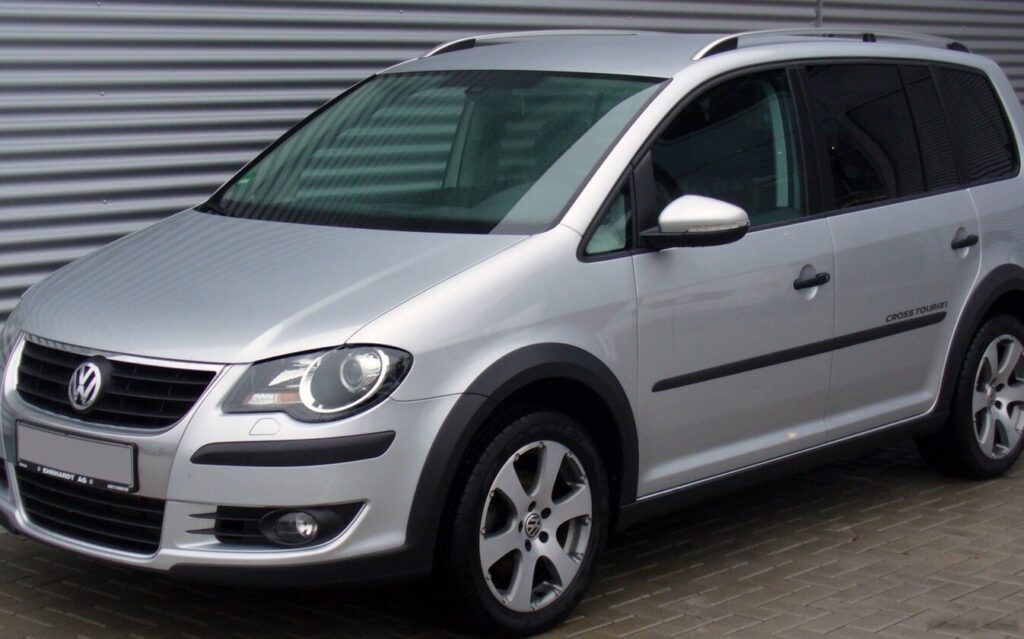
The Volkswagen Cross Touran I 1.9 TDI (105 hp) 7-speed DSG was a variant of the first-generation Cross Touran, produced between 2008 and 2010. Positioned as a mid-range offering within the Cross Touran lineup, it aimed to provide a balance between fuel efficiency, practicality, and a slightly more rugged aesthetic compared to the standard Touran. The Cross Touran itself was a derivative of the fifth-generation Golf (Mk5) and Touran, sharing the 1HX0/A3 platform, and distinguished by its raised ride height, plastic body cladding, and available all-wheel drive on other engine configurations. This particular 1.9 TDI variant was exclusively front-wheel drive.
Technical Specifications
| Brand | Volkswagen |
| Model | Touran |
| Generation | Cross Touran I |
| Type (Engine) | 1.9 TDI (105 Hp) 7 DSG |
| Start of production | 2008 |
| End of production | 2010 |
| Powertrain Architecture | Internal Combustion engine |
| Body type | Minivan |
| Seats | 5 |
| Doors | 5 |
| Fuel consumption (urban) | 7 l/100 km (33.6 US mpg, 40.4 UK mpg, 14.3 km/l) |
| Fuel consumption (extra urban) | 5.2 l/100 km (45.2 US mpg, 54.3 UK mpg, 19.2 km/l) |
| Fuel consumption (combined) | 5.8 l/100 km (40.6 US mpg, 48.7 UK mpg, 17.2 km/l) |
| CO2 emissions | 154 g/km |
| Fuel Type | Diesel |
| Acceleration 0 – 100 km/h | 13.5 sec |
| Acceleration 0 – 62 mph | 13.5 sec |
| Acceleration 0 – 60 mph | 12.8 sec |
| Maximum speed | 175 km/h (108.74 mph) |
| Emission standard | Euro 4 |
| Weight-to-power ratio | 15 kg/Hp, 66.9 Hp/tonne |
| Weight-to-torque ratio | 6.3 kg/Nm, 159.2 Nm/tonne |
| Power | 105 Hp @ 4000 rpm |
| Power per litre | 55.4 Hp/l |
| Torque | 250 Nm @ 1900 rpm (184.39 lb.-ft. @ 1900 rpm) |
| Engine layout | Front, Transverse |
| Engine Model/Code | EA188 / BLS |
| Engine displacement | 1896 cm3 (115.7 cu. in.) |
| Number of cylinders | 4 |
| Engine configuration | Inline |
| Cylinder Bore | 79.5 mm (3.13 in.) |
| Piston Stroke | 95.5 mm (3.76 in.) |
| Compression ratio | 19:1 |
| Number of valves per cylinder | 2 |
| Fuel injection system | Pump-nozzle (Unit Injector) |
| Engine aspiration | Turbocharger, Intercooler |
| Valvetrain | SOHC |
| Engine oil capacity | 4.3 l (4.54 US qt | 3.78 UK qt) |
| Coolant | 8 l (8.45 US qt | 7.04 UK qt) |
| Kerb Weight | 1570 kg (3461.26 lbs.) |
| Max. weight | 2200 kg (4850.17 lbs.) |
| Max load | 630 kg (1388.91 lbs.) |
| Trunk (boot) space – minimum | 695 l (24.54 cu. ft.) |
| Trunk (boot) space – maximum | 1989 l (70.24 cu. ft.) |
| Fuel tank capacity | 60 l (15.85 US gal | 13.2 UK gal) |
| Max. roof load | 100 kg (220.46 lbs.) |
| Permitted trailer load with brakes (8%) | 1800 kg (3968.32 lbs.) |
| Permitted trailer load with brakes (12%) | 1500 kg (3306.93 lbs.) |
| Permitted trailer load without brakes | 750 kg (1653.47 lbs.) |
| Permitted towbar download | 75 kg (165.35 lbs.) |
| Length | 4407 mm (173.5 in.) |
| Width | 1799 mm (70.83 in.) |
| Width including mirrors | 2047 mm (80.59 in.) |
| Height | 1670 mm (65.75 in.) |
| Wheelbase | 2677 mm (105.39 in.) |
| Front track | 1550 mm (61.02 in.) |
| Rear track | 1531 mm (60.28 in.) |
| Minimum turning circle | 11.2 m (36.75 ft.) |
| Front suspension | Independent type McPherson, Transverse stabilizer |
| Rear suspension | Independent multi-link suspension, Transverse stabilizer |
| Front brakes | Ventilated discs |
| Rear brakes | Disc |
| Gearbox | 7 gears, automatic transmission DSG |
| Front tires | 215/50 R17 |
| Rear tires | 235/45 R17 |
Powertrain & Engine Architecture
The heart of this Cross Touran variant was the 1.9-liter (1896 cc) inline-four cylinder diesel engine, designated the EA188 BLS. This engine was a mainstay in the Volkswagen Group’s lineup for several years, known for its durability and relatively good fuel economy. It featured a single overhead camshaft (SOHC) valvetrain with two valves per cylinder. The BLS engine utilized a pump-nozzle (unit injector) fuel injection system, a technology that allowed for precise fuel delivery and contributed to its efficiency. A turbocharger with an intercooler was employed to boost power output. The engine produced 105 horsepower at 4000 rpm and 250 Nm (184 lb-ft) of torque at 1900 rpm. The engine was transversely mounted in the front of the vehicle.
The engine was paired with a 7-speed dual-clutch gearbox (DSG). This transmission offered quicker and smoother shifts compared to a traditional automatic transmission, and also contributed to improved fuel efficiency. The DSG’s gear ratios were tuned to prioritize fuel economy and drivability, rather than outright performance.
Driving Characteristics
The 1.9 TDI with the 7-speed DSG delivered adequate, but not exhilarating, performance. Acceleration from 0 to 60 mph took around 12.8-13.5 seconds, and the top speed was 175 km/h (108.74 mph). The DSG transmission helped to keep the engine in its optimal power band, but the relatively low horsepower output meant that overtaking maneuvers required careful planning. Compared to the more powerful 2.0 TDI variants, this 1.9 TDI felt noticeably slower. However, the DSG transmission provided a more refined driving experience than the manual transmission options available on other trims. The focus was on usability and fuel efficiency, making it well-suited for everyday driving and longer journeys.
Equipment & Trim Levels
The Cross Touran I 1.9 TDI 7 DSG typically came with a reasonable level of standard equipment. This included air conditioning, power windows, central locking, and an audio system. The interior featured cloth upholstery, and the dashboard layout was typical of early 2000s Volkswagens – functional and relatively understated. Optional extras included alloy wheels, a sunroof, parking sensors, and upgraded audio systems. The “Cross” designation added some unique exterior touches, such as plastic body cladding and silver-colored roof rails, giving it a slightly more rugged appearance.
Chassis & Braking
The Cross Touran I featured independent suspension all around – McPherson struts at the front and a multi-link setup at the rear. This provided a comfortable ride quality, although the raised ride height of the Cross Touran did result in slightly more body roll in corners compared to the standard Touran. The braking system consisted of ventilated discs at the front and solid discs at the rear. Anti-lock braking system (ABS) was standard. The steering was rack and pinion with electric power assistance.
Market Reception & Comparison
The 1.9 TDI 7 DSG Cross Touran was generally well-received by critics as a practical and fuel-efficient family vehicle. It was praised for its comfortable ride, spacious interior, and the convenience of the DSG transmission. However, some reviewers noted that the engine lacked outright power, particularly when fully loaded. Compared to the 2.0 TDI variants, the 1.9 TDI offered better fuel economy but less performance. It was often seen as a good choice for drivers who prioritized economy and practicality over sporty driving dynamics.
Legacy
The 1.9 TDI engine, particularly the BLS code, gained a reputation for being robust and reliable, provided it was properly maintained. The DSG transmission, while offering a superior driving experience, could be prone to issues if not serviced according to Volkswagen’s recommendations. Today, used examples of the Cross Touran I 1.9 TDI 7 DSG are relatively affordable and can represent good value for money. However, potential buyers should be aware of the potential maintenance costs associated with the DSG transmission and ensure that the vehicle has been well-maintained throughout its life. The engine’s durability means that many examples are still on the road today, serving as a testament to its engineering.