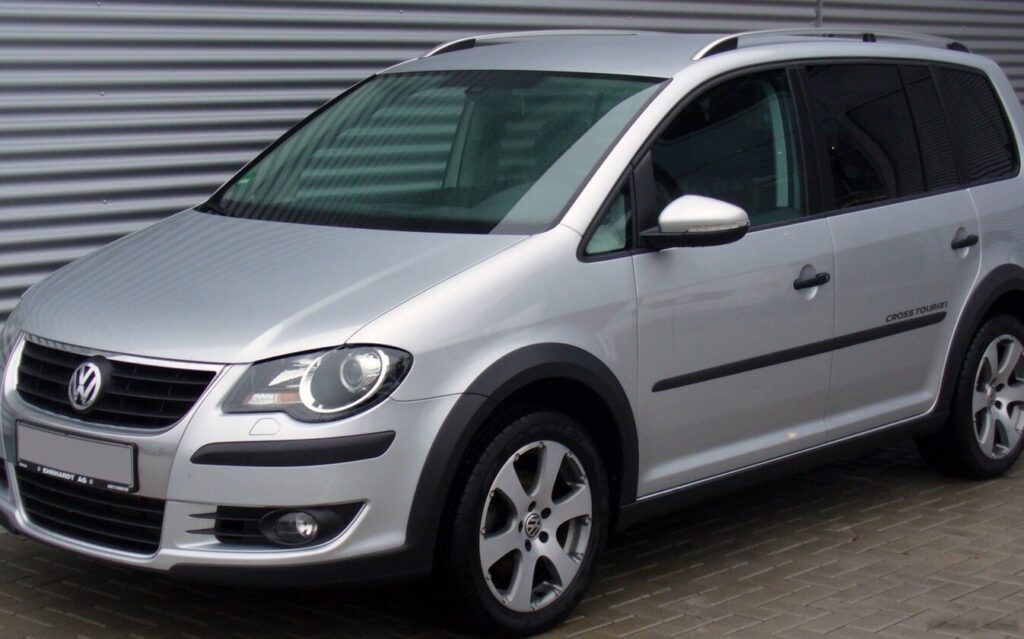
The Volkswagen Cross Touran I 2.0 TDI (140 hp) was a variant of the first-generation Cross Touran, produced between 2007 and 2010. Positioned as a mid-range offering within the Cross Touran lineup, it aimed to bridge the gap between more economical engine options and the higher-performance variants. The Cross Touran itself was a ruggedized version of the standard Touran MPV, featuring increased ground clearance, body cladding, and available all-wheel drive – though this specific 2.0 TDI model was typically front-wheel drive. It was primarily marketed in Europe as a practical and versatile family vehicle, offering a blend of space, comfort, and reasonable running costs.
Technical Specifications
| Brand | Volkswagen |
| Model | Touran |
| Generation | Cross Touran I |
| Type (Engine) | 2.0 TDI (140 Hp) |
| Start of production | 2007 |
| End of production | 2010 |
| Powertrain Architecture | Internal Combustion engine |
| Body type | Minivan |
| Seats | 5 |
| Doors | 5 |
| Fuel consumption (economy) – urban (NEDC) | 7.7 l/100 km (30.5 US mpg, 36.7 UK mpg, 13 km/l) |
| Fuel consumption (economy) – extra urban (NEDC) | 5.4 l/100 km (43.6 US mpg, 52.3 UK mpg, 18.5 km/l) |
| Fuel consumption (economy) – combined (NEDC) | 6.2 l/100 km (37.9 US mpg, 45.6 UK mpg, 16.1 km/l) |
| CO2 emissions (NEDC) | 164 g/km |
| Fuel Type | Diesel |
| Acceleration 0 – 100 km/h | 10.4 sec |
| Acceleration 0 – 62 mph | 10.4 sec |
| Acceleration 0 – 60 mph | 9.9 sec |
| Maximum speed | 194 km/h (120.55 mph) |
| Emission standard | Euro 4 |
| Weight-to-power ratio | 11.2 kg/Hp, 88.9 Hp/tonne |
| Weight-to-torque ratio | 4.9 kg/Nm, 203.3 Nm/tonne |
| Power | 140 Hp @ 4000 rpm |
| Power per litre | 71.1 Hp/l |
| Torque | 320 Nm @ 1800 rpm (236.02 lb.-ft. @ 1800 rpm) |
| Engine layout | Front, Transverse |
| Engine Model/Code | EA188 / BMM |
| Engine displacement | 1968 cm3 (120.09 cu. in.) |
| Number of cylinders | 4 |
| Engine configuration | Inline |
| Cylinder Bore | 81 mm (3.19 in.) |
| Piston Stroke | 95.5 mm (3.76 in.) |
| Compression ratio | 18.5:1 |
| Number of valves per cylinder | 2 |
| Fuel injection system | Pump-nozzle (Unit Injector) |
| Engine aspiration | Turbocharger, Intercooler |
| Valvetrain | SOHC |
| Engine oil capacity | 4.3 l (4.54 US qt, 3.78 UK qt) |
| Coolant | 8 l (8.45 US qt, 7.04 UK qt) |
| Kerb Weight | 1574 kg (3470.08 lbs.) |
| Max. weight | 2190 kg (4828.12 lbs.) |
| Max load | 616 kg (1358.05 lbs.) |
| Trunk (boot) space – minimum | 695 l (24.54 cu. ft.) |
| Trunk (boot) space – maximum | 1989 l (70.24 cu. ft.) |
| Fuel tank capacity | 60 l (15.85 US gal, 13.2 UK gal) |
| Max. roof load | 100 kg (220.46 lbs.) |
| Permitted trailer load with brakes (8%) | 1800 kg (3968.32 lbs.) |
| Permitted trailer load with brakes (12%) | 1500 kg (3306.93 lbs.) |
| Permitted trailer load without brakes | 750 kg (1653.47 lbs.) |
| Permitted towbar download | 75 kg (165.35 lbs.) |
| Length | 4407 mm (173.5 in.) |
| Width | 1799 mm (70.83 in.) |
| Width including mirrors | 2047 mm (80.59 in.) |
| Height | 1670 mm (65.75 in.) |
| Wheelbase | 2677 mm (105.39 in.) |
| Front track | 1550 mm (61.02 in.) |
| Rear (Back) track | 1531 mm (60.28 in.) |
| Minimum turning circle | 11.2 m (36.75 ft.) |
| Front suspension | Independent type McPherson, Transverse stabilizer |
| Rear suspension | Independent multi-link suspension, Transverse stabilizer |
| Front brakes | Ventilated discs |
| Rear brakes | Disc |
| Drive wheel | Front wheel drive |
| Number of gears | 6 |
| Gearbox type | manual transmission |
INTRODUCTION
The Volkswagen Cross Touran I 2.0 TDI (140 hp) represented a popular choice for European buyers seeking a versatile and relatively economical MPV. Introduced in 2007 as part of the Cross Touran range, it built upon the standard Touran’s practicality with a more rugged aesthetic and slightly enhanced off-road capability (though primarily a cosmetic upgrade for most models). This variant utilized the EA188 engine family, specifically the BMM code, a 2.0-liter turbocharged diesel engine. It was positioned as a middle-ground option, offering more performance than the lower-powered 1.9 TDI models, but at a lower price point than the more potent 2.0 TDI PD (particle diesel filter) versions.
Powertrain & Engine Architecture
The heart of the Cross Touran I 2.0 TDI (140 hp) is the EA188 BMM engine, a four-cylinder, inline diesel engine displacing 1968cc. This engine employed pump-nozzle (unit injector) technology for direct fuel injection, a system known for its precise fuel delivery and contribution to the engine’s torque output. The engine featured a single overhead camshaft (SOHC) valvetrain operating two valves per cylinder. A turbocharger with an intercooler was used to boost power and efficiency. The 140 horsepower peak was achieved at 4000 rpm, while the substantial 320 Nm (236 lb-ft) of torque was available from just 1800 rpm, providing strong low-end and mid-range acceleration. The engine was typically paired with a six-speed manual transmission, although a six-speed automatic transmission (often the 6HP19) was also available, albeit less common.
Driving Characteristics
The 2.0 TDI (140 hp) Cross Touran offered a balanced driving experience. While not particularly sporty, the engine’s torque delivery made it feel responsive in everyday driving situations. Acceleration to 62 mph (100 km/h) took around 10.4 seconds, which was adequate for a family MPV. The six-speed manual transmission allowed drivers to keep the engine in its optimal power band, while the optional automatic provided convenience, though at the expense of some responsiveness. Compared to the 1.9 TDI models, the 2.0 TDI offered noticeably more power and a more relaxed cruising experience. However, it didn’t match the outright performance of the higher-output 2.0 TDI PD variants. The front-wheel-drive configuration provided predictable handling, and the slightly raised suspension of the Cross Touran offered improved ride comfort on uneven surfaces.
Equipment & Trim Levels
The Cross Touran I 2.0 TDI (140 hp) typically came with a reasonable level of standard equipment. This included features like air conditioning, power windows, central locking, and an audio system. Higher trim levels added features such as alloy wheels, fog lights, parking sensors, and a multi-function steering wheel. Interior upholstery was generally cloth, with options for leather available. The dashboard layout was functional and straightforward, with a focus on practicality. Optional extras included a sunroof, navigation system, and upgraded audio systems. The Cross Touran also featured distinctive exterior styling cues, including black plastic cladding around the wheel arches and sills, and silver roof rails.
Chassis & Braking
The Cross Touran I 2.0 TDI (140 hp) utilized an independent McPherson strut suspension at the front and an independent multi-link suspension at the rear. This setup provided a good balance of ride comfort and handling. A transverse stabilizer bar was fitted to both axles to reduce body roll. Braking duties were handled by ventilated discs at the front and solid discs at the rear. Anti-lock braking system (ABS) was standard. The steering was a rack-and-pinion system with electric power assistance. The tires were typically sized 215/50 R17 at the front and 235/45 R17 at the rear, mounted on alloy wheels.
Market Reception & Comparison
The Volkswagen Cross Touran I 2.0 TDI (140 hp) was generally well-received by automotive critics. It was praised for its spacious interior, comfortable ride, and fuel efficiency. The 2.0 TDI engine was considered a good compromise between performance and economy. However, some critics noted that the interior plastics could feel a bit low-rent in places. Compared to other MPVs in its class, such as the Ford C-Max and Renault Scenic, the Cross Touran offered a more premium feel and a more refined driving experience. Fuel economy was competitive, with combined figures around 6.2 l/100 km (37.9 US mpg). Reliability was generally good, although the pump-nozzle fuel injection system could be prone to issues if not properly maintained.
Legacy
The Volkswagen Cross Touran I 2.0 TDI (140 hp) remains a popular choice on the used car market. Its reputation for practicality, reliability, and fuel efficiency has ensured continued demand. The EA188 engine, while not without its potential issues (particularly related to the pump-nozzle injectors and potential DPF problems), is generally considered durable if properly maintained. Today, these vehicles can be found at relatively affordable prices, making them an attractive option for families seeking a spacious and versatile MPV. However, potential buyers should be aware of the age-related wear and tear and ensure a thorough inspection before purchase, paying particular attention to the fuel injection system and diesel particulate filter.