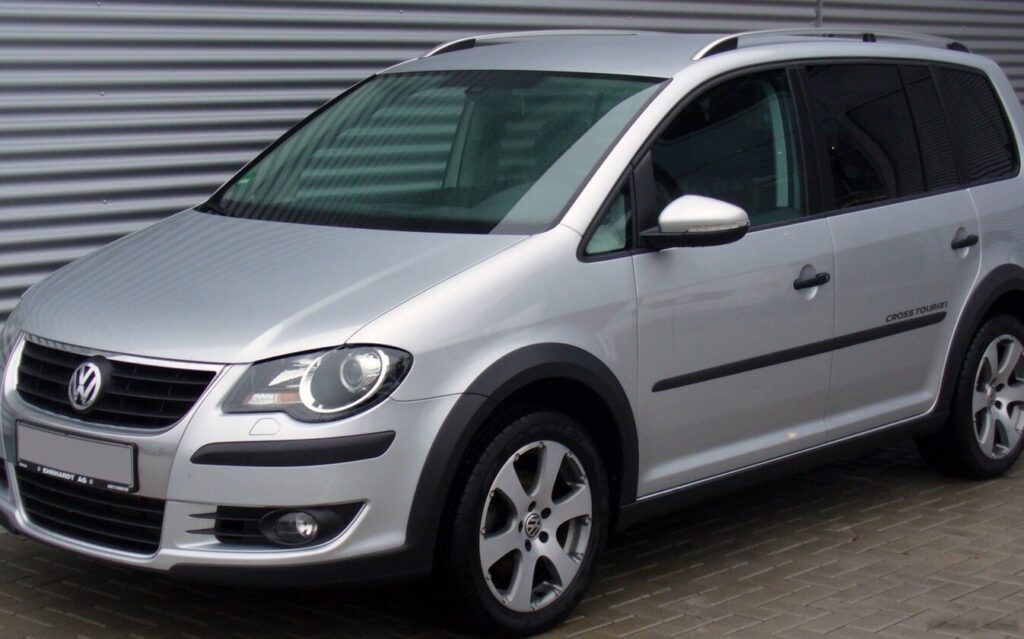
The Volkswagen Cross Touran I 2.0 TDI (170 hp) was a variant of the first-generation Cross Touran, produced between 2007 and 2010. Positioned as a more rugged and versatile version of the standard Touran minivan, the Cross Touran aimed to bridge the gap between a traditional MPV and a compact SUV. This particular 2.0 TDI engine, producing 170 horsepower, represented a mid-range offering within the Cross Touran lineup, balancing performance with fuel efficiency. It was primarily sold in the European market, where demand for practical, fuel-conscious family vehicles was high.
Technical Specifications
| Brand | Volkswagen |
| Model | Touran |
| Generation | Cross Touran I |
| Type (Engine) | 2.0 TDI (170 Hp) |
| Start of production | 2007 |
| End of production | 2010 |
| Powertrain Architecture | Internal Combustion engine |
| Body type | Minivan |
| Seats | 5 |
| Doors | 5 |
| Fuel consumption (economy) – urban (NEDC) | 8.5 l/100 km (27.7 US mpg, 33.2 UK mpg, 11.8 km/l) |
| Fuel consumption (economy) – extra urban (NEDC) | 5.7 l/100 km (41.3 US mpg, 49.6 UK mpg, 17.5 km/l) |
| Fuel consumption (economy) – combined (NEDC) | 6.7 l/100 km (35.1 US mpg, 42.2 UK mpg, 14.9 km/l) |
| CO2 emissions (NEDC) | 177 g/km |
| Fuel Type | Diesel |
| Acceleration 0 – 100 km/h | 9.2 sec |
| Acceleration 0 – 62 mph | 9.2 sec |
| Acceleration 0 – 60 mph | 8.7 sec |
| Maximum speed | 208 km/h (129.25 mph) |
| Emission standard | Euro 4 |
| Weight-to-power ratio | 9.4 kg/Hp, 106.5 Hp/tonne |
| Weight-to-torque ratio | 4.6 kg/Nm, 219.3 Nm/tonne |
| Power | 170 Hp @ 4200 rpm |
| Power per litre | 86.4 Hp/l |
| Torque | 350 Nm @ 2000 rpm (258.15 lb.-ft. @ 2000 rpm) |
| Engine layout | Front, Transverse |
| Engine Model/Code | EA188 / BMN |
| Engine displacement | 1968 cm3 (120.09 cu. in.) |
| Number of cylinders | 4 |
| Engine configuration | Inline |
| Cylinder Bore | 81 mm (3.19 in.) |
| Piston Stroke | 95.5 mm (3.76 in.) |
| Compression ratio | 18.5:1 |
| Number of valves per cylinder | 4 |
| Fuel injection system | Pump-nozzle (Unit Injector) |
| Engine aspiration | Turbocharger, Intercooler |
| Valvetrain | DOHC |
| Engine oil capacity | 4.3 l (4.54 US qt | 3.78 UK qt) |
| Coolant | 8 l (8.45 US qt | 7.04 UK qt) |
| Kerb Weight | 1596 kg (3518.58 lbs.) |
| Max. weight | 2210 kg (4872.22 lbs.) |
| Max load | 614 kg (1353.64 lbs.) |
| Trunk (boot) space – minimum | 695 l (24.54 cu. ft.) |
| Trunk (boot) space – maximum | 1989 l (70.24 cu. ft.) |
| Fuel tank capacity | 60 l (15.85 US gal | 13.2 UK gal) |
| Max. roof load | 100 kg (220.46 lbs.) |
| Permitted trailer load with brakes (8%) | 1800 kg (3968.32 lbs.) |
| Permitted trailer load with brakes (12%) | 1600 kg (3527.4 lbs.) |
| Permitted trailer load without brakes | 750 kg (1653.47 lbs.) |
| Permitted towbar download | 75 kg (165.35 lbs.) |
| Length | 4407 mm (173.5 in.) |
| Width | 1799 mm (70.83 in.) |
| Width including mirrors | 2047 mm (80.59 in.) |
| Height | 1670 mm (65.75 in.) |
| Wheelbase | 2677 mm (105.39 in.) |
| Front track | 1550 mm (61.02 in.) |
| Rear (Back) track | 1531 mm (60.28 in.) |
| Minimum turning circle (turning diameter) | 11.2 m (36.75 ft.) |
| Front suspension | Independent type McPherson, Transverse stabilizer |
| Rear suspension | Independent multi-link suspension, Transverse stabilizer |
| Front brakes | Ventilated discs |
| Rear brakes | Disc |
| Drive wheel | Front wheel drive |
| Number of gears and type of gearbox | 6 gears, manual transmission |
INTRODUCTION
The Volkswagen Cross Touran I, launched in 2007, was a derivative of the standard Touran MPV, designed to appeal to buyers seeking a more adventurous and visually distinct vehicle. It featured a raised ride height, rugged body cladding, and often, all-wheel drive options (though the 2.0 TDI 170hp was typically front-wheel drive). The Cross Touran was built on the Volkswagen Group’s PQ35 platform (also known as the 1HX0/A3 platform), shared with models like the Golf Mk5 and Audi A3. The 2.0 TDI 170 hp variant occupied a middle ground in the Cross Touran range, offering a balance between performance and economy, making it a popular choice for families and those covering long distances.
Powertrain & Engine Architecture
The heart of the Cross Touran I 2.0 TDI (170 hp) is the EA188 series 2.0-liter four-cylinder diesel engine, specifically the BMN engine code. This engine utilizes a common rail direct injection system, delivering fuel directly into the combustion chamber at extremely high pressure. The BMN engine employs pump-nozzle (Unit Injector) technology, a system known for its robust nature and ability to handle varying fuel qualities. The engine features a single turbocharger with an intercooler, boosting power output and improving efficiency. The engine’s double overhead camshaft (DOHC) valvetrain, with four valves per cylinder, optimizes gas flow for enhanced performance. The 170 horsepower peak is achieved at 4200 rpm, while the substantial 350 Nm (258 lb-ft) of torque is available from just 2000 rpm, providing strong pulling power. The engine is transversely mounted at the front of the vehicle. The transmission is a six-speed manual gearbox, offering precise gear changes and contributing to the vehicle’s overall efficiency.
Driving Characteristics
The 2.0 TDI 170 hp engine in the Cross Touran provides a respectable level of performance for a minivan. Acceleration from 0-60 mph takes approximately 8.7 seconds, and the vehicle has a top speed of 129.25 mph. The readily available torque makes overtaking and hill climbing relatively effortless. Compared to the lower-powered 1.9 TDI versions, the 2.0 TDI offers noticeably more punch, especially at higher speeds. However, it doesn’t possess the outright performance of the more expensive and less common petrol-powered variants. The six-speed manual transmission is well-matched to the engine, allowing drivers to keep the engine in its optimal power band. The gear ratios are spaced to provide both good acceleration and comfortable cruising. The front-wheel-drive configuration provides adequate traction in most conditions, but can struggle in slippery surfaces compared to the optional 4Motion all-wheel-drive system.
Equipment & Trim Levels
The Cross Touran I 2.0 TDI (170 hp) typically came with a generous level of standard equipment. This included air conditioning, electric windows, central locking, a CD stereo system, and alloy wheels. Safety features such as ABS brakes, front and side airbags, and electronic stability control were also standard. Higher trim levels offered additional features such as climate control, a multi-function steering wheel, parking sensors, and upgraded upholstery. Interior upholstery was typically cloth, but leather options were available. The dashboard layout was functional and well-designed, with clear instrumentation and intuitive controls. Optional extras included a sunroof, navigation system, and a rear parking camera.
Chassis & Braking
The Cross Touran I featured an independent suspension setup on both the front and rear axles. The front suspension utilized a McPherson strut design with a transverse stabilizer bar, while the rear suspension employed a multi-link system, also with a stabilizer bar. This setup provided a comfortable ride and good handling characteristics. The braking system consisted of ventilated discs on the front wheels and solid discs on the rear wheels. ABS (Anti-lock Braking System) was standard, enhancing braking performance and stability. The raised ride height of the Cross Touran, compared to the standard Touran, provided increased ground clearance, making it more capable on rough terrain.
Market Reception & Comparison
The Volkswagen Cross Touran I 2.0 TDI (170 hp) was generally well-received by automotive critics. It was praised for its practicality, spacious interior, comfortable ride, and fuel efficiency. The 2.0 TDI engine was considered a good compromise between performance and economy. Compared to the lower-powered 1.9 TDI versions, the 2.0 TDI offered a more refined driving experience and better performance. However, some critics noted that the front-wheel-drive configuration could limit traction in adverse conditions. Fuel economy was a strong point, with combined figures around 35.1 US mpg. Reliability was generally good, although the pump-nozzle injection system could be prone to issues if not properly maintained.
Legacy
The Volkswagen Cross Touran I 2.0 TDI (170 hp) remains a popular choice in the used car market. Its combination of practicality, fuel efficiency, and reasonable performance makes it an attractive option for families. The EA188 2.0 TDI engine is known for its durability, but regular maintenance, including oil changes and fuel filter replacements, is crucial to ensure long-term reliability. The pump-nozzle injectors can be a potential weak point, and should be inspected periodically. Overall, the Cross Touran I 2.0 TDI (170 hp) represents a well-rounded and capable MPV that continues to offer good value for money.