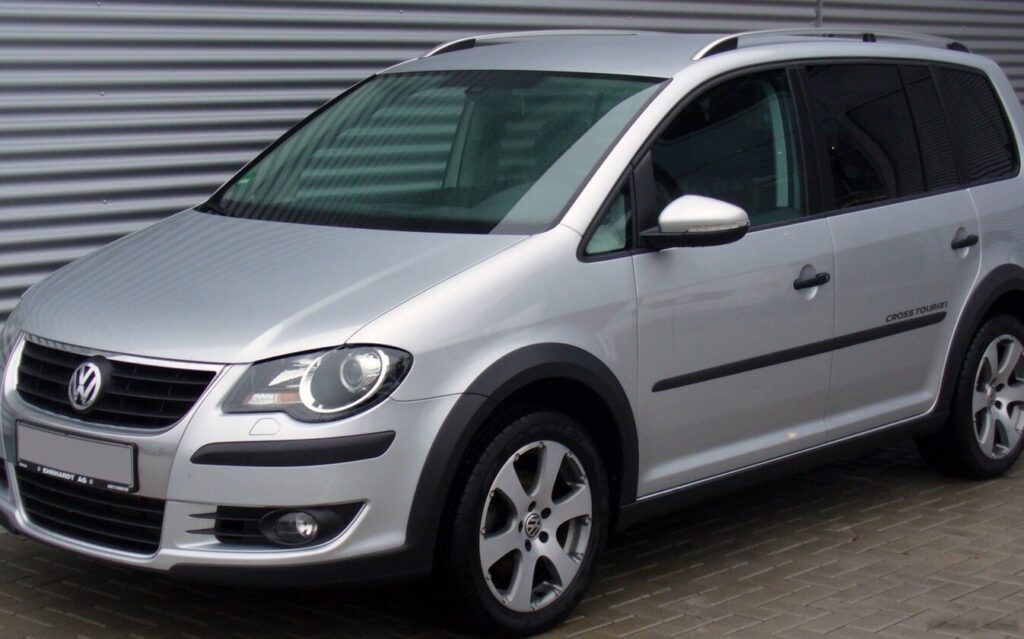
The Volkswagen Cross Touran I 2.0 TDI (170 hp) DSG was a variant of the first-generation Cross Touran, produced between 2007 and 2010. Positioned as a mid-range offering within the Cross Touran lineup, it combined the practicality of a compact minivan with the enhanced styling and capability of a crossover. This model aimed to appeal to families seeking a versatile vehicle suitable for both urban driving and occasional off-road excursions. It was primarily sold in the European market, where the compact minivan segment was particularly popular.
Technical Specifications
| Brand | Volkswagen |
| Model | Touran |
| Generation | Cross Touran I |
| Type (Engine) | 2.0 TDI (170 Hp) DSG |
| Start of production | 2007 |
| End of production | 2010 |
| Powertrain Architecture | Internal Combustion engine |
| Body type | Minivan |
| Seats | 5 |
| Doors | 5 |
| Fuel consumption (economy) – urban (NEDC) | 8.7 l/100 km (27 US mpg, 32.5 UK mpg, 11.5 km/l) |
| Fuel consumption (economy) – extra urban (NEDC) | 5.9 l/100 km (39.9 US mpg, 47.9 UK mpg, 16.9 km/l) |
| Fuel consumption (economy) – combined (NEDC) | 7 l/100 km (33.6 US mpg, 40.4 UK mpg, 14.3 km/l) |
| CO2 emissions (NEDC) | 185 g/km |
| Fuel Type | Diesel |
| Acceleration 0 – 100 km/h | 9.3 sec |
| Acceleration 0 – 62 mph | 9.3 sec |
| Acceleration 0 – 60 mph | 8.8 sec |
| Maximum speed | 206 km/h (128 mph) |
| Emission standard | Euro 4 |
| Weight-to-power ratio | 9.5 kg/Hp, 104.8 Hp/tonne |
| Weight-to-torque ratio | 4.6 kg/Nm, 215.8 Nm/tonne |
| Power | 170 Hp @ 4200 rpm |
| Power per litre | 86.4 Hp/l |
| Torque | 350 Nm @ 2000 rpm (258.15 lb.-ft. @ 2000 rpm) |
| Engine layout | Front, Transverse |
| Engine Model/Code | EA188 / BMN |
| Engine displacement | 1968 cm3 (120.09 cu. in.) |
| Number of cylinders | 4 |
| Engine configuration | Inline |
| Cylinder Bore | 81 mm (3.19 in.) |
| Piston Stroke | 95.5 mm (3.76 in.) |
| Compression ratio | 18.5:1 |
| Number of valves per cylinder | 4 |
| Fuel injection system | Pump-nozzle (Unit Injector) |
| Engine aspiration | Turbocharger, Intercooler |
| Valvetrain | DOHC |
| Engine oil capacity | 4.3 l (4.54 US qt, 3.78 UK qt) |
| Coolant | 8 l (8.45 US qt, 7.04 UK qt) |
| Kerb Weight | 1622 kg (3575.9 lbs.) |
| Max. weight | 2230 kg (4916.31 lbs.) |
| Max load | 608 kg (1340.41 lbs.) |
| Trunk (boot) space – minimum | 695 l (24.54 cu. ft.) |
| Trunk (boot) space – maximum | 1989 l (70.24 cu. ft.) |
| Fuel tank capacity | 60 l (15.85 US gal, 13.2 UK gal) |
| Max. roof load | 100 kg (220.46 lbs.) |
| Permitted trailer load with brakes (8%) | 1800 kg (3968.32 lbs.) |
| Permitted trailer load with brakes (12%) | 1600 kg (3527.4 lbs.) |
| Permitted trailer load without brakes | 750 kg (1653.47 lbs.) |
| Permitted towbar download | 75 kg (165.35 lbs.) |
| Length | 4407 mm (173.5 in.) |
| Width | 1799 mm (70.83 in.) |
| Width including mirrors | 2047 mm (80.59 in.) |
| Height | 1670 mm (65.75 in.) |
| Wheelbase | 2677 mm (105.39 in.) |
| Front track | 1550 mm (61.02 in.) |
| Rear (Back) track | 1531 mm (60.28 in.) |
| Minimum turning circle | 11.2 m (36.75 ft.) |
| Front brakes | Ventilated discs |
| Rear brakes | Disc |
| Gearbox | 6 gears, automatic transmission DSG |
INTRODUCTION
The Volkswagen Cross Touran I, launched in 2007, represented an attempt to broaden the appeal of the Touran minivan. The “Cross” designation signified a more rugged appearance and slightly increased ground clearance, aiming to bridge the gap between a traditional MPV and a small SUV. The 2.0 TDI (170 hp) DSG variant was a popular choice, offering a balance of performance, fuel efficiency, and convenience. Built on the Volkswagen Group’s A5 (1HX0) platform, shared with models like the Audi A3 and the SEAT León, the Cross Touran aimed to provide a practical and versatile vehicle for families.
Powertrain & Engine Architecture
At the heart of the Cross Touran I 2.0 TDI DSG lies the EA188 series engine, specifically the BMN code. This 1968cc, four-cylinder diesel engine utilizes pump-nozzle (unit injector) technology for direct fuel injection. This system, while effective, was known for being more mechanically complex than later common-rail systems. The engine features a single overhead camshaft (SOHC) per cylinder bank, operating four valves per cylinder (DOHC). A turbocharger with an intercooler is employed to boost power output to 170 horsepower at 4200 rpm and 350 Nm (258 lb-ft) of torque at 2000 rpm. The engine’s high compression ratio of 18.5:1 contributes to its efficiency. The Direct-Shift Gearbox (DSG), a six-speed dual-clutch transmission, was a key feature, providing smooth and rapid gear changes. This DSG unit, known for its efficiency and responsiveness, contributed significantly to the driving experience.
Driving Characteristics
The 2.0 TDI (170 hp) DSG powertrain in the Cross Touran offered a respectable level of performance for a minivan. Acceleration from 0-100 km/h (0-62 mph) took approximately 9.3 seconds, and the vehicle could reach a top speed of 206 km/h (128 mph). The DSG transmission played a crucial role in maximizing the engine’s output, providing quick shifts and keeping the engine within its optimal power band. Compared to the lower-powered 1.9 TDI versions, the 2.0 TDI offered noticeably more punch, particularly during overtaking maneuvers. While not as sporty as some hatchback alternatives, the Cross Touran provided a comfortable and capable driving experience. The automatic transmission made it particularly well-suited for urban driving and long journeys, reducing driver fatigue. The gear ratios were tuned for a balance of acceleration and fuel economy.
Equipment & Trim Levels
The Cross Touran I 2.0 TDI DSG typically came equipped with a reasonable level of standard features. These included air conditioning, power windows, central locking, and an audio system. The “Cross” trim added exterior styling cues such as plastic body cladding, roof rails, and often, alloy wheels. Interior upholstery was typically cloth, although leather options were available. Optional extras included a sunroof, navigation system, parking sensors, and upgraded audio systems. Safety features such as ABS (Anti-lock Braking System) and multiple airbags were standard. The dashboard layout was typical of Volkswagen products from that era, with a functional and ergonomic design.
Chassis & Braking
The Cross Touran I featured an independent suspension setup on both the front and rear axles. The front suspension utilized McPherson struts with a transverse stabilizer bar, while the rear employed a multi-link suspension, also with a stabilizer bar. This configuration provided a comfortable ride and decent handling characteristics. Braking duties were handled by ventilated discs on the front wheels and solid discs on the rear. ABS was standard, enhancing braking performance and stability. The slightly increased ride height of the “Cross” model, compared to the standard Touran, provided a bit more ground clearance for tackling rougher terrain, although it was not designed for serious off-roading.
Market Reception & Comparison
The Volkswagen Cross Touran I 2.0 TDI DSG was generally well-received by automotive critics. It was praised for its practicality, versatility, and comfortable ride. The 2.0 TDI engine was considered a good compromise between performance and fuel economy. However, some critics noted that the pump-nozzle diesel engine could be prone to reliability issues, and the DSG transmission required regular maintenance. Compared to the 1.9 TDI versions, the 2.0 TDI offered a noticeable performance upgrade, but at a higher price point. Fuel economy was competitive for its class, averaging around 7 l/100 km (33.6 US mpg). The Cross Touran faced competition from other compact minivans such as the Renault Scenic and the Citroën C4 Picasso.
Legacy
The Volkswagen Cross Touran I 2.0 TDI DSG remains a relatively common sight on European roads today. While the pump-nozzle diesel engine and DSG transmission can require maintenance, they are generally considered reliable if properly cared for. The vehicle’s practicality and versatility continue to appeal to families. In the used car market, the 2.0 TDI DSG variant typically commands a higher price than the lower-powered versions. The Cross Touran I paved the way for subsequent generations of the model, which continued to build on its strengths and address some of its weaknesses. The EA188 engine, despite its quirks, proved to be a durable and tunable powerplant, and remains popular with enthusiasts.