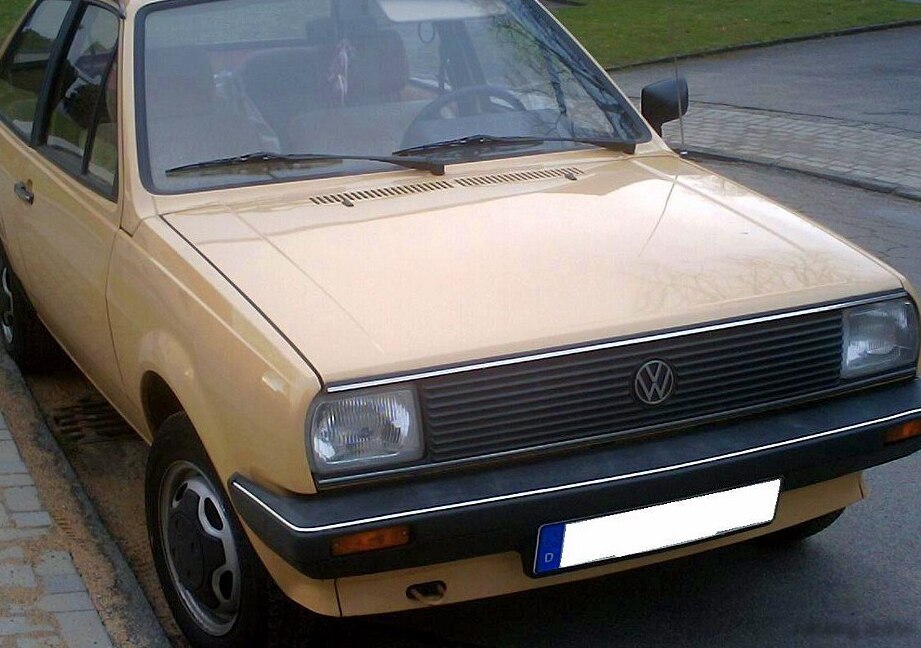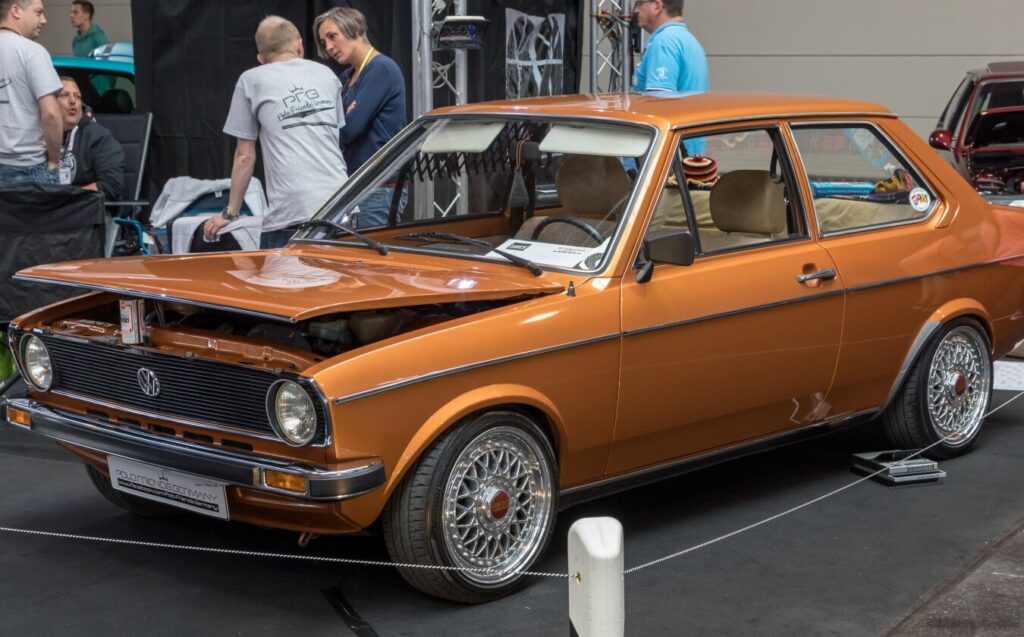
The Volkswagen Derby, produced between 1977 and 1981, was a compact sedan based on the Volkswagen Polo (Typ 86) platform. Intended primarily for markets outside of West Germany where the three-box sedan body style was preferred, the Derby offered a more traditional appearance than the hatchback Polo. The 1.3-liter, 60 horsepower variant represented the entry-level offering in the Derby lineup, aimed at buyers seeking economical and practical transportation. This model played a significant role in expanding Volkswagen’s reach in regions like Latin America and Southern Europe, where sedans were more popular than hatchbacks.
Technical Specifications
| Brand | Volkswagen |
| Model | Derby |
| Generation | Derby (86) |
| Type (Engine) | 1.3 (60 Hp) |
| Start of production | 1977 |
| End of production | 1981 |
| Powertrain Architecture | Internal Combustion engine |
| Body type | Sedan |
| Seats | 5 |
| Doors | 2 |
| Fuel consumption (urban) | 10.2 l/100 km (23.1 US mpg) |
| Fuel consumption (extra urban) | 6.6 l/100 km (35.6 US mpg) |
| Fuel Type | Petrol (Gasoline) |
| Acceleration 0 – 60 mph | 12.9 sec |
| Maximum speed | 153 km/h (95.07 mph) |
| Weight-to-power ratio | 11.7 kg/Hp |
| Weight-to-torque ratio | 7.4 kg/Nm |
| Power | 60 Hp @ 5600 rpm |
| Power per litre | 47.2 Hp/l |
| Torque | 95 Nm @ 3400 rpm (70.07 lb.-ft. @ 3400 rpm) |
| Engine layout | Front, Transverse |
| Engine Model/Code | HH |
| Engine displacement | 1272 cm3 (77.62 cu. in.) |
| Number of cylinders | 4 |
| Engine configuration | Inline |
| Cylinder Bore | 75 mm (2.95 in.) |
| Piston Stroke | 72 mm (2.83 in.) |
| Compression ratio | 8.2:1 |
| Number of valves per cylinder | 2 |
| Fuel injection system | Carburettor |
| Engine aspiration | Naturally aspirated engine |
| Valvetrain | SOHC |
| Engine oil capacity | 3.5 l (3.7 US qt | 3.08 UK qt) |
| Kerb Weight | 700 kg (1543.24 lbs.) |
| Max. weight | 1130 kg (2491.22 lbs.) |
| Max load | 430 kg (947.99 lbs.) |
| Fuel tank capacity | 36 l (9.51 US gal | 7.92 UK gal) |
| Permitted trailer load with brakes (12%) | 650 kg (1433 lbs.) |
| Permitted trailer load without brakes | 380 kg (837.76 lbs.) |
| Length | 3914 mm (154.09 in.) |
| Width | 1557 mm (61.3 in.) |
| Height | 1351 mm (53.19 in.) |
| Wheelbase | 2329 mm (91.69 in.) |
| Front track | 1295 mm (50.98 in.) |
| Rear (Back) track | 1313 mm (51.69 in.) |
| Ride height (ground clearance) | 97 mm (3.82 in.) |
| Minimum turning circle (turning diameter) | 9.6 m (31.5 ft.) |
| Drivetrain Architecture | The Internal combustion engine (ICE) drives the front wheels of the vehicle. |
| Drive wheel | Front wheel drive |
| Number of gears and type of gearbox | 4 gears, manual transmission |
| Front suspension | Wishbone, Transverse stabilizer |
| Rear suspension | Trailing arm, Torsion |
| Front brakes | Disc |
| Rear brakes | Drum |
| Steering type | Steering rack and pinion |
| Wheel rims size | Front wheel rims: 4.5J x 13Rear wheel rims: 4.5J x 13 |
INTRODUCTION
The Volkswagen Derby 1.3, produced from 1977 to 1981, was a key variant within the Derby range. Positioned as the entry-level model, it offered a more affordable alternative to the higher-spec 1.5 and later 1.6-liter versions. Built on the Volkswagen Group’s A1 platform – also known as the 1HX0/A3 platform – the Derby aimed to provide a practical and economical sedan option, particularly in markets where the hatchback configuration of the Polo was less favored. The 1.3-liter engine, designated with the HH engine code, was a mainstay of Volkswagen’s smaller models during this period, known for its reliability and simplicity.
Powertrain & Engine Architecture
The heart of the Derby 1.3 was the 1272cc inline-four cylinder engine, identified by the HH engine code. This engine featured a single overhead camshaft (SOHC) valvetrain operating two valves per cylinder. Fuel delivery was managed by a single carburetor, a common setup for vehicles of this era prioritizing simplicity and cost-effectiveness. The engine produced 60 horsepower at 5600 rpm and 95 Nm (70.07 lb-ft) of torque at 3400 rpm. The engine’s transverse mounting and front-wheel drive configuration were typical of Volkswagen’s front-wheel drive designs. The Derby 1.3 was exclusively offered with a four-speed manual transmission, designed to maximize fuel efficiency and provide adequate performance for everyday driving. The transmission was a fully synchronized unit, offering smooth gear changes for the time.
Driving Characteristics
The Derby 1.3, with its 60 horsepower and four-speed manual transmission, offered modest but adequate performance. Acceleration from 0 to 60 mph took approximately 12.9 seconds, and the top speed was around 95 mph. The car’s relatively light weight of 700 kg (1543 lbs) helped to offset the engine’s limited power output. The four-speed gearbox was geared for economy, resulting in a relatively high final drive ratio. This meant that while the car was comfortable cruising at highway speeds, acceleration in higher gears was somewhat limited. Compared to the 1.5 and 1.6-liter versions, the 1.3 felt noticeably slower, particularly when fully loaded or climbing hills. However, the 1.3’s lighter weight and simpler engine contributed to better fuel economy and reduced maintenance costs.
Equipment & Trim Levels
The Derby 1.3 was typically equipped with basic but functional features. Standard equipment included cloth upholstery, vinyl floor covering, and a simple dashboard layout with basic instrumentation – speedometer, fuel gauge, and temperature gauge. Power steering, air conditioning, and electric windows were not typically offered on this base model. Optional extras included a radio, upgraded upholstery, and a sunroof. The interior was designed with practicality in mind, offering sufficient space for five passengers, although rear legroom was somewhat limited. The exterior trim was also basic, with black plastic bumpers and steel wheels with hubcaps being standard.
Chassis & Braking
The Derby 1.3 utilized a relatively simple chassis design. The front suspension consisted of independent wishbones with a transverse stabilizer bar, while the rear suspension employed a trailing arm torsion beam setup. This configuration provided a reasonable balance between ride comfort and handling. The braking system featured disc brakes on the front wheels and drum brakes on the rear wheels. The braking system was adequate for the car’s weight and performance, but lacked the stopping power of more modern systems. Steering was via a rack and pinion system, providing precise and responsive steering feel.
Market Reception & Comparison
The Derby 1.3 was generally well-received as an affordable and reliable family sedan. Critics praised its fuel economy and ease of maintenance, but noted its limited performance compared to higher-spec models. Compared to the 1.5 and 1.6-liter Derby variants, the 1.3 offered significantly lower running costs but at the expense of performance. The 1.5-liter version, for example, offered around 20% more power and noticeably quicker acceleration. However, the 1.3’s simplicity and reliability made it a popular choice for budget-conscious buyers and those seeking a dependable daily driver. Fuel economy figures of around 35.6 US mpg (extra urban) were considered excellent for the time.
Legacy
The Volkswagen Derby 1.3, while not a performance icon, has earned a reputation for durability and reliability. The HH engine is known for its longevity, and many examples are still on the road today. In the used car market, the Derby 1.3 remains an affordable classic, appealing to enthusiasts and those seeking a simple, easy-to-maintain vehicle. Parts availability is generally good, thanks to the widespread use of the HH engine in other Volkswagen models. The Derby 1.3 represents a significant chapter in Volkswagen’s history, demonstrating the company’s commitment to providing practical and affordable transportation to a wide range of customers.