
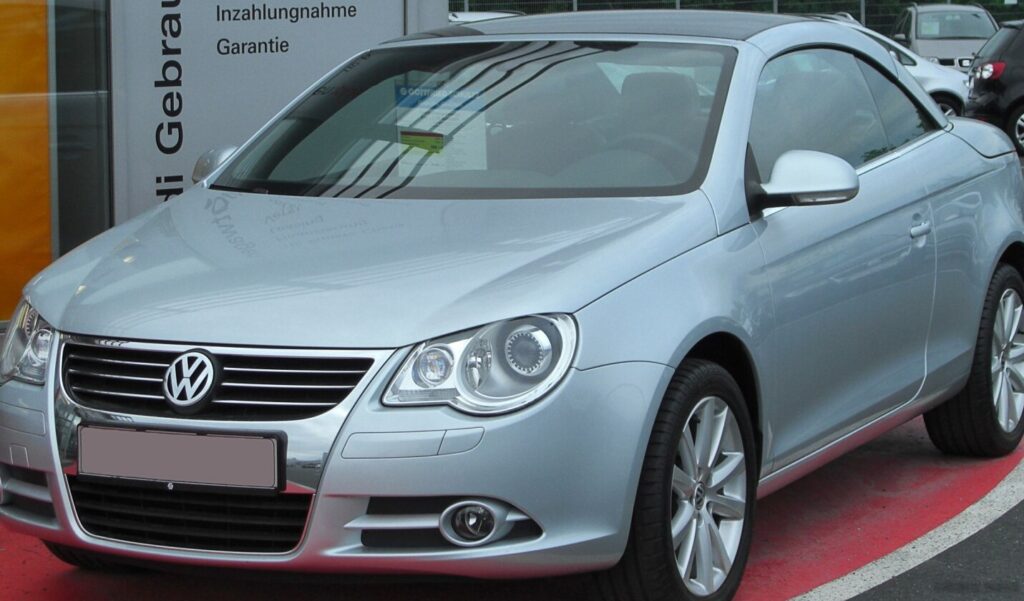
The Volkswagen Eos 1.4 TSI BMT (122 hp) was a front-wheel-drive, two-door coupe-convertible produced between 2009 and 2010. Positioned as a more accessible entry point into the Eos range, it offered a blend of style, practicality, and fuel efficiency. This variant occupied the lower-mid range of the Eos lineup, sitting below the more powerful 1.8 TSI and 2.0 TDI models. It was primarily marketed in Europe, aiming at buyers seeking a stylish open-top experience without the higher costs associated with larger engines or premium trim levels.
Technical Specifications
| Brand | Volkswagen |
| Model | Eos |
| Generation | Eos |
| Type (Engine) | 1.4 TSI BMT (122 Hp) |
| Start of production | 2009 |
| End of production | 2010 |
| Powertrain Architecture | Internal Combustion engine |
| Body type | Coupe – Cabriolet |
| Seats | 4 |
| Doors | 2 |
| Fuel consumption (economy) – urban (NEDC) | 7.6 l/100 km (30.9 US mpg, 37.2 UK mpg, 13.2 km/l) |
| Fuel consumption (economy) – extra urban (NEDC) | 5.3 l/100 km (44.4 US mpg, 53.3 UK mpg, 18.9 km/l) |
| Fuel consumption (economy) – combined (NEDC) | 6.2 l/100 km (37.9 US mpg, 45.6 UK mpg, 16.1 km/l) |
| CO2 emissions (NEDC) | 144 g/km |
| Fuel Type | Petrol (Gasoline) |
| Acceleration 0 – 100 km/h | 10.9 sec |
| Acceleration 0 – 62 mph | 10.9 sec |
| Acceleration 0 – 60 mph | 10.4 sec |
| Maximum speed | 196 km/h (121.79 mph) |
| Emission standard | Euro 5 |
| Weight-to-power ratio | 11.9 kg/Hp, 84.3 Hp/tonne |
| Weight-to-torque ratio | 7.2 kg/Nm, 138.1 Nm/tonne |
| Power | 122 Hp @ 5500 rpm |
| Power per litre | 87.8 Hp/l |
| Torque | 200 Nm @ 1500-4000 rpm (147.51 lb.-ft. @ 1500-4000 rpm) |
| Engine layout | Front, Transverse |
| Engine Model/Code | CAXA |
| Engine displacement | 1390 cm3 (84.82 cu. in.) |
| Number of cylinders | 4 |
| Engine configuration | Inline |
| Cylinder Bore | 76.5 mm (3.01 in.) |
| Piston Stroke | 75.6 mm (2.98 in.) |
| Compression ratio | 10:1 |
| Number of valves per cylinder | 4 |
| Fuel injection system | Direct injection |
| Engine aspiration | Turbocharger, Intercooler |
| Valvetrain | DOHC |
| Engine oil capacity | 3.6 l (3.8 US qt | 3.17 UK qt) |
| Kerb Weight | 1448 kg (3192.29 lbs.) |
| Max. weight | 1920 kg (4232.88 lbs.) |
| Max load | 472 kg (1040.58 lbs.) |
| Trunk (boot) space – minimum | 205 l (7.24 cu. ft.) |
| Trunk (boot) space – maximum | 380 l (13.42 cu. ft.) |
| Fuel tank capacity | 55 l (14.53 US gal | 12.1 UK gal) |
| Permitted trailer load with brakes (8%) | 1600 kg (3527.4 lbs.) |
| Permitted trailer load with brakes (12%) | 1400 kg (3086.47 lbs.) |
| Permitted trailer load without brakes | 750 kg (1653.47 lbs.) |
| Permitted towbar download | 75 kg (165.35 lbs.) |
| Length | 4407 mm (173.5 in.) |
| Width | 1791 mm (70.51 in.) |
| Width including mirrors | 2009 mm (79.09 in.) |
| Height | 1443 mm (56.81 in.) |
| Wheelbase | 2578 mm (101.5 in.) |
| Front track | 1545 mm (60.83 in.) |
| Rear (Back) track | 1553 mm (61.14 in.) |
| Ride height (ground clearance) | 106 mm (4.17 in.) |
| Minimum turning circle (turning diameter) | 10.9 m (35.76 ft.) |
| Front suspension | Coil spring, Wishbone, Transverse stabilizer |
| Rear suspension | Independent multi-link suspension, Transverse stabilizer |
| Front brakes | Ventilated discs |
| Rear brakes | Disc |
| Assisting systems | ABS (Anti-lock braking system) |
| Steering type | Steering rack and pinion |
| Power steering | Electric Steering |
| Tires size | 215/55 R16 |
| Wheel rims size | 7J x 16 |
INTRODUCTION
The Volkswagen Eos, launched in 2006, was conceived as a stylish and practical coupe-convertible aimed at bridging the gap between the Golf and the more premium Passat. The 1.4 TSI BMT variant, introduced in 2009, represented a fuel-efficient and cost-effective option within the Eos range. Built on the A5 platform (shared with the Mk5 Golf and Mk6 Jetta), the Eos distinguished itself with its unique five-piece retractable hardtop, offering the security and refinement of a coupe with the open-air enjoyment of a convertible. The “BMT” designation stands for “BlueMotion Technology,” signifying Volkswagen’s efforts to improve fuel economy and reduce emissions.
Powertrain & Engine Architecture
The heart of the Eos 1.4 TSI BMT is the CAXA engine code, a 1.4-liter turbocharged inline-four cylinder petrol engine. This engine utilizes direct fuel injection (FSI) and a turbocharger with an intercooler to deliver a balance of power and efficiency. The engine’s key features include variable valve timing on both the intake and exhaust sides, contributing to its broad torque curve. The BMT package incorporates start-stop technology, automatically shutting off the engine when the vehicle is stationary to further reduce fuel consumption. The engine is transversely mounted at the front of the vehicle. The 1.4 TSI engine produces 122 horsepower at 5500 rpm and 200 Nm (147.51 lb-ft) of torque between 1500 and 4000 rpm. This variant was typically paired with a six-speed manual transmission, although a seven-speed DSG (Direct-Shift Gearbox) dual-clutch automatic transmission was also available as an option. The automatic transmission offered quicker shifts and improved fuel economy, but at a higher cost.
Driving Characteristics
The Eos 1.4 TSI BMT offered a comfortable and refined driving experience, prioritizing fuel efficiency over outright performance. Acceleration from 0-60 mph took around 10.4 seconds, and the top speed was 121.79 mph. While not particularly sporty, the engine provided adequate power for everyday driving and cruising. The turbocharger provided a noticeable boost in power, but turbo lag was present, especially at lower engine speeds. The six-speed manual transmission allowed drivers to make the most of the engine’s powerband, while the optional DSG automatic offered smooth and seamless gear changes. Compared to the more powerful 1.8 TSI and 2.0 TDI models, the 1.4 TSI BMT felt less responsive and required more effort to maintain speed on inclines or during overtaking maneuvers. However, its lighter weight and more efficient engine contributed to better fuel economy and lower running costs.
Equipment & Trim Levels
The Eos 1.4 TSI BMT typically came equipped with a reasonable level of standard features. These included air conditioning, alloy wheels, a CD stereo system, electric front windows, and ABS brakes. Higher trim levels offered additional features such as climate control, a multi-function steering wheel, and upgraded upholstery. Optional extras included a panoramic sunroof, leather seats, and a premium sound system. Interior upholstery was typically cloth, with leather options available at extra cost. The dashboard layout was similar to that of the Golf Mk5/Mk6, with a functional and user-friendly design.
Chassis & Braking
The Eos 1.4 TSI BMT utilized a MacPherson strut front suspension and a multi-link rear suspension, providing a comfortable ride and good handling characteristics. The suspension was tuned for comfort rather than outright sportiness. Front brakes were ventilated discs, while rear brakes were solid discs. ABS (Anti-lock Braking System) was standard. The Eos’s chassis was reinforced to compensate for the loss of structural rigidity resulting from the retractable hardtop. Stabilizer bars were fitted to both the front and rear axles to reduce body roll during cornering.
Market Reception & Comparison
The Eos 1.4 TSI BMT was generally well-received by automotive critics as a stylish and fuel-efficient convertible. However, some reviewers noted its lack of outright performance compared to higher-powered variants. Fuel economy was a key selling point, with the BMT package helping to achieve combined fuel consumption figures of around 37.9 US mpg. Compared to the 1.8 TSI, the 1.4 TSI BMT offered lower running costs but less performance. The 2.0 TDI provided even better fuel economy but with the drawbacks associated with diesel engines, such as higher maintenance costs and potential emissions concerns. The Eos competed with other coupe-convertibles such as the Renault Megane Coupe-Cabriolet and the Ford Focus CC.
Legacy
The Volkswagen Eos 1.4 TSI BMT has proven to be a relatively reliable vehicle, with the CAXA engine generally considered durable. However, like all modern vehicles, it is susceptible to age-related issues such as wear and tear on suspension components and potential problems with the retractable hardtop mechanism. On the used car market, the Eos 1.4 TSI BMT represents a relatively affordable entry point into the coupe-convertible segment. Its fuel efficiency and stylish design continue to appeal to buyers seeking a practical and enjoyable open-top experience. Regular maintenance and careful attention to the hardtop’s operation are essential to ensure its long-term reliability.
