
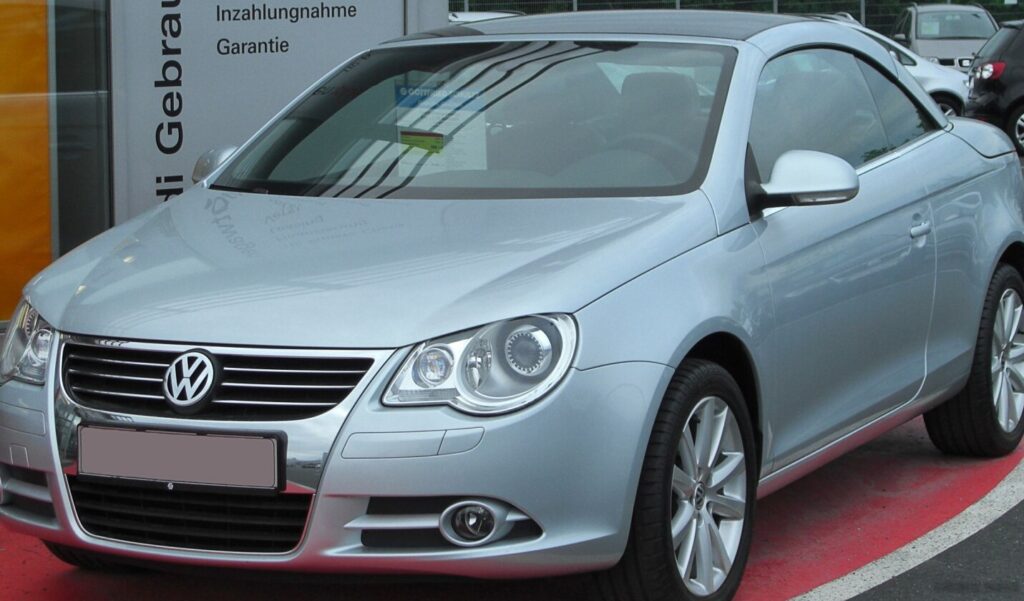
The Volkswagen Eos 1.6 FSI, produced from 2006 to 2007, represents an entry-level offering within the first generation (2006-2008) Eos range. Positioned as a stylish and accessible coupe-convertible, it aimed to broaden the appeal of the Eos beyond the more powerful and expensive engine options. Built on the Volkswagen Group’s A5 (or 1HX0) platform – shared with the Golf Mk5, Jetta Mk5, and Scirocco – the Eos distinguished itself with its unique five-piece retractable hardtop, offering the security and refinement of a coupe with the open-air experience of a convertible. The 1.6 FSI variant was primarily marketed in Europe, where fuel economy and purchase price were significant considerations for buyers in this segment.
Technical Specifications
| Brand | Volkswagen |
| Model | Eos |
| Generation | Eos |
| Type (Engine) | 1.6 FSI (115 Hp) |
| Start of production | 2006 |
| End of production | 2007 |
| Powertrain Architecture | Internal Combustion engine |
| Body type | Coupe – Cabriolet |
| Seats | 4 |
| Doors | 2 |
| Fuel consumption (economy) – urban (NEDC) | 10.2 l/100 km (23.1 US mpg, 27.7 UK mpg, 9.8 km/l) |
| Fuel consumption (economy) – extra urban (NEDC) | 6.3 l/100 km (37.3 US mpg, 44.8 UK mpg, 15.9 km/l) |
| Fuel consumption (economy) – combined (NEDC) | 7.7 l/100 km (30.5 US mpg, 36.7 UK mpg, 13 km/l) |
| CO2 emissions (NEDC) | 181 g/km |
| Fuel Type | Petrol (Gasoline) |
| Acceleration 0 – 100 km/h | 11.9 sec |
| Acceleration 0 – 62 mph | 11.9 sec |
| Acceleration 0 – 60 mph | 11.3 sec |
| Maximum speed | 192 km/h (119.3 mph) |
| Emission standard | Euro 4 |
| Weight-to-power ratio | 13.1 kg/Hp, 76.5 Hp/tonne |
| Weight-to-torque ratio | 9.7 kg/Nm, 103.1 Nm/tonne |
| Power | 115 Hp @ 6000 rpm |
| Power per litre | 72 Hp/l |
| Torque | 155 Nm @ 4000 rpm (114.32 lb.-ft. @ 4000 rpm) |
| Engine layout | Front, Transverse |
| Engine Model/Code | BLF |
| Engine displacement | 1598 cm3 (97.52 cu. in.) |
| Number of cylinders | 4 |
| Engine configuration | Inline |
| Cylinder Bore | 76.5 mm (3.01 in.) |
| Piston Stroke | 86.9 mm (3.42 in.) |
| Compression ratio | 12:1 |
| Number of valves per cylinder | 4 |
| Fuel injection system | Direct injection |
| Engine aspiration | Naturally aspirated engine |
| Valvetrain | DOHC |
| Engine oil capacity | 3.5 l (3.7 US qt | 3.08 UK qt) |
| Kerb Weight | 1503 kg (3313.55 lbs.) |
| Max. weight | 1930 kg (4254.92 lbs.) |
| Max load | 427 kg (941.37 lbs.) |
| Trunk (boot) space – minimum | 205 l (7.24 cu. ft.) |
| Trunk (boot) space – maximum | 380 l (13.42 cu. ft.) |
| Fuel tank capacity | 55 l (14.53 US gal | 12.1 UK gal) |
| Permitted trailer load with brakes (12%) | 1500 kg (3306.93 lbs.) |
| Permitted trailer load without brakes | 750 kg (1653.47 lbs.) |
| Permitted towbar download | 75 kg (165.35 lbs.) |
| Length | 4407 mm (173.5 in.) |
| Width | 1791 mm (70.51 in.) |
| Width including mirrors | 2026 mm (79.76 in.) |
| Height | 1437 mm (56.57 in.) |
| Wheelbase | 2578 mm (101.5 in.) |
| Front track | 1545 mm (60.83 in.) |
| Rear (Back) track | 1553 mm (61.14 in.) |
| Minimum turning circle | 10.9 m (35.76 ft.) |
| Drivetrain Architecture | The Internal combustion engine (ICE) drives the front wheels of the vehicle. |
| Drive wheel | Front wheel drive |
| Number of gears and type of gearbox | 6 gears, manual transmission |
| Front suspension | Coil spring, Wishbone, Transverse stabilizer |
| Rear suspension | Independent multi-link suspension, Transverse stabilizer |
| Front brakes | Ventilated discs |
| Rear brakes | Disc |
| Assisting systems | ABS (Anti-lock braking system) |
| Steering type | Steering rack and pinion |
| Power steering | Electric Steering |
| Tires size | 215/55 R16 |
| Wheel rims size | 7J x 16 |
Powertrain & Engine Architecture
The Eos 1.6 FSI utilized the Volkswagen BLF engine code, a 1.6-liter inline-four cylinder engine. This engine was part of Volkswagen’s FSI (Fuel Stratified Injection) family, employing direct fuel injection to enhance efficiency and power output. Unlike traditional port fuel injection, FSI injects fuel directly into the combustion chamber, allowing for more precise control of the air-fuel mixture and higher compression ratios. The BLF engine featured a double overhead camshaft (DOHC) valvetrain with four valves per cylinder, contributing to its relatively high specific output for its displacement. The engine produced 115 horsepower at 6000 rpm and 155 Nm (114 lb-ft) of torque at 4000 rpm. The standard transmission for this variant was a 6-speed manual gearbox, although a 6-speed automatic transmission was also available as an option. The automatic transmission was a conventional torque converter type, prioritizing smooth shifts over outright performance.
Driving Characteristics
The 1.6 FSI-equipped Eos offered a comfortable and refined driving experience, but performance was modest. Acceleration from 0-62 mph (0-100 km/h) took around 11.9 seconds, making it noticeably slower than the more powerful 2.0 FSI or VR6 models. The engine felt responsive enough for everyday driving, but required frequent downshifts when overtaking or climbing hills. The automatic transmission, while smooth, further dulled the performance, with noticeable delays in response. The Eos’s suspension provided a good balance between comfort and handling, absorbing bumps effectively while maintaining reasonable body control. The steering was light and precise, making it easy to maneuver in urban environments.
Equipment & Trim Levels
The 1.6 FSI Eos typically came equipped with a reasonable level of standard features, including air conditioning, electric front windows, central locking, and a basic audio system. Higher trim levels, such as ‘Sport’ or ‘Comfort’, added features like alloy wheels, upgraded upholstery, a multi-function steering wheel, and a more sophisticated audio system. Optional extras included leather seats, a sunroof (in addition to the retractable hardtop), parking sensors, and a navigation system. Interior upholstery was typically cloth, with leather available as an upgrade. The dashboard layout was typical of Volkswagen’s mid-2000s designs, characterized by a functional and understated aesthetic.
Chassis & Braking
The Eos 1.6 FSI utilized a MacPherson strut front suspension and a multi-link rear suspension, providing a comfortable ride and decent handling characteristics. The front brakes were ventilated discs, while the rear brakes were solid discs. Anti-lock Braking System (ABS) was standard. The Eos’s chassis was reinforced to compensate for the lack of a fixed roof, adding weight but improving structural rigidity. Stabilizer bars were fitted to both the front and rear axles to reduce body roll during cornering.
Market Reception & Comparison
The Eos 1.6 FSI was generally well-received by critics as an affordable and stylish entry point into the coupe-convertible market. However, its performance was often criticized as being underwhelming, particularly when compared to the more powerful engine options. Fuel economy was a strong point, making it an attractive option for buyers prioritizing efficiency. Compared to the 2.0 FSI, the 1.6 FSI offered lower running costs but significantly less performance. The VR6 model provided a substantial performance upgrade but came with a higher price tag and increased fuel consumption. The 1.6 FSI appealed to buyers who valued style and comfort over outright speed.
Legacy
The BLF 1.6 FSI engine, while generally reliable, is known to be susceptible to carbon buildup on the intake valves, a common issue with direct injection engines. Regular use of fuel system cleaners and occasional professional cleaning can help mitigate this problem. The Eos itself has proven to be a relatively durable vehicle, with many examples still on the road today. However, the complex retractable hardtop mechanism can be prone to issues, requiring careful maintenance. In the used car market, the 1.6 FSI Eos represents an affordable and attractive option for those seeking a stylish and well-equipped coupe-convertible, but potential buyers should be aware of the potential for carbon buildup and hardtop maintenance requirements.
