
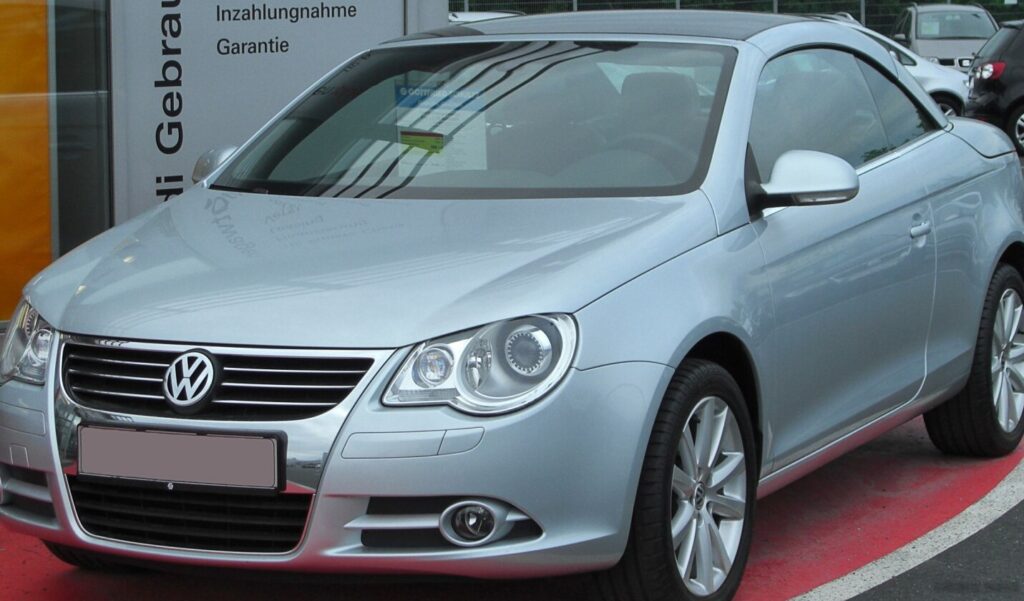
The Volkswagen Eos 2.0 TFSI, produced from 2006 to 2009, represented a key offering within the first generation (2006-2009) of Volkswagen’s hardtop convertible. Positioned as a more premium alternative to the Golf and Jetta, the Eos aimed to combine the open-air experience of a convertible with the security and practicality of a coupe. The 2.0 TFSI variant, generating 200 horsepower, served as a mid-range option in the Eos lineup, bridging the gap between the base 1.6-liter engine and the more powerful 3.2-liter VR6. It was primarily marketed towards buyers seeking a balance of performance, fuel efficiency, and sophisticated styling.
Technical Specifications
| Brand | Volkswagen |
| Model | Eos |
| Generation | Eos (First Generation) |
| Type (Engine) | 2.0 16V TFSI (200 Hp) |
| Start of production | March, 2006 |
| End of production | November, 2009 |
| Powertrain Architecture | Internal Combustion engine |
| Body type | Coupe – Cabriolet |
| Seats | 4 |
| Doors | 2 |
| Fuel consumption (urban) | 11.2 l/100 km (21 US mpg, 25.2 UK mpg, 8.9 km/l) |
| Fuel consumption (extra urban) | 6.5 l/100 km (36.2 US mpg, 43.5 UK mpg, 15.4 km/l) |
| Fuel consumption (combined) | 8.2 l/100 km (28.7 US mpg, 34.4 UK mpg, 12.2 km/l) |
| Fuel Type | Petrol (Gasoline) |
| Acceleration 0 – 100 km/h | 7.8 sec |
| Acceleration 0 – 62 mph | 7.8 sec |
| Acceleration 0 – 60 mph | 7.4 sec |
| Maximum speed | 232 km/h (144.16 mph) |
| Weight-to-power ratio | 7.7 kg/Hp, 130 Hp/tonne |
| Weight-to-torque ratio | 5.5 kg/Nm, 181.9 Nm/tonne |
| Power | 200 Hp @ 5100 rpm |
| Power per litre | 100.8 Hp/l |
| Torque | 280 Nm @ 1800 rpm (206.52 lb.-ft. @ 1800 rpm) |
| Engine layout | Front, Transverse |
| Engine Model/Code | BWA, CCZA, CAWB |
| Engine displacement | 1984 cm3 (121.07 cu. in.) |
| Number of cylinders | 4 |
| Engine configuration | Inline |
| Cylinder Bore | 82.5 mm (3.25 in.) |
| Piston Stroke | 92.8 mm (3.65 in.) |
| Compression ratio | 10.3:1 |
| Number of valves per cylinder | 4 |
| Fuel injection system | Direct injection |
| Engine aspiration | Turbocharger, Intercooler |
| Engine oil capacity | 4.6 l (4.86 US qt | 4.05 UK qt) |
| Kerb Weight | 1539 kg (3392.91 lbs.) |
| Max. weight | 2000 kg (4409.25 lbs.) |
| Max load | 461 kg (1016.33 lbs.) |
| Trunk (boot) space – minimum | 205 l (7.24 cu. ft.) |
| Trunk (boot) space – maximum | 380 l (13.42 cu. ft.) |
| Fuel tank capacity | 55 l (14.53 US gal | 12.1 UK gal) |
| Length | 4407 mm (173.5 in.) |
| Width | 1791 mm (70.51 in.) |
| Height | 1443 mm (56.81 in.) |
| Wheelbase | 2578 mm (101.5 in.) |
| Front track | 1545 mm (60.83 in.) |
| Rear (Back) track | 1553 mm (61.14 in.) |
| Minimum turning circle | 10.9 m (35.76 ft.) |
| Drivetrain Architecture | Front wheel drive |
| Number of gears | 6 gears, manual transmission |
| Front suspension | Spring Strut |
| Rear suspension | Coil spring |
| Front brakes | Ventilated discs |
| Rear brakes | Disc |
| Assisting systems | ABS (Anti-lock braking system) |
| Steering type | Steering rack and pinion |
| Tires size | 215/55 R16 |
| Wheel rims size | 7J x 16 |
Powertrain & Engine Architecture
The heart of the Eos 2.0 TFSI is the 1.984-liter, inline-four cylinder engine, designated with engine codes such as BWA, CCZA, and CAWB depending on the specific production year and market. This engine belongs to Volkswagen’s EA888 family, known for its robust design and potential for tuning. A key feature is its direct fuel injection (FSI) system, which precisely meters fuel directly into the combustion chamber, improving efficiency and power output. The engine also utilizes a turbocharger with an intercooler to further enhance performance. The turbocharger boosts air intake pressure, allowing more air and fuel to be burned, resulting in increased horsepower and torque. The valvetrain employs four valves per cylinder, contributing to improved breathing and overall engine efficiency. The 200 hp version typically featured a slightly different turbocharger and engine management calibration compared to other EA888 variants. The engine was paired with a six-speed manual transmission as standard, offering precise gear changes and driver engagement. A six-speed automatic transmission (Tiptronic) was also available as an option, providing convenience and smoother shifts, though at the expense of some performance and fuel economy.
Driving Characteristics
The Eos 2.0 TFSI offered a respectable driving experience, balancing performance with comfort. The 200 horsepower and 206 lb-ft of torque provided adequate acceleration, with a 0-60 mph time of around 7.4 seconds. While not a sports car, the engine felt responsive and provided sufficient power for everyday driving and highway cruising. The automatic transmission, while smooth, could sometimes feel hesitant during quick acceleration, and the gear ratios were tuned more for fuel efficiency than outright performance. Compared to the more powerful 3.2-liter VR6 Eos, the 2.0 TFSI offered less raw power but felt more nimble and easier to handle. The manual transmission version provided a more engaging driving experience, allowing drivers to fully utilize the engine’s powerband. The suspension was tuned for comfort, providing a relatively smooth ride, but it wasn’t particularly sporty.
Equipment & Trim Levels
The Eos 2.0 TFSI typically came well-equipped, reflecting its positioning as a premium offering. Standard features included automatic climate control, power windows and locks, a premium audio system, and alloy wheels. Interior upholstery was typically cloth, with leather options available as upgrades. Trim levels varied by market, but generally included options for upgraded audio systems, navigation, heated seats, and a retractable hardtop with a sunroof function. The retractable hardtop was a defining feature of the Eos, providing the security of a coupe with the open-air enjoyment of a convertible. Optional extras included bi-xenon headlights, parking sensors, and a sport suspension package.
Chassis & Braking
The Eos utilized a front-wheel-drive layout with a MacPherson strut suspension in the front and a multi-link coil spring suspension in the rear. The suspension was tuned for a balance of comfort and handling. Braking duties were handled by ventilated disc brakes in the front and solid disc brakes in the rear. Anti-lock braking system (ABS) was standard. The chassis was reinforced to compensate for the lack of a fixed roof, providing adequate rigidity. Stabilizer bars were fitted to both the front and rear axles to reduce body roll during cornering.
Market Reception & Comparison
The Volkswagen Eos 2.0 TFSI was generally well-received by automotive critics. It was praised for its stylish design, comfortable interior, and the convenience of its retractable hardtop. However, some critics noted that the 2.0 TFSI engine, while adequate, lacked the punch of the VR6. Fuel economy was considered reasonable for a convertible, averaging around 28.7 US mpg in combined driving. Compared to other convertibles in its class, such as the Mazda MX-5 and BMW 1 Series Convertible, the Eos offered a more practical and comfortable experience, but lacked the sporty handling of some competitors. Reliability was generally good, although some owners reported issues with the retractable hardtop mechanism over time.
Legacy
The Volkswagen Eos, while not a massive sales success, remains a popular choice among used car buyers seeking a stylish and practical convertible. The 2.0 TFSI engine has proven to be relatively reliable, although regular maintenance is essential. The EA888 engine family is well-regarded for its durability and tunability. Today, the Eos 2.0 TFSI represents an affordable entry point into the world of hardtop convertibles, offering a unique combination of style, comfort, and practicality. Parts availability is generally good, and the car’s relatively simple mechanical design makes it relatively easy to maintain.
