
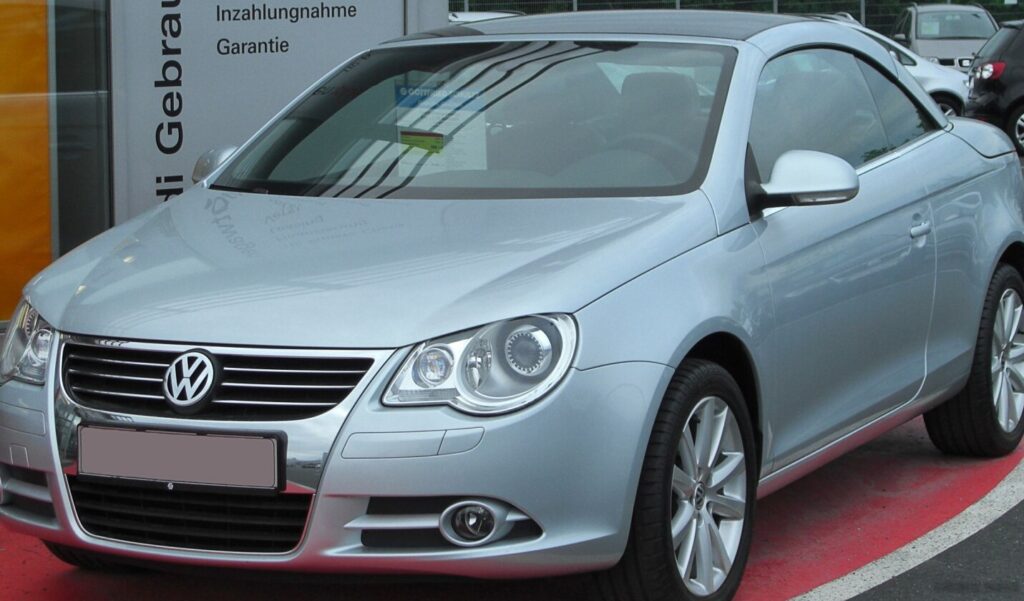
The Volkswagen Eos 2.0 TFSI with the Direct-Shift Gearbox (DSG) represents a compelling blend of performance and practicality within the Eos range. Produced from 2006 to 2009, this variant occupied a mid-range position in the Eos lineup, offering a significant step up in power and driving experience compared to the base 1.6-liter models, while remaining more accessible than the range-topping 3.2-liter V6. The Eos itself was Volkswagen’s entry into the premium compact convertible market, aiming to provide a more refined and technologically advanced alternative to rivals like the Mazda MX-5 and Peugeot 206 CC.
Technical Specifications
| Brand | Volkswagen |
| Model | Eos |
| Type (Engine) | 2.0 16V TFSI (200 Hp) DSG |
| Start of production | March, 2006 |
| End of production | November, 2009 |
| Powertrain Architecture | Internal Combustion engine |
| Body type | Coupe – Cabriolet |
| Seats | 4 |
| Doors | 2 |
| Fuel consumption (urban) | 11.3 l/100 km (20.8 US mpg) |
| Fuel consumption (extra urban) | 6.5 l/100 km (36.2 US mpg) |
| Fuel consumption (combined) | 8.2 l/100 km (28.7 US mpg) |
| Fuel Type | Petrol (Gasoline) |
| Acceleration 0 – 100 km/h | 7.9 sec |
| Acceleration 0 – 62 mph | 7.9 sec |
| Acceleration 0 – 60 mph | 7.5 sec |
| Maximum speed | 229 km/h (142.29 mph) |
| Emission standard | Euro 4 |
| Weight-to-power ratio | 7.7 kg/Hp |
| Weight-to-torque ratio | 5.5 kg/Nm |
| Power | 200 Hp @ 5100 rpm |
| Torque | 280 Nm @ 1800 rpm (206.52 lb.-ft. @ 1800 rpm) |
| Engine layout | Front, Transverse |
| Engine Model/Code | BWA, CCZA, CAWB |
| Engine displacement | 1984 cm3 (121.07 cu. in.) |
| Number of cylinders | 4 |
| Engine configuration | Inline |
| Cylinder Bore | 82.5 mm (3.25 in.) |
| Piston Stroke | 92.8 mm (3.65 in.) |
| Compression ratio | 10.3:1 |
| Number of valves per cylinder | 4 |
| Fuel injection system | Direct injection |
| Engine aspiration | Turbocharger, Intercooler |
| Engine oil capacity | 4.6 l (4.86 US qt | 4.05 UK qt) |
| Kerb Weight | 1539 kg (3392.91 lbs.) |
| Max. weight | 2000 kg (4409.25 lbs.) |
| Max load | 461 kg (1016.33 lbs.) |
| Trunk (boot) space – minimum | 205 l (7.24 cu. ft.) |
| Trunk (boot) space – maximum | 380 l (13.42 cu. ft.) |
| Fuel tank capacity | 55 l (14.53 US gal | 12.1 UK gal) |
| Length | 4407 mm (173.5 in.) |
| Width | 1791 mm (70.51 in.) |
| Height | 1443 mm (56.81 in.) |
| Wheelbase | 2578 mm (101.5 in.) |
| Front track | 1545 mm (60.83 in.) |
| Rear (Back) track | 1553 mm (61.14 in.) |
| Minimum turning circle | 10.9 m (35.76 ft.) |
| Drivetrain Architecture | Front wheel drive |
| Number of gears and type of gearbox | 6 gears, automatic transmission |
| Front suspension | Spring Strut |
| Rear suspension | Coil spring |
| Front brakes | Ventilated discs |
| Rear brakes | Disc |
| Assisting systems | ABS (Anti-lock braking system) |
| Steering type | Steering rack and pinion |
| Tires size | 215/55 R16 |
| Wheel rims size | 7J x 16 |
INTRODUCTION
The Volkswagen Eos, launched in 2006, was designed to fill a gap in Volkswagen’s lineup – a stylish, comfortable, and relatively affordable convertible that could compete with the likes of the Renault Megane Coupe-Cabriolet and Ford Focus Coupe-Cabriolet. The 2.0 TFSI with DSG, introduced alongside the initial model range, quickly became a popular choice for buyers seeking a balance between performance and fuel efficiency. The Eos was built on the A5 platform, shared with the Mk5 Golf and Jetta, providing a solid foundation for its convertible design. The “TFSI” designation signifies Volkswagen’s turbocharged fuel stratified injection technology, offering improved power and economy compared to traditional naturally aspirated engines.
Powertrain & Engine Architecture
At the heart of the Eos 2.0 TFSI lies the BWA, CCZA, or CAWB engine code, a 1.984-liter inline-four cylinder engine. This engine utilizes direct fuel injection, a technology that precisely meters fuel directly into the combustion chamber, enhancing efficiency and reducing emissions. The engine is turbocharged, employing a K03 turbocharger and an intercooler to increase power output. The valvetrain features four valves per cylinder, contributing to improved breathing and overall performance. The 2.0 TFSI produces 200 horsepower at 5100 rpm and 280 Nm (206.52 lb-ft) of torque from as low as 1800 rpm.
The DSG (Direct-Shift Gearbox) is a six-speed dual-clutch transmission. Unlike a traditional automatic, the DSG offers incredibly fast and smooth gear changes, mimicking the feel of a manual transmission but without the need for a clutch pedal. It achieves this by having two separate clutches, one for odd-numbered gears and one for even-numbered gears. While the gear is engaged, the next gear is pre-selected, allowing for near-instantaneous shifts. This transmission significantly enhances the driving experience, providing quicker acceleration and improved fuel economy compared to a conventional automatic.
Driving Characteristics
The Eos 2.0 TFSI DSG delivers a noticeably more engaging driving experience than the base 1.6-liter models. The turbocharger provides a strong mid-range punch, making overtaking maneuvers effortless. Acceleration from 0 to 60 mph takes approximately 7.5 seconds, and the car feels responsive and agile. The DSG transmission contributes significantly to this feeling, providing quick and precise gear changes. While not a sports car, the 2.0 TFSI offers a satisfying level of performance for everyday driving. Compared to the manual transmission version, the DSG offers slightly slower acceleration due to the inherent losses in the dual-clutch system, but the convenience and smoothness of the automatic shifting are often preferred by buyers.
Equipment & Trim Levels
The Eos 2.0 TFSI typically came well-equipped, reflecting its mid-range positioning. Standard features included air conditioning, alloy wheels, a multi-function steering wheel, and an integrated audio system. Higher trim levels, such as the Sport or Comfort packages, added features like leather upholstery, heated front seats, a sunroof, and upgraded audio systems. Optional extras included navigation systems, parking sensors, and bi-xenon headlights. Interior upholstery was typically cloth on base models, with leather options available on higher trims. The dashboard layout was clean and functional, typical of Volkswagen’s design philosophy at the time.
Chassis & Braking
The Eos utilizes a front independent suspension with spring struts and a rear coil spring suspension. This setup provides a comfortable ride while maintaining reasonable handling characteristics. The front brakes are ventilated discs, providing ample stopping power, while the rear brakes are solid discs. ABS (Anti-lock Braking System) is standard, enhancing safety and control during emergency braking situations. The Eos’s chassis was reinforced to compensate for the loss of structural rigidity inherent in a convertible design, ensuring a stable and secure driving experience.
Market Reception & Comparison
The Volkswagen Eos 2.0 TFSI DSG was generally well-received by automotive critics. It was praised for its stylish design, comfortable interior, and strong performance. The DSG transmission was a particular highlight, lauded for its smoothness and responsiveness. Fuel economy was considered respectable for a convertible, averaging around 28.7 US mpg in combined driving. Compared to the 1.6-liter Eos, the 2.0 TFSI offered a significant performance upgrade, making it a more enjoyable car to drive. However, it was more expensive to purchase and maintain, and fuel consumption was slightly higher. Compared to the 3.2-liter V6, the 2.0 TFSI offered a better balance between performance and economy, appealing to a wider range of buyers.
Legacy
The Volkswagen Eos 2.0 TFSI DSG has proven to be a relatively reliable powertrain. The 2.0 TFSI engine, while not without its potential issues (such as carbon buildup on the intake valves), is generally robust when properly maintained. The DSG transmission, while more complex than a traditional automatic, is also generally reliable, provided that regular fluid changes are performed. Today, the Eos 2.0 TFSI can be found on the used car market at relatively affordable prices. It remains a stylish and enjoyable convertible, offering a good value for those seeking a premium open-top experience. However, potential buyers should be aware of the potential maintenance costs associated with a European car of this age, including the DSG transmission and the potential for carbon buildup in the engine.
