
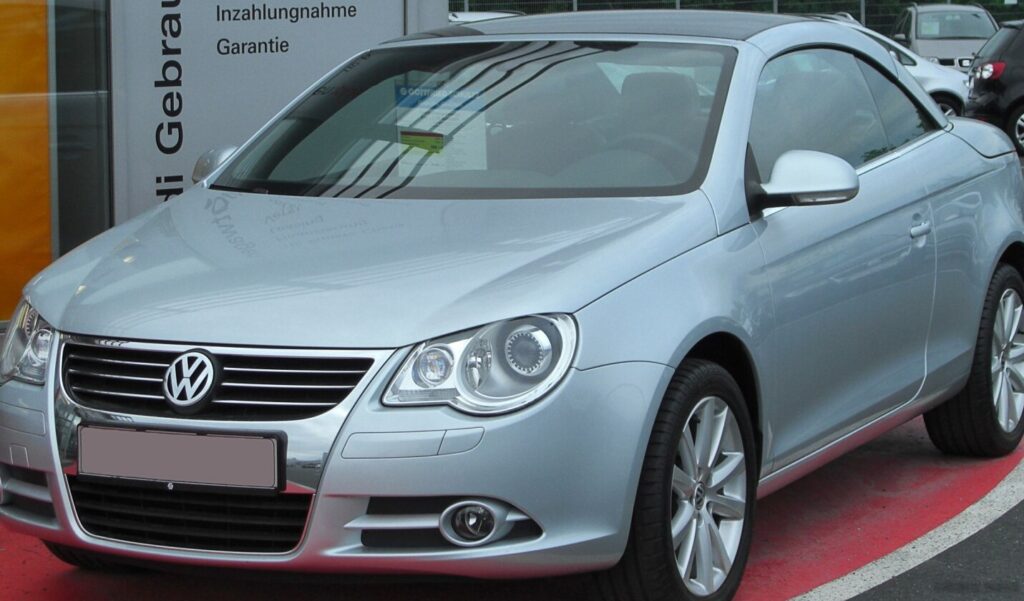
The Volkswagen Eos 2.0 TDI with the Direct-Shift Gearbox (DSG) represents a compelling blend of practicality, style, and efficiency within the Eos range. Produced between 2008 and 2010, this variant occupied a mid-range position in the Eos lineup, offering a diesel-powered alternative to the gasoline engines available. The Eos itself was Volkswagen’s entry into the coupe-convertible market, aiming to provide a more premium and refined experience than some of its competitors. It was built on the A5 (1HX0) platform, shared with the Golf Mk5 and Jetta Mk5, providing a solid foundation for its folding hardtop mechanism.
Technical Specifications
| Brand | Volkswagen |
| Model | Eos |
| Generation | Eos |
| Type (Engine) | 2.0 TDI (140 Hp) DSG |
| Start of production | 2008 |
| End of production | 2010 |
| Powertrain Architecture | Internal Combustion engine |
| Body type | Coupe – Cabriolet |
| Seats | 4 |
| Doors | 2 |
| Fuel consumption (economy) – urban (NEDC) | 7.6 l/100 km (30.9 US mpg, 37.2 UK mpg, 13.2 km/l) |
| Fuel consumption (economy) – extra urban (NEDC) | 4.9 l/100 km (48 US mpg, 57.6 UK mpg, 20.4 km/l) |
| Fuel consumption (economy) – combined (NEDC) | 5.9 l/100 km (39.9 US mpg, 47.9 UK mpg, 16.9 km/l) |
| CO2 emissions (NEDC) | 154 g/km |
| Fuel Type | Diesel |
| Acceleration 0 – 100 km/h | 10.3 sec |
| Acceleration 0 – 62 mph | 10.3 sec |
| Acceleration 0 – 60 mph | 9.8 sec |
| Maximum speed | 203 km/h (126.14 mph) |
| Emission standard | Euro 5 |
| Weight-to-power ratio | 10.9 kg/Hp, 91.4 Hp/tonne |
| Weight-to-torque ratio | 4.8 kg/Nm, 209 Nm/tonne |
| Power | 140 Hp @ 4200 rpm |
| Power per litre | 71.1 Hp/l |
| Torque | 320 Nm @ 1750-2500 rpm (236.02 lb.-ft. @ 1750-2500 rpm) |
| Engine layout | Front, Transverse |
| Engine Model/Code | CBAB, CFFB |
| Engine displacement | 1968 cm3 (120.09 cu. in.) |
| Number of cylinders | 4 |
| Engine configuration | Inline |
| Cylinder Bore | 81 mm (3.19 in.) |
| Piston Stroke | 95.5 mm (3.76 in.) |
| Compression ratio | 18:1 |
| Number of valves per cylinder | 4 |
| Fuel injection system | Diesel Commonrail |
| Engine aspiration | Turbocharger, Intercooler |
| Valvetrain | DOHC |
| Engine oil capacity | 4 l (4.23 US qt | 3.52 UK qt) |
| Kerb Weight | 1531 kg (3375.28 lbs.) |
| Max. weight | 2030 kg (4475.38 lbs.) |
| Max load | 499 kg (1100.11 lbs.) |
| Trunk (boot) space – minimum | 205 l (7.24 cu. ft.) |
| Trunk (boot) space – maximum | 380 l (13.42 cu. ft.) |
| Fuel tank capacity | 55 l (14.53 US gal | 12.1 UK gal) |
| Permitted trailer load with brakes (8%) | 1700 kg (3747.86 lbs.) |
| Permitted trailer load with brakes (12%) | 1500 kg (3306.93 lbs.) |
| Permitted trailer load without brakes | 750 kg (1653.47 lbs.) |
| Permitted towbar download | 75 kg (165.35 lbs.) |
| Length | 4407 mm (173.5 in.) |
| Width | 1791 mm (70.51 in.) |
| Width including mirrors | 2009 mm (79.09 in.) |
| Height | 1443 mm (56.81 in.) |
| Wheelbase | 2578 mm (101.5 in.) |
| Front track | 1545 mm (60.83 in.) |
| Rear (Back) track | 1553 mm (61.14 in.) |
| Ride height (ground clearance) | 106 mm (4.17 in.) |
| Minimum turning circle (turning diameter) | 10.9 m (35.76 ft.) |
| Drivetrain Architecture | The Internal combustion engine (ICE) drives the front wheels of the vehicle. |
| Drive wheel | Front wheel drive |
| Number of gears and type of gearbox | 6 gears, automatic transmission DSG |
| Front suspension | Coil spring, Wishbone, Transverse stabilizer |
| Rear suspension | Independent multi-link suspension, Transverse stabilizer |
| Front brakes | Ventilated discs |
| Rear brakes | Disc |
| Assisting systems | ABS (Anti-lock braking system) |
| Steering type | Steering rack and pinion |
| Power steering | Electric Steering |
| Tires size | 215/55 R16 |
| Wheel rims size | 7J x 16 |
Powertrain & Engine Architecture
The heart of the Eos 2.0 TDI DSG is the Volkswagen Group’s 1968cc inline-four cylinder diesel engine, designated either CBAB or CFFB depending on minor variations. This engine is a common-rail direct injection diesel, utilizing piezo injectors for precise fuel delivery. The turbocharger, coupled with an intercooler, provides increased air density for improved power output. The engine produces 140 horsepower at 4200 rpm and a substantial 320 Nm (236 lb-ft) of torque between 1750 and 2500 rpm. This torque curve is a hallmark of diesel engines, providing strong pulling power at lower engine speeds. The engine features a double overhead camshaft (DOHC) valvetrain with four valves per cylinder, optimizing gas flow for efficient combustion. The engine is transversely mounted in the front of the vehicle.
The ‘DSG’ in the name refers to Volkswagen’s Dual-Shift Gearbox, a six-speed automated manual transmission. This transmission offers the efficiency of a manual gearbox with the convenience of an automatic. It utilizes two separate clutches to pre-select the next gear, resulting in incredibly fast and smooth gear changes. This contributes to both improved performance and fuel economy.
Driving Characteristics
The 2.0 TDI DSG Eos delivers a refined and comfortable driving experience. The abundant torque makes everyday driving effortless, with strong acceleration from low speeds. While not a sports car, the 140 hp engine provides adequate power for highway cruising and overtaking. The DSG transmission shifts quickly and smoothly, enhancing the overall driving experience. Compared to the 1.6L gasoline engine option, the 2.0 TDI offers significantly more torque and better fuel economy. It’s also noticeably quicker than the base engine. However, it doesn’t match the performance of the more powerful 2.0 TSI gasoline engine, which offers a more spirited driving experience. The DSG transmission, while efficient, can sometimes feel slightly less engaging than a traditional manual gearbox.
Equipment & Trim Levels
The Eos 2.0 TDI DSG typically came well-equipped, reflecting its positioning as a mid-range model. Standard features often included climate control, alloy wheels, a multi-function steering wheel, and an infotainment system with a CD player. Safety features such as ABS, traction control, and multiple airbags were also standard. Optional extras included leather upholstery, a sunroof (in addition to the folding hardtop), parking sensors, and upgraded audio systems. Trim levels varied slightly depending on the market, but generally offered increasing levels of luxury and convenience.
Chassis & Braking
The Eos utilizes a MacPherson strut front suspension and a multi-link rear suspension, providing a comfortable ride and good handling characteristics. The suspension is tuned for comfort rather than outright sportiness. The braking system consists of ventilated discs at the front and solid discs at the rear, providing adequate stopping power. ABS (Anti-lock Braking System) is standard, enhancing safety during emergency braking situations. Stabilizer bars are fitted to both the front and rear axles to reduce body roll during cornering.
Market Reception & Comparison
The Eos 2.0 TDI DSG was generally well-received by automotive critics. It was praised for its comfortable ride, refined interior, and fuel-efficient diesel engine. The DSG transmission was also a highlight, offering smooth and quick gear changes. Compared to other coupe-convertibles in its class, the Eos offered a compelling combination of practicality and style. Fuel economy was a key selling point, particularly in Europe where diesel engines are more popular. Reliability was generally good, although some owners reported minor issues with the DSG transmission.
Legacy
The Volkswagen Eos 2.0 TDI DSG remains a relatively common sight on the used car market. The 2.0 TDI engine is known for its durability and longevity, provided it has been properly maintained. The DSG transmission, while potentially requiring more frequent servicing than a traditional automatic, is generally reliable. These cars offer a good value proposition for buyers seeking a stylish and fuel-efficient coupe-convertible. However, potential buyers should be aware of the potential maintenance costs associated with the DSG transmission and ensure that the car has a full service history.
