
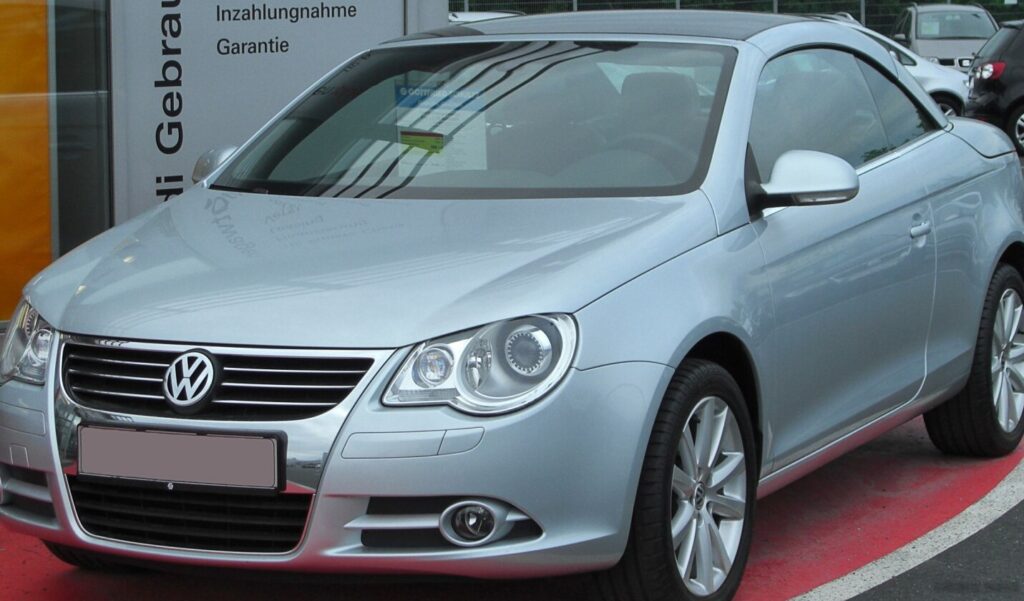
The Volkswagen Eos 2.0 TDI (140 hp) PDE, produced between March 2006 and May 2008, represents a compelling blend of coupe and convertible styling within the first generation (2006-2008) Eos lineup. Positioned as a mid-range offering, it aimed to provide a balance between fuel efficiency, reasonable performance, and the open-air experience characteristic of a retractable hardtop convertible. The Eos itself was designed to fill a gap in Volkswagen’s portfolio, offering a more premium alternative to the New Beetle Cabriolet and competing with models like the Renault Mégane Coupé-Cabriolet and Opel Astra TwinTop. This particular diesel variant was primarily targeted at the European market, where diesel engines enjoyed significant popularity due to favorable taxation and fuel economy.
Technical Specifications
| Brand | Volkswagen |
| Model | Eos |
| Generation | Eos |
| Type (Engine) | 2.0 TDI (140 Hp) PDE |
| Start of production | March, 2006 |
| End of production | May, 2008 |
| Powertrain Architecture | Internal Combustion engine |
| Body type | Coupe – Cabriolet |
| Seats | 4 |
| Doors | 2 |
| Fuel consumption (urban) | 8 l/100 km (29.4 US mpg, 35.3 UK mpg, 12.5 km/l) |
| Fuel consumption (extra urban) | 5 l/100 km (47 US mpg, 56.5 UK mpg, 20 km/l) |
| Fuel consumption (combined) | 6 l/100 km (39.2 US mpg, 47.1 UK mpg, 16.7 km/l) |
| Fuel Type | Diesel |
| Acceleration 0 – 100 km/h | 10.3 sec |
| Acceleration 0 – 62 mph | 10.3 sec |
| Acceleration 0 – 60 mph | 9.8 sec |
| Maximum speed | 206 km/h (128 mph) |
| Weight-to-power ratio | 11.1 kg/Hp, 90.4 Hp/tonne |
| Weight-to-torque ratio | 4.8 kg/Nm, 206.7 Nm/tonne |
| Power | 140 Hp @ 4000 rpm |
| Power per litre | 71.1 Hp/l |
| Torque | 320 Nm @ 1750 rpm (236.02 lb.-ft. @ 1750 rpm) |
| Engine layout | Front, Transverse |
| Engine Model/Code | EA188 / BMM |
| Engine displacement | 1968 cm3 (120.09 cu. in.) |
| Number of cylinders | 4 |
| Engine configuration | Inline |
| Cylinder Bore | 81 mm (3.19 in.) |
| Piston Stroke | 95.5 mm (3.76 in.) |
| Compression ratio | 18.5:1 |
| Number of valves per cylinder | 2 |
| Fuel injection system | Diesel Commonrail |
| Engine aspiration | Turbocharger, Intercooler |
| Engine oil capacity | 4.3 l (4.54 US qt | 3.78 UK qt) |
| Kerb Weight | 1548 kg (3412.76 lbs.) |
| Max. weight | 2010 kg (4431.29 lbs.) |
| Max load | 462 kg (1018.54 lbs.) |
| Trunk (boot) space – minimum | 205 l (7.24 cu. ft.) |
| Trunk (boot) space – maximum | 380 l (13.42 cu. ft.) |
| Fuel tank capacity | 55 l (14.53 US gal | 12.1 UK gal) |
| Length | 4407 mm (173.5 in.) |
| Width | 1791 mm (70.51 in.) |
| Height | 1443 mm (56.81 in.) |
| Wheelbase | 2578 mm (101.5 in.) |
| Front track | 1545 mm (60.83 in.) |
| Rear (Back) track | 1553 mm (61.14 in.) |
| Minimum turning circle | 10.9 m (35.76 ft.) |
| Drivetrain Architecture | The Internal combustion engine (ICE) drives the front wheels of the vehicle. |
| Drive wheel | Front wheel drive |
| Number of gears | 6 gears, manual transmission |
| Front suspension | Spring Strut |
| Rear suspension | Coil spring |
| Front brakes | Ventilated discs |
| Rear brakes | Disc |
| Assisting systems | ABS (Anti-lock braking system) |
| Steering type | Steering rack and pinion |
| Tires size | 215/55 R16 |
| Wheel rims size | 7J x 16 |
Powertrain & Engine Architecture
The heart of the Eos 2.0 TDI is the EA188 series engine, specifically the BMM code. This 1968cc inline-four cylinder diesel engine utilizes a common rail direct injection system (PDE – Pump-Diesel-Engine) to deliver fuel directly into the combustion chamber at extremely high pressures. The PDE system, while effective, was later superseded by more advanced common rail technologies offering finer control and reduced noise. The engine features a single overhead camshaft (SOHC) operating two valves per cylinder. A turbocharger with an intercooler is employed to boost power and torque, providing 140 horsepower at 4000 rpm and a substantial 320 Nm (236 lb-ft) of torque from as low as 1750 rpm. This torque output is a key characteristic of diesel engines, providing strong pulling power at lower engine speeds. The engine is transversely mounted in the front of the vehicle, driving the front wheels.
Driving Characteristics
The 2.0 TDI with the six-speed manual transmission offered a respectable driving experience for the Eos. While not a sports car, the engine’s torque allowed for effortless cruising and confident overtaking. Acceleration from 0-60 mph took around 9.8 seconds, and the top speed was 128 mph. Compared to the more powerful 2.0-liter petrol (gasoline) versions, the TDI lacked outright punch, but it compensated with superior fuel economy and a broader, more usable powerband. The six-speed gearbox was well-matched to the engine, providing adequate ratios for both city driving and highway cruising. The manual transmission was the most common offering, though a Direct-Shift Gearbox (DSG) was available as an option, providing quicker shifts and a more refined driving experience. The Eos’s weight, around 3400 lbs, was noticeable, particularly during spirited driving, but the chassis remained composed and predictable.
Equipment & Trim Levels
The 2.0 TDI typically came equipped with a reasonable level of standard features. This included air conditioning, alloy wheels, a CD stereo system, and electric windows and mirrors. Higher trim levels, such as the ‘Sport’ or ‘Comfort’ packages, added features like automatic climate control, upgraded upholstery, parking sensors, and a sunroof. Interior upholstery was typically cloth, with leather options available as an upgrade. The dashboard layout was functional and well-designed, with a focus on ergonomics. Optional extras included a navigation system, premium sound system, and heated seats.
Chassis & Braking
The Eos utilized a MacPherson strut front suspension and a multi-link rear suspension, providing a comfortable ride and decent handling. The front brakes were ventilated discs, while the rear brakes were solid discs. Anti-lock Braking System (ABS) was standard. The suspension was tuned to prioritize comfort over outright sportiness, but it still offered a reasonably controlled driving experience. Stabilizer bars were fitted to both the front and rear axles to reduce body roll during cornering. The Eos’s chassis was reinforced to compensate for the loss of structural rigidity resulting from the retractable hardtop mechanism.
Market Reception & Comparison
The Eos 2.0 TDI was generally well-received by automotive critics. It was praised for its fuel efficiency, comfortable ride, and stylish design. However, some critics noted that the engine lacked the refinement of some of its competitors, and the car’s weight could be a hindrance to performance. Compared to the petrol (gasoline) versions of the Eos, the TDI offered significantly better fuel economy, making it a popular choice for drivers who covered long distances. The 2.0 TDI was also more affordable than the more powerful engine options, making it an attractive option for budget-conscious buyers. Reliability was generally good, although the PDE fuel injection system could be prone to issues if not properly maintained.
Legacy
The Volkswagen Eos 2.0 TDI, while not a groundbreaking vehicle, remains a popular choice in the used car market. Its combination of style, practicality, and fuel efficiency continues to appeal to buyers. The EA188 engine, in its various iterations, has proven to be a durable and reliable unit, although regular maintenance is essential. The PDE fuel injection system requires careful attention to fuel quality and regular servicing to prevent issues. Today, the Eos 2.0 TDI represents a relatively affordable entry point into the world of retractable hardtop convertibles, offering a unique blend of open-air enjoyment and everyday usability.
