
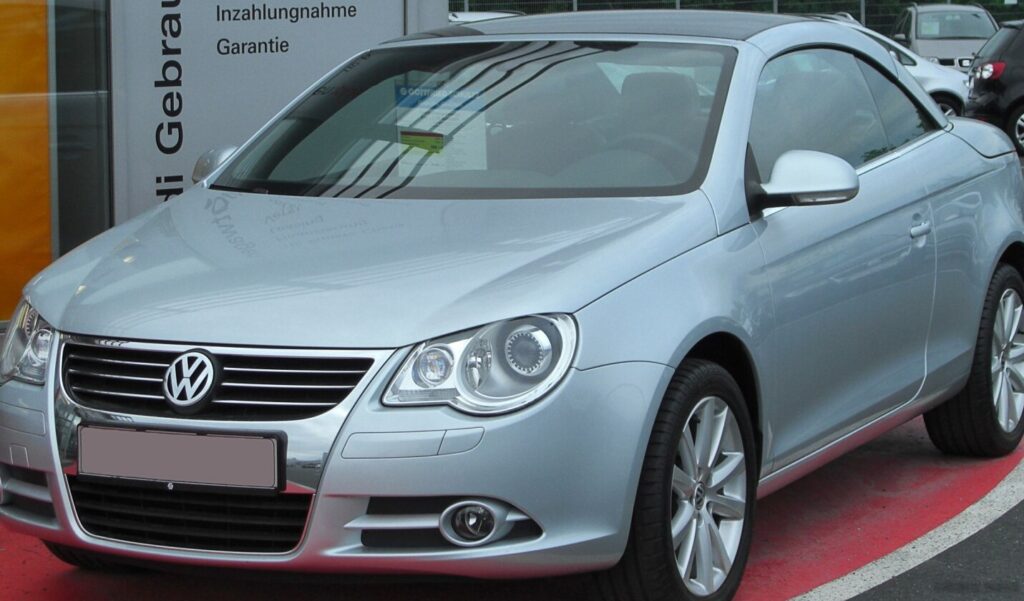
The Volkswagen Eos 2.0 TSI, produced from 2009 to 2010, represents a compelling blend of coupe and convertible styling within the Eos model range. Positioned as a mid-range offering, it slotted between the more economical 1.6-liter variants and the range-topping 2.0 TDI diesel. This particular iteration, powered by the 210 horsepower 2.0-liter turbocharged gasoline engine, aimed to deliver a more spirited driving experience while retaining the Eos’s core appeal of open-air motoring and practical usability. The Eos itself was built on the Volkswagen Group’s A5 (or 1HX0) platform, shared with models like the Golf Mk5 and Jetta Mk5, and was marketed primarily in Europe and North America.
Technical Specifications
| Brand | Volkswagen |
| Model | Eos |
| Generation | Eos |
| Type (Engine) | 2.0 TSI (210 Hp) |
| Start of production | 2009 |
| End of production | 2010 |
| Powertrain Architecture | Internal Combustion engine |
| Body type | Coupe – Cabriolet |
| Seats | 4 |
| Doors | 2 |
| Fuel consumption (economy) – urban (NEDC) | 9.7 l/100 km (24.2 US mpg, 29.1 UK mpg, 10.3 km/l) |
| Fuel consumption (economy) – extra urban (NEDC) | 5.7 l/100 km (41.3 US mpg, 49.6 UK mpg, 17.5 km/l) |
| Fuel consumption (economy) – combined (NEDC) | 7.2 l/100 km (32.7 US mpg, 39.2 UK mpg, 13.9 km/l) |
| CO2 emissions (NEDC) | 167 g/km |
| Fuel Type | Petrol (Gasoline) |
| Acceleration 0 – 100 km/h | 7.8 sec |
| Acceleration 0 – 62 mph | 7.8 sec |
| Acceleration 0 – 60 mph | 7.4 sec |
| Maximum speed | 236 km/h (146.64 mph) |
| Emission standard | Euro 5 |
| Weight-to-power ratio | 7.1 kg/Hp, 140.3 Hp/tonne |
| Weight-to-torque ratio | 5.3 kg/Nm, 187 Nm/tonne |
| Power | 210 Hp @ 5300-6200 rpm |
| Power per litre | 105.8 Hp/l |
| Torque | 280 Nm @ 1700-5200 rpm (206.52 lb.-ft. @ 1700-5200 rpm) |
| Engine layout | Front, Transverse |
| Engine Model/Code | CCZB |
| Engine displacement | 1984 cm3 (121.07 cu. in.) |
| Number of cylinders | 4 |
| Engine configuration | Inline |
| Cylinder Bore | 82.5 mm (3.25 in.) |
| Piston Stroke | 92.8 mm (3.65 in.) |
| Compression ratio | 9.6:1 |
| Number of valves per cylinder | 4 |
| Fuel injection system | Direct injection |
| Engine aspiration | Turbocharger, Intercooler |
| Valvetrain | DOHC |
| Engine oil capacity | 4.6 l (4.86 US qt | 4.05 UK qt) |
| Kerb Weight | 1497 kg (3300.32 lbs.) |
| Max. weight | 2000 kg (4409.25 lbs.) |
| Max load | 503 kg (1108.93 lbs.) |
| Trunk (boot) space – minimum | 205 l (7.24 cu. ft.) |
| Trunk (boot) space – maximum | 380 l (13.42 cu. ft.) |
| Fuel tank capacity | 55 l (14.53 US gal | 12.1 UK gal) |
| Permitted trailer load with brakes (8%) | 1700 kg (3747.86 lbs.) |
| Permitted trailer load with brakes (12%) | 1500 kg (3306.93 lbs.) |
| Permitted trailer load without brakes | 750 kg (1653.47 lbs.) |
| Permitted towbar download | 75 kg (165.35 lbs.) |
| Length | 4407 mm (173.5 in.) |
| Width | 1791 mm (70.51 in.) |
| Width including mirrors | 2009 mm (79.09 in.) |
| Height | 1443 mm (56.81 in.) |
| Wheelbase | 2578 mm (101.5 in.) |
| Front track | 1545 mm (60.83 in.) |
| Rear (Back) track | 1553 mm (61.14 in.) |
| Ride height (ground clearance) | 106 mm (4.17 in.) |
| Minimum turning circle (turning diameter) | 10.9 m (35.76 ft.) |
| Front suspension | Coil spring, Wishbone, Transverse stabilizer |
| Rear suspension | Independent multi-link suspension, Transverse stabilizer |
| Front brakes | Ventilated discs |
| Rear brakes | Disc |
| Assisting systems | ABS (Anti-lock braking system) |
| Steering type | Steering rack and pinion |
| Power steering | Electric Steering |
| Tires size | 215/55 R16 |
| Wheel rims size | 7J x 16 |
Powertrain & Engine Architecture
At the heart of the Eos 2.0 TSI lies the CCZB engine code, a 1.984-liter inline-four cylinder gasoline engine. This engine is a member of Volkswagen’s EA888 family, known for its robust construction and tuning potential. The CCZB utilizes direct fuel injection (FSI) and a turbocharger with an intercooler to deliver a substantial 210 horsepower and 280 Nm (206.52 lb-ft) of torque. The engine’s valvetrain features a dual overhead camshaft (DOHC) design with four valves per cylinder, optimizing airflow for improved performance. The engine’s power delivery is relatively flat across a broad rev range, with peak torque available from 1700 to 5200 rpm. The engine was typically paired with a six-speed manual transmission, but a six-speed automatic transmission (often the 09G) was also offered, and is the focus of this article. This automatic transmission featured Tiptronic functionality, allowing drivers to manually shift gears when desired.
Driving Characteristics
The 2.0 TSI engine, when coupled with the six-speed automatic transmission, provided a comfortable and capable driving experience. While not as overtly sporty as the manual version, the automatic offered smooth gear changes and adequate acceleration. The 0-60 mph time of around 7.4 seconds was respectable for its class. The automatic transmission’s gear ratios were tuned for a balance of fuel efficiency and responsiveness. In typical driving conditions, the transmission would upshift quickly to maximize fuel economy, but would readily downshift when more power was needed for overtaking or climbing hills. Compared to the lower-powered 1.6-liter Eos models, the 2.0 TSI offered a significant performance boost, making it more suitable for long highway journeys and spirited driving. However, it didn’t quite match the responsiveness of the manual transmission or the higher-output versions of the 2.0 TSI found in other Volkswagen models like the Golf GTI.
Equipment & Trim Levels
The Eos 2.0 TSI typically came well-equipped, reflecting its mid-range positioning. Standard features often included automatic climate control, a multi-function steering wheel, alloy wheels, and a CD stereo system. The interior upholstery was usually cloth, but leather options were available. The dashboard layout was typical of Volkswagen’s design language at the time, with a clean and functional aesthetic. Optional extras included a sunroof, navigation system, upgraded audio system, and parking sensors. The Eos’s retractable hardtop was a key feature, providing the security and weather protection of a coupe with the open-air experience of a convertible.
Chassis & Braking
The Eos 2.0 TSI utilized a MacPherson strut front suspension and a multi-link rear suspension, providing a comfortable ride and good handling characteristics. Stabilizer bars were fitted to both the front and rear axles to reduce body roll during cornering. The braking system consisted of ventilated discs at the front and solid discs at the rear, providing adequate stopping power. Anti-lock braking system (ABS) was standard. The Eos’s chassis was reinforced to compensate for the lack of a fixed roof, ensuring structural rigidity and safety.
Market Reception & Comparison
The Volkswagen Eos 2.0 TSI was generally well-received by automotive critics. It was praised for its stylish design, comfortable ride, and refined engine. However, some critics noted that the Eos was relatively expensive compared to other convertibles in its class. Fuel economy was considered reasonable for a 2.0-liter turbocharged engine, averaging around 32.7 US mpg in combined driving. Reliability was generally good, although some owners reported minor issues with the retractable hardtop mechanism. Compared to the 1.6-liter Eos, the 2.0 TSI offered a significant performance upgrade, while the 2.0 TDI provided better fuel economy but less outright power.
Legacy
The Volkswagen Eos 2.0 TSI, while not a high-volume seller, has developed a following among enthusiasts who appreciate its blend of style, comfort, and performance. The CCZB engine is known for its durability and reliability, and well-maintained examples continue to be sought after in the used car market. The automatic transmission, while not as engaging as the manual, is generally considered reliable. The Eos’s retractable hardtop remains a desirable feature, offering a unique combination of coupe and convertible practicality. Today, the Eos 2.0 TSI represents a relatively affordable entry point into the world of German convertible motoring.
