
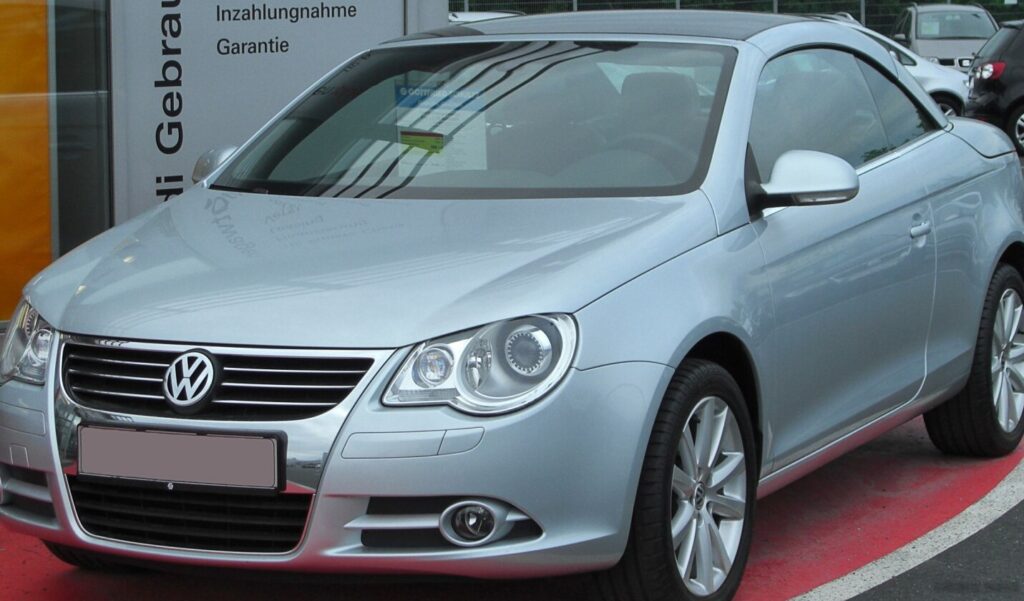
The Volkswagen Eos 2.0 TSI (210 Hp) DSG represents a compelling blend of open-air motoring and turbocharged performance within the Eos model range. Produced from 2009 to 2010, this variant occupied a mid-to-upper position in the Eos lineup, offering a significant step up in power and driving dynamics compared to the base 1.6-liter models. The Eos itself was Volkswagen’s entry into the coupe-convertible segment, aiming to provide a more refined and practical alternative to rivals like the Mazda MX-5 and Peugeot 206 CC. It was built on the A5 (1HX0) platform, shared with the Golf Mk5 and Jetta Mk5, providing a solid foundation for its folding hardtop mechanism.
Technical Specifications
| Brand | Volkswagen |
| Model | Eos |
| Generation | Eos |
| Type (Engine) | 2.0 TSI (210 Hp) DSG |
| Start of production | 2009 |
| End of production | 2010 |
| Powertrain Architecture | Internal Combustion engine |
| Body type | Coupe – Cabriolet |
| Seats | 4 |
| Doors | 2 |
| Fuel consumption (economy) – urban (NEDC) | 10.4 l/100 km (22.6 US mpg, 27.2 UK mpg, 9.6 km/l) |
| Fuel consumption (economy) – extra urban (NEDC) | 6.1 l/100 km (38.6 US mpg, 46.3 UK mpg, 16.4 km/l) |
| Fuel consumption (economy) – combined (NEDC) | 7.7 l/100 km (30.5 US mpg, 36.7 UK mpg, 13 km/l) |
| CO2 emissions (NEDC) | 178 g/km |
| Fuel Type | Petrol (Gasoline) |
| Acceleration 0 – 100 km/h | 7.8 sec |
| Acceleration 0 – 62 mph | 7.8 sec |
| Acceleration 0 – 60 mph | 7.4 sec |
| Maximum speed | 234 km/h (145.4 mph) |
| Emission standard | Euro 5 |
| Weight-to-power ratio | 7.2 kg/Hp, 138.7 Hp/tonne |
| Weight-to-torque ratio | 5.4 kg/Nm, 184.9 Nm/tonne |
| Power | 210 Hp @ 5300-6200 rpm |
| Power per litre | 105.8 Hp/l |
| Torque | 280 Nm @ 1700-5200 rpm (206.52 lb.-ft. @ 1700-5200 rpm) |
| Engine layout | Front, Transverse |
| Engine Model/Code | CCZB |
| Engine displacement | 1984 cm3 (121.07 cu. in.) |
| Number of cylinders | 4 |
| Engine configuration | Inline |
| Cylinder Bore | 82.5 mm (3.25 in.) |
| Piston Stroke | 92.8 mm (3.65 in.) |
| Compression ratio | 9.6:1 |
| Number of valves per cylinder | 4 |
| Fuel injection system | Direct injection |
| Engine aspiration | Turbocharger, Intercooler |
| Valvetrain | DOHC |
| Engine oil capacity | 4.6 l (4.86 US qt | 4.05 UK qt) |
| Kerb Weight | 1514 kg (3337.8 lbs.) |
| Max. weight | 2020 kg (4453.34 lbs.) |
| Max load | 506 kg (1115.54 lbs.) |
| Trunk (boot) space – minimum | 205 l (7.24 cu. ft.) |
| Trunk (boot) space – maximum | 380 l (13.42 cu. ft.) |
| Fuel tank capacity | 55 l (14.53 US gal | 12.1 UK gal) |
| Permitted trailer load with brakes (8%) | 1700 kg (3747.86 lbs.) |
| Permitted trailer load with brakes (12%) | 1500 kg (3306.93 lbs.) |
| Permitted trailer load without brakes | 750 kg (1653.47 lbs.) |
| Permitted towbar download | 75 kg (165.35 lbs.) |
| Length | 4407 mm (173.5 in.) |
| Width | 1791 mm (70.51 in.) |
| Width including mirrors | 2009 mm (79.09 in.) |
| Height | 1443 mm (56.81 in.) |
| Wheelbase | 2578 mm (101.5 in.) |
| Front track | 1545 mm (60.83 in.) |
| Rear (Back) track | 1553 mm (61.14 in.) |
| Ride height (ground clearance) | 106 mm (4.17 in.) |
| Minimum turning circle (turning diameter) | 10.9 m (35.76 ft.) |
| Front suspension | Coil spring, Wishbone, Transverse stabilizer |
| Rear suspension | Independent multi-link suspension, Transverse stabilizer |
| Front brakes | Ventilated discs |
| Rear brakes | Disc |
| Drive wheel | Front wheel drive |
| Number of gears and type of gearbox | 6 gears, automatic transmission DSG |
| Tires size | 215/55 R16 |
| Wheel rims size | 7J x 16 |
INTRODUCTION
The Volkswagen Eos 2.0 TSI DSG, produced between 2009 and 2010, represents a significant upgrade within the Eos range. Positioned as a more performance-oriented variant, it catered to drivers seeking a blend of open-top enjoyment and spirited driving. The Eos, launched in 2006, aimed to fill a gap in Volkswagen’s lineup, offering a retractable hardtop convertible that combined the security and weather protection of a coupe with the freedom of a convertible. The 2.0 TSI model, utilizing the advanced CCZB engine code, was a key component in establishing the Eos as a credible competitor in the premium coupe-convertible segment.
Powertrain & Engine Architecture
At the heart of the Eos 2.0 TSI DSG lies the CCZB engine, a 1984cc inline-four cylinder powerplant. This engine is a member of Volkswagen’s EA888 family, known for its robust construction and tuning potential. The CCZB features direct fuel injection (FSI), a turbocharger with an intercooler, and a dual overhead camshaft (DOHC) valvetrain with four valves per cylinder. This configuration allows for a broad torque curve and responsive power delivery. The engine produces 210 horsepower at 5300-6200 rpm and 280 Nm (206.52 lb-ft) of torque between 1700 and 5200 rpm. The engine’s turbocharger is a K04 unit, providing a good balance between responsiveness and peak power. Paired with the engine is the Volkswagen’s 6-speed DSG (Direct-Shift Gearbox) dual-clutch transmission. This transmission offers quick, seamless shifts and contributes to the car’s overall performance and efficiency. The DSG allows for both fully automatic operation and manual gear selection via steering wheel-mounted paddles or the gear selector.
Driving Characteristics
The Eos 2.0 TSI DSG delivers a noticeably more engaging driving experience than the lower-powered variants. The 210 hp output and 280 Nm of torque provide ample power for both everyday driving and spirited acceleration. The 0-60 mph sprint takes approximately 7.4 seconds, and the car boasts a top speed of 145.4 mph. The DSG transmission plays a crucial role in maximizing the engine’s potential, providing rapid gear changes that keep the engine within its optimal power band. Compared to the manual transmission options available on other Eos models, the DSG offers smoother shifts and eliminates the need for constant clutch engagement. While not a dedicated sports car, the Eos 2.0 TSI DSG offers a refined and capable driving experience, with good body control and responsive steering. The front-wheel-drive layout provides predictable handling, although traction can be limited under hard acceleration.
Equipment & Trim Levels
The 2.0 TSI DSG trim typically included a generous level of standard equipment. Interior features often included premium cloth or leather upholstery, automatic climate control, a multi-function steering wheel, and a CD/radio system with MP3 compatibility. Optional extras could include a sunroof, navigation system, upgraded sound system, and parking sensors. The Eos also featured a fully automatic retractable hardtop, which could be operated at speeds up to 30 km/h (19 mph). Safety features included ABS, electronic stability control (ESC), and multiple airbags. The interior design was generally clean and functional, with a focus on ergonomics and usability.
Chassis & Braking
The Eos 2.0 TSI DSG utilizes a MacPherson strut front suspension and a multi-link rear suspension. This setup provides a good balance between ride comfort and handling precision. The suspension is tuned to provide a relatively compliant ride, while still offering adequate body control during cornering. The car is equipped with ventilated disc brakes at the front and solid disc brakes at the rear. ABS (Anti-lock Braking System) is standard, providing enhanced braking performance and stability. The steering is a power-assisted rack and pinion system, offering precise and responsive steering feel.
Market Reception & Comparison
The Volkswagen Eos 2.0 TSI DSG was generally well-received by automotive critics. Reviewers praised the car’s stylish design, comfortable interior, and refined driving experience. The 2.0 TSI engine was lauded for its power and responsiveness, and the DSG transmission was commended for its smooth and quick shifts. Compared to the base 1.6-liter models, the 2.0 TSI offered a significant performance upgrade, making it a more appealing option for drivers who prioritized driving enjoyment. However, some critics noted that the Eos was slightly heavier than some of its rivals, which impacted its handling agility. Fuel economy was also considered average for its class.
Legacy
The Volkswagen Eos 2.0 TSI DSG has proven to be a relatively reliable vehicle in the used car market. The EA888 engine is known for its durability, and the DSG transmission, while requiring occasional maintenance, is generally robust. Common issues include oil leaks and occasional problems with the retractable hardtop mechanism. However, with proper maintenance, these cars can provide many years of reliable service. Today, the Eos 2.0 TSI DSG remains a popular choice for buyers seeking a stylish and affordable coupe-convertible with a good balance of performance and practicality. Its blend of German engineering and open-air enjoyment continues to appeal to a wide range of drivers.
