
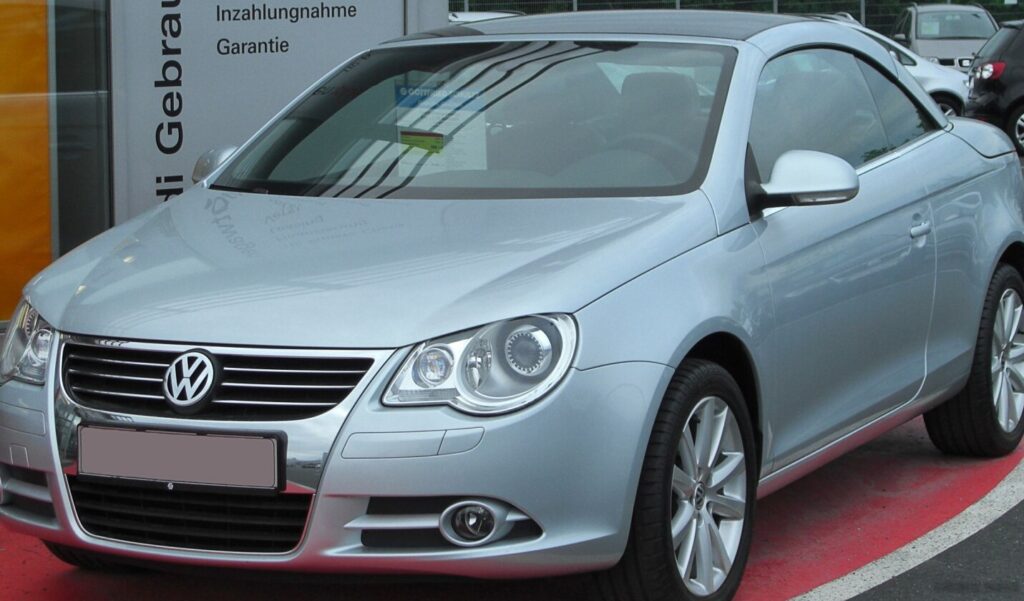
The Volkswagen Eos 3.2 V6, produced from March 2006 to May 2009, represented the performance pinnacle of the first-generation Eos (2006-2015) coupe-convertible. Positioned as the flagship trim, it offered a substantial power upgrade over the base 1.6 and 2.0-liter models, appealing to buyers seeking a more engaging driving experience combined with the versatility of a retractable hardtop. The Eos itself was designed to bridge the gap between Volkswagen’s New Beetle and the more expensive Audi A4 Cabriolet, offering a premium feel at a relatively accessible price point, primarily targeting the European and North American markets.
Technical Specifications
| Brand | Volkswagen |
| Model | Eos |
| Generation | Eos |
| Type (Engine) | 3.2 V6 (250 Hp) DSG |
| Start of production | March, 2006 |
| End of production | May, 2009 |
| Powertrain Architecture | Internal Combustion engine |
| Body type | Coupe – Cabriolet |
| Seats | 4 |
| Doors | 2 |
| Fuel consumption (economy) – urban | 13.4 l/100 km (17.6 US mpg, 21.1 UK mpg, 7.5 km/l) |
| Fuel consumption (economy) – extra urban | 6.8 l/100 km (34.6 US mpg, 41.5 UK mpg, 14.7 km/l) |
| Fuel consumption (economy) – combined | 9.2 l/100 km (25.6 US mpg, 30.7 UK mpg, 10.9 km/l) |
| Fuel Type | Petrol (Gasoline) |
| Acceleration 0 – 100 km/h | 7.3 sec |
| Acceleration 0 – 62 mph | 7.3 sec |
| Acceleration 0 – 60 mph | 6.9 sec |
| Maximum speed | 247 km/h (153.48 mph) |
| Emission standard | Euro 4 |
| Weight-to-power ratio | 6.2 kg/Hp, 162.4 Hp/tonne |
| Weight-to-torque ratio | 4.7 kg/Nm, 214.4 Nm/tonne |
| Power | 250 Hp @ 6250 rpm |
| Power per litre | 78.9 Hp/l |
| Torque | 330 Nm @ 2750 rpm (243.4 lb.-ft. @ 2750 rpm) |
| Engine layout | Front, Transverse |
| Engine Model/Code | BUB, CBRA |
| Engine displacement | 3168 cm3 (193.32 cu. in.) |
| Number of cylinders | 6 |
| Engine configuration | V-engine |
| Cylinder Bore | 86 mm (3.39 in.) |
| Piston Stroke | 90.9 mm (3.58 in.) |
| Compression ratio | 12:1 |
| Number of valves per cylinder | 4 |
| Fuel injection system | Direct injection |
| Engine aspiration | Naturally aspirated engine |
| Engine oil capacity | 5.5 l (5.81 US qt | 4.84 UK qt) |
| Coolant | 9 l (9.51 US qt | 7.92 UK qt) |
| Kerb Weight | 1539 kg (3392.91 lbs.) |
| Max. weight | 2000 kg (4409.25 lbs.) |
| Max load | 461 kg (1016.33 lbs.) |
| Trunk (boot) space – minimum | 205 l (7.24 cu. ft.) |
| Trunk (boot) space – maximum | 380 l (13.42 cu. ft.) |
| Fuel tank capacity | 55 l (14.53 US gal | 12.1 UK gal) |
| Length | 4407 mm (173.5 in.) |
| Width | 1791 mm (70.51 in.) |
| Height | 1443 mm (56.81 in.) |
| Wheelbase | 2578 mm (101.5 in.) |
| Front track | 1545 mm (60.83 in.) |
| Rear (Back) track | 1553 mm (61.14 in.) |
| Minimum turning circle | 10.9 m (35.76 ft.) |
| Drivetrain Architecture | The Internal combustion engine (ICE) drives the front wheels of the vehicle. |
| Drive wheel | Front wheel drive |
| Number of gears and type of gearbox | 6 gears, automatic transmission |
| Front suspension | Spring Strut |
| Rear suspension | Coil spring |
| Front brakes | Ventilated discs |
| Rear brakes | Disc |
| Assisting systems | ABS (Anti-lock braking system) |
| Steering type | Steering rack and pinion |
| Tires size | 215/55 R16 |
| Wheel rims size | 7J x 16 |
Powertrain & Engine Architecture
The heart of the Eos 3.2 V6 is the BUB (and later CBRA) 3.2-liter naturally aspirated V6 engine. This engine, part of Volkswagen’s VR6 family, features a narrow-angle V configuration (15 degrees between cylinder banks) which allows it to be packaged more compactly than a traditional V6. It utilizes direct fuel injection (FSI) to enhance efficiency and power output. The engine boasts a robust valvetrain with four valves per cylinder, contributing to its high-revving nature. Paired exclusively with a six-speed Direct-Shift Gearbox (DSG), a dual-clutch transmission, the 3.2 V6 delivers quick and seamless gear changes. The DSG’s programming was tuned for a balance between performance and comfort, offering both automatic and manual shift modes.
Driving Characteristics
The 3.2 V6 Eos offered a noticeably different driving experience compared to the lower-displacement models. The 250 horsepower and 243 lb-ft of torque provided brisk acceleration, with 0-60 mph times around 6.9 seconds. The DSG transmission played a crucial role in maximizing the engine’s potential, providing rapid shifts and keeping the engine in its optimal power band. While front-wheel drive, the Eos 3.2 V6 exhibited good traction, especially with the electronic stability control system engaged. Compared to the 1.6 or 2.0-liter versions, the 3.2 felt significantly more refined and capable, particularly during highway cruising and overtaking maneuvers. The gear ratios in the DSG were optimized for both acceleration and fuel economy, though the combined fuel consumption of 25.6 US mpg was still relatively modest.
Equipment & Trim Levels
The 3.2 V6 Eos typically came well-equipped as standard. Features included leather upholstery, heated front seats, automatic climate control, a premium audio system, and alloy wheels. Optional extras included navigation system, bi-xenon headlights, and a panoramic sunroof. The interior trim was generally upscale, with high-quality materials and a focus on comfort. The Eos 3.2 V6 was often identified by its unique badging and subtle exterior styling cues, such as chrome accents and larger exhaust outlets.
Chassis & Braking
The Eos 3.2 V6 utilized a MacPherson strut front suspension and a multi-link rear suspension, providing a comfortable yet controlled ride. The suspension was tuned to handle the increased power and weight of the V6 engine. Braking duties were handled by ventilated disc brakes at the front and solid disc brakes at the rear, providing adequate stopping power. Anti-lock braking system (ABS) was standard, enhancing safety and stability. The steering was a rack-and-pinion system, offering precise and responsive handling.
Market Reception & Comparison
Critics generally praised the Eos 3.2 V6 for its powerful engine, refined ride, and stylish design. However, some noted the relatively high price compared to other convertibles in its class. Compared to the 2.0-liter turbocharged Eos, the 3.2 V6 offered more raw power but slightly lower fuel economy. The 1.6-liter model was significantly more affordable but lacked the performance and refinement of the V6. The Eos 3.2 V6 competed with models like the Volvo C70, Saab 9-3 Convertible, and Audi A4 Cabriolet.
Legacy
The Volkswagen Eos 3.2 V6, while not a high-volume seller, remains a desirable variant among enthusiasts. The 3.2-liter VR6 engine is known for its reliability and durability, provided it receives regular maintenance. The DSG transmission, while complex, is generally robust when properly serviced. Today, well-maintained examples of the Eos 3.2 V6 command a premium in the used car market, appealing to buyers seeking a unique and enjoyable convertible experience. The combination of a powerful engine, a retractable hardtop, and a relatively upscale interior has ensured its continued appeal.
