
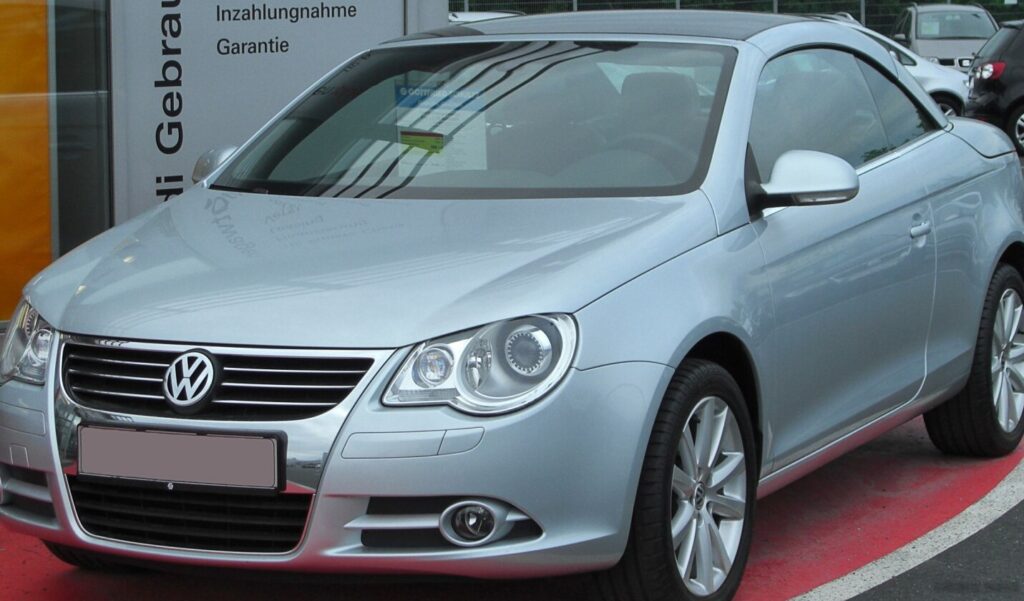
The Volkswagen Eos 3.6 FSI V6 (260 Hp) DSG represents the performance pinnacle of the first-generation Eos (2006-2010) coupe-convertible. Introduced in 2009 and remaining in production through 2010, this variant aimed to deliver a more engaging driving experience than the more common four-cylinder models. It occupied the top trim level within the Eos range, offering a blend of sporty performance, comfortable luxury, and the unique appeal of a retractable hardtop convertible. The Eos itself was positioned as Volkswagen’s answer to premium drop-top competitors like the Audi A4 Cabriolet and BMW 3 Series Convertible, offering a more accessible price point.
Technical Specifications
| Brand | Volkswagen |
| Model | Eos |
| Type (Engine) | 3.6 FSI V6 (260 Hp) DSG |
| Start of production | 2009 |
| End of production | 2010 |
| Powertrain Architecture | Internal Combustion engine |
| Body type | Coupe – Cabriolet |
| Seats | 4 |
| Doors | 2 |
| Fuel consumption (economy) – urban (NEDC) | 13.2 l/100 km (17.8 US mpg, 21.4 UK mpg, 7.6 km/l) |
| Fuel consumption (economy) – extra urban (NEDC) | 6.8 l/100 km (34.6 US mpg, 41.5 UK mpg, 14.7 km/l) |
| Fuel consumption (economy) – combined (NEDC) | 9.2 l/100 km (25.6 US mpg, 30.7 UK mpg, 10.9 km/l) |
| CO2 emissions (NEDC) | 214 g/km |
| Fuel Type | Petrol (Gasoline) |
| Acceleration 0 – 100 km/h | 6.9 sec |
| Acceleration 0 – 62 mph | 6.9 sec |
| Acceleration 0 – 60 mph | 6.6 sec |
| Maximum speed | 250 km/h (155.34 mph) – Electronically limited |
| Emission standard | Euro 5 |
| Weight-to-power ratio | 6.1 kg/Hp, 163.4 Hp/tonne |
| Weight-to-torque ratio | 4.5 kg/Nm, 220 Nm/tonne |
| Power | 260 Hp @ 6000 rpm |
| Power per litre | 72.3 Hp/l |
| Torque | 350 Nm @ 2400-4000 rpm (258.15 lb.-ft. @ 2400-4000 rpm) |
| Engine layout | Front, Transverse |
| Engine Model/Code | CDVA |
| Engine displacement | 3597 cm3 (219.5 cu. in.) |
| Number of cylinders | 6 |
| Engine configuration | VR-engine |
| Cylinder Bore | 89 mm (3.5 in.) |
| Piston Stroke | 96.4 mm (3.8 in.) |
| Number of valves per cylinder | 4 |
| Fuel injection system | Direct injection |
| Engine aspiration | Naturally aspirated engine |
| Valvetrain | DOHC |
| Engine oil capacity | 5.5 l (5.81 US qt | 4.84 UK qt) |
| Coolant | 9 l (9.51 US qt | 7.92 UK qt) |
| Kerb Weight | 1591 kg (3507.55 lbs.) |
| Max. weight | 2070 kg (4563.57 lbs.) |
| Max load | 479 kg (1056.01 lbs.) |
| Trunk (boot) space – minimum | 183 l (6.46 cu. ft.) |
| Trunk (boot) space – maximum | 358 l (12.64 cu. ft.) |
| Fuel tank capacity | 55 l (14.53 US gal | 12.1 UK gal) |
| Permitted trailer load with brakes (8%) | 1700 kg (3747.86 lbs.) |
| Permitted trailer load with brakes (12%) | 1500 kg (3306.93 lbs.) |
| Permitted trailer load without brakes | 750 kg (1653.47 lbs.) |
| Permitted towbar download | 75 kg (165.35 lbs.) |
| Length | 4407 mm (173.5 in.) |
| Width | 1791 mm (70.51 in.) |
| Width including mirrors | 2009 mm (79.09 in.) |
| Height | 1443 mm (56.81 in.) |
| Wheelbase | 2578 mm (101.5 in.) |
| Front track | 1545 mm (60.83 in.) |
| Rear (Back) track | 1553 mm (61.14 in.) |
| Ride height (ground clearance) | 106 mm (4.17 in.) |
| Minimum turning circle (turning diameter) | 10.9 m (35.76 ft.) |
| Front suspension | Coil spring, Wishbone, Transverse stabilizer |
| Rear suspension | Independent multi-link suspension, Transverse stabilizer |
| Front brakes | Ventilated discs |
| Rear brakes | Disc |
| Number of gears and type of gearbox | 6 gears, automatic transmission DSG |
| Tires size | 235/45 R17 |
| Wheel rims size | 7.5J x 17 |
Powertrain & Engine Architecture
The heart of the Eos 3.6 FSI V6 is the CDVA engine, a 3.6-liter naturally aspirated VR6. This engine utilizes direct fuel injection (FSI – Fuel Stratified Injection) to enhance efficiency and power output. The VR6 configuration, with its narrow 15-degree V-angle, allows for a relatively compact engine design while maintaining a smooth six-cylinder operation. The engine produces 260 horsepower at 6000 rpm and 258 lb-ft of torque between 2400 and 4000 rpm. The dual-clutch gearbox (DSG) is a 6-speed automatic transmission known for its quick and smooth shifts. It offers both fully automatic operation and manual control via steering wheel-mounted paddle shifters or the gear selector.
Driving Characteristics
The 3.6 FSI V6 DSG-equipped Eos delivers a noticeably more spirited driving experience compared to the 1.6 or 2.0-liter four-cylinder variants. Acceleration is brisk, with 0-60 mph times around 6.6 seconds. The DSG transmission contributes to this performance, providing rapid gear changes and keeping the engine within its optimal power band. While not a dedicated sports car, the Eos 3.6 offers ample power for comfortable highway cruising and enjoyable backroad driving. The suspension is tuned for a balance between comfort and handling, providing a reasonably controlled ride without being overly harsh. The steering is precise, though it lacks the ultimate feel of some more focused sports cars.
Equipment & Trim Levels
As the top-of-the-line Eos, the 3.6 FSI V6 came standard with a generous array of features. These typically included leather upholstery, heated front seats, automatic climate control, a premium audio system, and alloy wheels. Optional extras could include navigation, bi-xenon headlights, and a sunroof (in addition to the retractable hardtop). The interior trim was generally well-appointed, with high-quality materials and a clean, modern design. The Eos aimed for a premium feel, though it didn’t quite reach the level of fit and finish found in some of its more expensive competitors.
Chassis & Braking
The Eos 3.6 FSI V6 utilizes a front-wheel-drive layout. The front suspension consists of coil springs, wishbones, and a transverse stabilizer bar. The rear suspension is an independent multi-link setup, also with a transverse stabilizer bar. This configuration provides a good balance of ride comfort and handling. Braking duties are handled by ventilated discs at the front and solid discs at the rear. Anti-lock brakes (ABS) are standard. The chassis was reinforced to compensate for the loss of structural rigidity inherent in a convertible design, particularly with the retractable hardtop mechanism.
Market Reception & Comparison
Critics generally praised the Eos 3.6 FSI V6 for its strong engine, smooth DSG transmission, and comfortable ride. However, some reviewers noted that the car’s weight and front-wheel-drive layout limited its ultimate handling potential. Compared to the four-cylinder Eos models, the 3.6 offered a significant performance upgrade, but at a higher price point. Fuel economy was also lower with the V6 engine. Against competitors like the Audi A4 Cabriolet and BMW 3 Series Convertible, the Eos offered a more affordable alternative, but lacked the same level of prestige and refinement.
Legacy
The Volkswagen Eos 3.6 FSI V6, while a relatively short-lived variant, remains a desirable option for enthusiasts seeking a stylish and capable convertible. The VR6 engine is known for its reliability, although regular maintenance is crucial. The DSG transmission, while generally robust, can be susceptible to issues if not properly serviced. On the used car market, these models tend to command a premium over the four-cylinder versions, reflecting their higher performance and better equipped status. Finding well-maintained examples is key, as age and mileage can impact the condition of the retractable hardtop mechanism and other components.
