Technical Specifications
| Brand | Volkswagen |
| Model | Eos |
| Generation | Eos (facelift 2010) |
| Type (Engine) | 2.0 TDI (140 Hp) DSG |
| Start of production | 2010 |
| End of production | 2013 |
| Powertrain Architecture | Internal Combustion engine |
| Body type | Coupe – Cabriolet |
| Seats | 4 |
| Doors | 2 |
| Fuel consumption (economy) – urban (NEDC) | 7.2 l/100 km (32.7 US mpg, 39.2 UK mpg, 13.9 km/l) |
| Fuel consumption (economy) – extra urban (NEDC) | 4.8 l/100 km (49 US mpg, 58.9 UK mpg, 20.8 km/l) |
| Fuel consumption (economy) – combined (NEDC) | 5.7 l/100 km (41.3 US mpg, 49.6 UK mpg, 17.5 km/l) |
| CO2 emissions (NEDC) | 149 g/km |
| Fuel Type | Diesel |
| Acceleration 0 – 100 km/h | 10.3 sec |
| Acceleration 0 – 62 mph | 10.3 sec |
| Acceleration 0 – 60 mph | 9.8 sec |
| Maximum speed | 204 km/h (126.76 mph) |
| Emission standard | Euro 5 |
| Weight-to-power ratio | 11 kg/Hp, 91.3 Hp/tonne |
| Weight-to-torque ratio | 4.8 kg/Nm, 208.7 Nm/tonne |
| Power | 140 Hp @ 4200 rpm |
| Power per litre | 71.1 Hp/l |
| Torque | 320 Nm @ 1750-2500 rpm (236.02 lb.-ft. @ 1750-2500 rpm) |
| Engine layout | Front, Transverse |
| Engine Model/Code | CBAB, CFFB |
| Engine displacement | 1968 cm3 (120.09 cu. in.) |
| Number of cylinders | 4 |
| Engine configuration | Inline |
| Cylinder Bore | 81 mm (3.19 in.) |
| Piston Stroke | 95.5 mm (3.76 in.) |
| Compression ratio | 18:1 |
| Number of valves per cylinder | 4 |
| Fuel injection system | Diesel Commonrail |
| Engine aspiration | Turbocharger, Intercooler |
| Valvetrain | DOHC |
| Engine oil capacity | 4 l (4.23 US qt | 3.52 UK qt) |
| Kerb Weight | 1533 kg (3379.69 lbs.) |
| Max. weight | 2030 kg (4475.38 lbs.) |
| Max load | 497 kg (1095.7 lbs.) |
| Trunk (boot) space – minimum | 205 l (7.24 cu. ft.) |
| Trunk (boot) space – maximum | 380 l (13.42 cu. ft.) |
| Fuel tank capacity | 55 l (14.53 US gal | 12.1 UK gal) |
| Permitted trailer load with brakes (8%) | 1700 kg (3747.86 lbs.) |
| Permitted trailer load with brakes (12%) | 1500 kg (3306.93 lbs.) |
| Permitted trailer load without brakes | 750 kg (1653.47 lbs.) |
| Permitted towbar download | 75 kg (165.35 lbs.) |
| Length | 4423 mm (174.13 in.) |
| Width | 1791 mm (70.51 in.) |
| Width including mirrors | 2009 mm (79.09 in.) |
| Height | 1444 mm (56.85 in.) |
| Wheelbase | 2578 mm (101.5 in.) |
| Front track | 1545 mm (60.83 in.) |
| Rear (Back) track | 1547 mm (60.91 in.) |
| Ride height (ground clearance) | 142 mm (5.59 in.) |
| Minimum turning circle (turning diameter) | 10.9 m (35.76 ft.) |
| Drivetrain Architecture | The Internal combustion engine (ICE) drives the front wheels of the vehicle. |
| Drive wheel | Front wheel drive |
| Number of gears and type of gearbox | 6 gears, automatic transmission DSG |
| Front suspension | Coil spring, Wishbone, Transverse stabilizer |
| Rear suspension | Independent multi-link suspension, Transverse stabilizer |
| Front brakes | Ventilated discs |
| Rear brakes | Disc |
| Assisting systems | ABS (Anti-lock braking system) |
| Steering type | Steering rack and pinion |
| Power steering | Electric Steering |
| Tires size | 215/55 R16 |
| Wheel rims size | 7J x 16 |
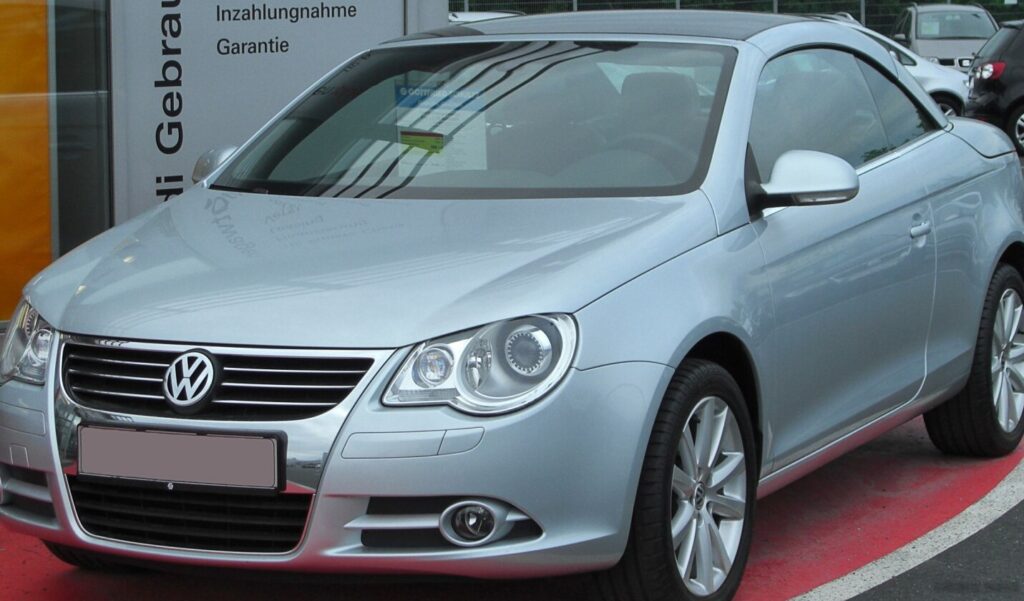
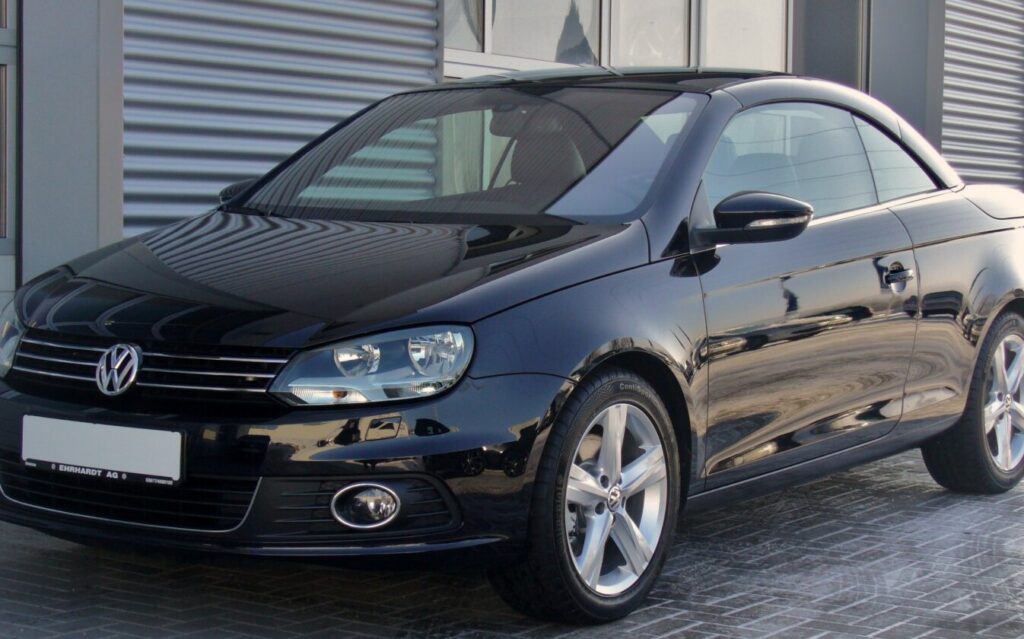
The Volkswagen Eos 2.0 TDI with the Direct-Shift Gearbox (DSG) represents a compelling blend of practicality, style, and efficiency within the Eos range. Produced from 2010 to 2013 as part of the facelifted first generation (internally designated the 1F7), this variant aimed to offer a more economical and refined experience compared to the petrol-powered options. The Eos itself was Volkswagen’s answer to the premium compact convertible market, competing with models like the Audi A3 Cabriolet and BMW 1 Series Convertible. This 2.0 TDI DSG model occupied a mid-range position in the Eos lineup, appealing to buyers prioritizing fuel economy and comfortable cruising over outright performance.
Powertrain & Engine Architecture
The heart of this Eos variant is the 2.0-liter four-cylinder diesel engine, specifically the CBAB or CFFB engine code depending on the exact production date and market. These engines are part of Volkswagen’s common rail direct injection diesel family. The CBAB, introduced in 2008, featured piezo injectors for improved fuel atomization and combustion efficiency. The CFFB, a later iteration, incorporated further refinements to reduce emissions and enhance performance. Both engines utilize a turbocharger with an intercooler to boost power output. The engine produces 140 horsepower at 4200 rpm and a substantial 320 Nm (236 lb-ft) of torque between 1750 and 2500 rpm. This torque curve provides strong low-end and mid-range acceleration, making it well-suited for everyday driving. The engine is paired with Volkswagen’s renowned 6-speed DSG (Direct-Shift Gearbox), a dual-clutch transmission that offers both the efficiency of a manual gearbox and the convenience of an automatic. The DSG provides quick, seamless shifts and contributes to the car’s overall responsiveness.
Driving Characteristics
The 2.0 TDI DSG Eos delivers a comfortable and refined driving experience. While not a sports car, the engine’s torque output provides ample power for overtaking and merging onto highways. The DSG transmission is a key contributor to the driving experience, offering smooth and quick gear changes. Compared to the 1.6 TDI models, the 2.0 TDI offers a noticeable performance improvement. The 2.0 TDI also feels more relaxed at highway speeds. Compared to the higher-output 2.0 TDI variants (often exceeding 170 hp), this 140 hp version prioritizes fuel economy over outright speed. The gear ratios in the DSG are tuned for efficiency, and the car feels most at home cruising at a steady pace. The steering is precise, and the suspension provides a good balance between comfort and handling.
Equipment & Trim Levels
The Eos 2.0 TDI DSG typically came well-equipped, reflecting its mid-range positioning. Standard features often included automatic climate control, alloy wheels, a multi-function steering wheel, and an infotainment system with a CD player and auxiliary input. Higher trim levels, such as Sport or Elegance, added features like leather upholstery, heated front seats, a sunroof, and upgraded audio systems. Optional extras included navigation systems, parking sensors, and bi-xenon headlights. Interior upholstery was typically cloth, with leather available as an upgrade. The dashboard layout was clean and functional, with a focus on ergonomics.
Chassis & Braking
The Eos utilizes a front-wheel-drive layout with a MacPherson strut suspension in the front and a multi-link independent suspension in the rear. This setup provides a comfortable ride and good handling characteristics. The front brakes are ventilated discs, while the rear brakes are solid discs. ABS (Anti-lock Braking System) is standard. The Eos’s chassis is reinforced to compensate for the lack of a fixed roof, ensuring structural rigidity. Stabilizer bars are fitted to both the front and rear axles to reduce body roll during cornering.
Market Reception & Comparison
The Volkswagen Eos 2.0 TDI DSG was generally well-received by automotive critics. It was praised for its fuel efficiency, comfortable ride, and refined interior. However, some critics noted that the performance was not as exhilarating as some of its competitors. Compared to the petrol-powered Eos models, the 2.0 TDI offered significantly better fuel economy. Against other diesel-powered convertibles, the Eos offered a competitive blend of price, features, and practicality. The 1.6 TDI offered even better fuel economy but lacked the performance of the 2.0 TDI. The higher-output 2.0 TDI models provided more power but at the expense of fuel efficiency.
Legacy
The 2.0 TDI engine, in its various iterations, proved to be a reliable and durable powertrain. The DSG transmission, while requiring occasional maintenance (fluid changes), is also generally considered reliable. Today, used Eos 2.0 TDI models represent a relatively affordable entry point into the premium compact convertible market. Common issues to look for include wear and tear on the DSG transmission and potential problems with the turbocharger. However, with proper maintenance, these cars can provide many years of enjoyable motoring. The Eos, while discontinued in 2013, remains a popular choice for those seeking a stylish and practical convertible with good fuel economy.