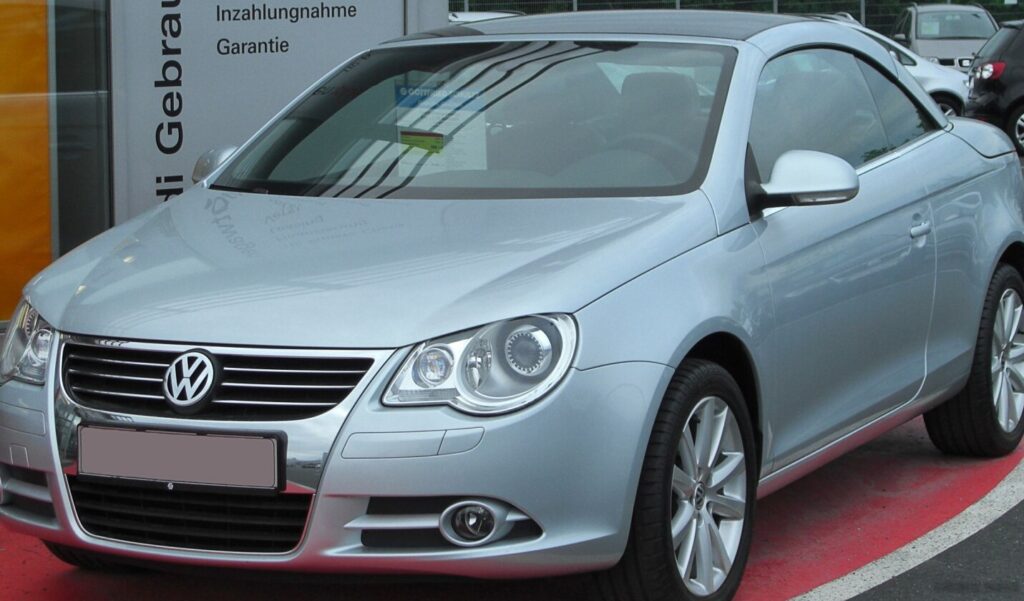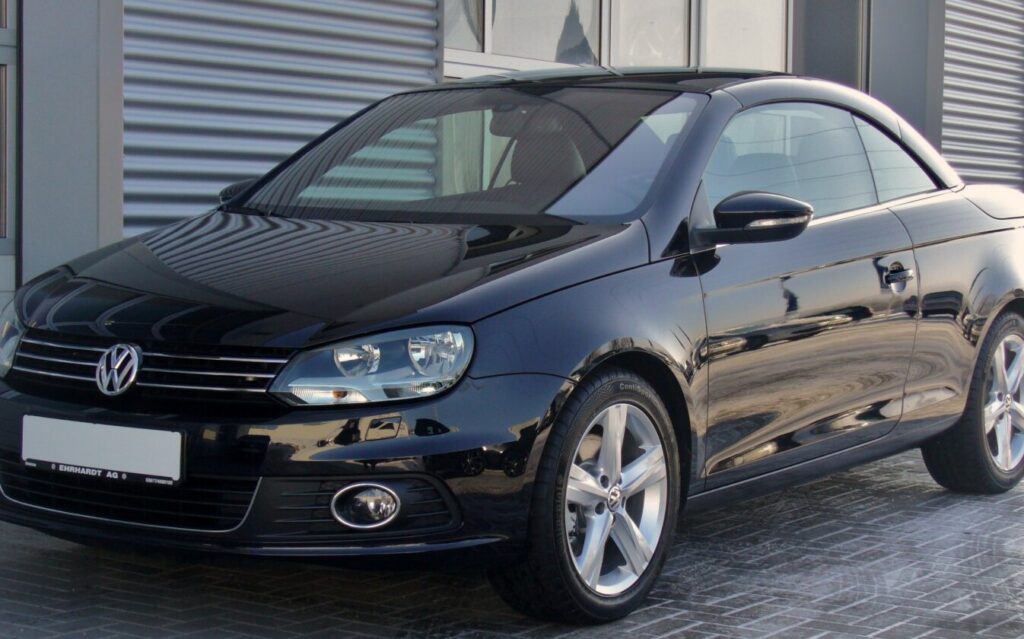
The Volkswagen Eos, particularly the facelifted 2010-2015 model year equipped with the 2.0 TSI 210 horsepower engine, represented a unique offering in Volkswagen’s lineup. Positioned as a premium compact convertible, the Eos aimed to blend the open-air experience of a cabriolet with the practicality and security of a coupe. Production spanned from October 2010 to May 2015, and it was built on the A5 (or 1HX0) platform, shared with the Golf Mk5 and Mk6, as well as the Audi TT and Scirocco. This variant, with its turbocharged engine, occupied the upper-mid range of the Eos lineup, offering a significant performance upgrade over the base 1.6 and 2.0 TDI models.
Technical Specifications
| Brand | Volkswagen |
| Model | Eos |
| Generation | Eos (facelift 2010) |
| Type (Engine) | 2.0 TSI (210 Hp) |
| Start of production | October, 2010 |
| End of production | May, 2015 |
| Powertrain Architecture | Internal Combustion engine |
| Body type | Coupe – Cabriolet |
| Seats | 4 |
| Doors | 2 |
| Fuel consumption (urban) | 9.6 l/100 km (24.5 US mpg) |
| Fuel consumption (extra urban) | 5.4 l/100 km (43.6 US mpg) |
| Fuel consumption (combined) | 7.1 l/100 km (33.1 US mpg) |
| CO2 emissions | 165 g/km |
| Fuel Type | Petrol (Gasoline) |
| Acceleration 0 – 100 km/h | 7.8 sec |
| Acceleration 0 – 62 mph | 7.8 sec |
| Acceleration 0 – 60 mph | 7.4 sec |
| Maximum speed | 238 km/h (147.89 mph) |
| Emission standard | Euro 5 |
| Weight-to-power ratio | 7.4 kg/Hp |
| Weight-to-torque ratio | 5.6 kg/Nm |
| Power | 210 Hp @ 5300-6200 rpm |
| Torque | 280 Nm @ 1700-5200 rpm (206.52 lb.-ft.) |
| Engine layout | Front, Transverse |
| Engine Model/Code | CCZB |
| Engine displacement | 1984 cm3 (121.07 cu. in.) |
| Number of cylinders | 4 |
| Engine configuration | Inline |
| Number of valves per cylinder | 4 |
| Fuel injection system | Direct injection |
| Engine aspiration | Turbocharger, Intercooler |
| Engine oil capacity | 4.7 l (4.97 US qt | 4.14 UK qt) |
| Kerb Weight | 1563 kg (3445.83 lbs.) |
| Max. weight | 2000 kg (4409.25 lbs.) |
| Max load | 437 kg (963.42 lbs.) |
| Trunk (boot) space – minimum | 205 l (7.24 cu. ft.) |
| Fuel tank capacity | 55 l (14.53 US gal | 12.1 UK gal) |
| Length | 4423 mm (174.13 in.) |
| Width | 1791 mm (70.51 in.) |
| Height | 1444 mm (56.85 in.) |
| Wheelbase | 2578 mm (101.5 in.) |
| Front track | 1545 mm (60.83 in.) |
| Rear (Back) track | 1547 mm (60.91 in.) |
| Minimum turning circle | 10.9 m (35.76 ft.) |
| Drivetrain Architecture | Front wheel drive |
| Number of gears | 6 gears, manual transmission |
| Front brakes | Ventilated discs |
| Assisting systems | ABS (Anti-lock braking system) |
| Steering type | Steering rack and pinion |
| Tires size | 215/55 R16; 235/40 R18 |
| Wheel rims size | 7J x 16; 8J x 18 |
Powertrain & Engine Architecture
At the heart of the 2010-2015 Volkswagen Eos 2.0 TSI was the CCZB engine code, a 1.984-liter (121.07 cubic inches) inline-four cylinder gasoline engine. This engine was a member of Volkswagen’s EA888 family, known for its robust design and tuning potential. The CCZB featured direct fuel injection (FSI), a turbocharger with an intercooler, and four valves per cylinder. Direct injection allowed for precise fuel delivery, improving efficiency and power output. The turbocharger boosted performance, providing increased torque and horsepower. The engine produced 210 hp at 5300-6200 rpm and 280 Nm (206.52 lb-ft) of torque between 1700 and 5200 rpm. The six-speed manual transmission was standard, offering precise gear changes and a more engaging driving experience. A six-speed DSG (Direct-Shift Gearbox) dual-clutch automatic transmission was also available as an option, providing quicker shifts and improved fuel economy.
Driving Characteristics
The 2.0 TSI engine transformed the Eos’s driving experience compared to the lower-powered variants. Acceleration from 0 to 60 mph took approximately 7.4 seconds, making it a genuinely quick car for its class. The readily available torque meant strong acceleration in everyday driving situations, such as merging onto highways or overtaking slower vehicles. The manual transmission offered a direct connection to the engine, while the DSG automatic provided smooth and rapid gear changes. The Eos’s suspension, tuned for comfort, provided a reasonably compliant ride, although it wasn’t as sporty as some of its rivals. The front-wheel-drive layout offered predictable handling, but could exhibit some torque steer under hard acceleration.
Equipment & Trim Levels
The 2.0 TSI Eos typically came well-equipped, reflecting its position as a premium model. Standard features often included automatic climate control, power windows and locks, a premium audio system, and alloy wheels. Leather upholstery, heated front seats, a sunroof (in addition to the retractable hardtop), and a navigation system were commonly available as options. Trim levels varied by market, but generally offered increasing levels of luxury and technology. The Sportline trim, for example, often included sport seats, a sport suspension, and unique styling cues.
Chassis & Braking
The Eos utilized a MacPherson strut front suspension and a multi-link rear suspension, providing a good balance of comfort and handling. The front brakes were ventilated discs, offering strong stopping power, while the rear brakes were typically solid discs. Anti-lock Braking System (ABS) was standard. The Eos’s chassis was reinforced to compensate for the lack of a fixed roof, ensuring structural rigidity and safety. Stabilizer bars were fitted front and rear to reduce body roll during cornering.
Market Reception & Comparison
The Volkswagen Eos 2.0 TSI was generally well-received by automotive critics. It was praised for its stylish design, comfortable interior, and enjoyable driving experience. The 2.0 TSI engine was considered a strong performer, providing ample power for both cruising and spirited driving. Compared to the base 1.6-liter engine, the 2.0 TSI offered a significant performance boost, but at the cost of slightly higher fuel consumption. The 2.0 TDI diesel variant offered comparable fuel economy but lacked the outright performance of the TSI. Competitors included the Audi A3 Cabriolet, BMW 1 Series Convertible, and Peugeot 308 CC.
Legacy
The Volkswagen Eos, while not a massive sales success, remains a well-regarded convertible. The 2.0 TSI engine, in particular, has proven to be relatively reliable, although regular maintenance is crucial. The EA888 engine family is known for its durability, but potential issues can include carbon buildup on the intake valves and oil consumption. On the used car market, the Eos 2.0 TSI offers a compelling combination of style, performance, and practicality. Its retractable hardtop provides added security and weather protection compared to traditional soft-top convertibles, making it a versatile choice for year-round driving. Finding well-maintained examples is key, as service history and proper care are essential for long-term reliability.