
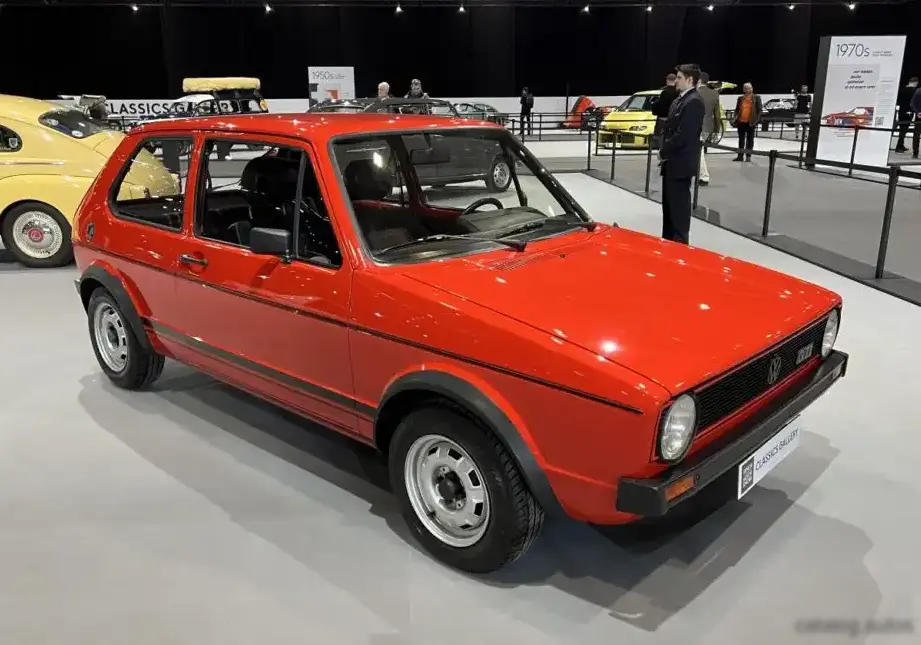
The Volkswagen Golf Mk1, produced from 1974 to 1983, represented a pivotal moment for the German automaker, transitioning Volkswagen away from the rear-engined, air-cooled Beetle and towards a modern, front-wheel-drive platform. The 3-door 1.1-liter variant, producing 50 horsepower, was introduced in 1974 and remained in production through 1979. This model served as the entry point into the Golf range, offering affordable and economical transportation to a broad audience. It was a key component of the Golf’s initial success, establishing the car as a practical and versatile hatchback in the European market. The Golf Mk1, internally designated as the 1HX0, laid the foundation for one of the most successful automotive nameplates in history.
Technical Specifications
| Brand | Volkswagen |
| Model | Golf |
| Generation | Golf I (3-door) |
| Type (Engine) | 1.1 (50 Hp) |
| Start of production | 1974 |
| End of production | 1979 |
| Powertrain Architecture | Internal Combustion engine |
| Body type | Hatchback |
| Seats | 5 |
| Doors | 3 |
| Fuel Type | Petrol (Gasoline) |
| Acceleration 0 – 100 km/h | 16.5 sec |
| Acceleration 0 – 62 mph | 16.5 sec |
| Acceleration 0 – 60 mph | 15.7 sec |
| Maximum speed | 140 km/h (86.99 mph) |
| Weight-to-power ratio | 15 kg/Hp, 66.7 Hp/tonne |
| Weight-to-torque ratio | 9.5 kg/Nm, 105.3 Nm/tonne |
| Power | 50 Hp @ 6000 rpm |
| Power per litre | 45.7 Hp/l |
| Torque | 79 Nm @ 3000 rpm (58.27 lb.-ft. @ 3000 rpm) |
| Engine layout | Front, Transverse |
| Engine Model/Code | FA |
| Engine displacement | 1093 cm3 (66.7 cu. in.) |
| Number of cylinders | 4 |
| Engine configuration | Inline |
| Cylinder Bore | 69.5 mm (2.74 in.) |
| Piston Stroke | 72 mm (2.83 in.) |
| Compression ratio | 8:1 |
| Number of valves per cylinder | 2 |
| Fuel injection system | Carburettor |
| Engine aspiration | Naturally aspirated engine |
| Valvetrain | SOHC |
| Engine oil capacity | 4 l (4.23 US qt | 3.52 UK qt) |
| Coolant | 4.5 l (4.76 US qt | 3.96 UK qt) |
| Kerb Weight | 750 kg (1653.47 lbs.) |
| Max. weight | 1170 kg (2579.41 lbs.) |
| Max load | 420 kg (925.94 lbs.) |
| Trunk (boot) space – minimum | 368 l (13 cu. ft.) |
| Trunk (boot) space – maximum | 1102 l (38.92 cu. ft.) |
| Fuel tank capacity | 40 l (10.57 US gal | 8.8 UK gal) |
| Permitted trailer load with brakes (12%) | 800 kg (1763.7 lbs.) |
| Permitted trailer load without brakes | 400 kg (881.85 lbs.) |
| Length | 3723 mm (146.57 in.) |
| Width | 1610 mm (63.39 in.) |
| Height | 1410 mm (55.51 in.) |
| Wheelbase | 2400 mm (94.49 in.) |
| Front track | 1390 mm (54.72 in.) |
| Rear (Back) track | 1350 mm (53.15 in.) |
| Ride height (ground clearance) | 125 mm (4.92 in.) |
| Minimum turning circle (turning diameter) | 10.5 m (34.45 ft.) |
| Drivetrain Architecture | The Internal combustion engine (ICE) drives the front wheels of the vehicle. |
| Drive wheel | Front wheel drive |
| Number of gears and type of gearbox | 4 gears, manual transmission |
| Front suspension | Independent, type McPherson with coil spring and anti-roll bar |
| Rear suspension | Coil spring, Torsion |
| Front brakes | Disc |
| Rear brakes | Drum |
| Steering type | Steering rack and pinion |
| Tires size | 175/70 R13 |
| Wheel rims size | 5J x 13 |
INTRODUCTION
The Volkswagen Golf Mk1 1.1 was the base model of the original Golf lineup, introduced in 1974 as a replacement for the Volkswagen Beetle. It was designed to be a practical, affordable, and modern hatchback, appealing to a wider range of buyers than the aging Beetle. The 1.1-liter engine, while modest in output, provided sufficient power for everyday driving and contributed to the car’s excellent fuel economy. This variant was particularly popular in Europe, where smaller displacement engines were favored due to tax regulations and fuel costs. The 3-door configuration further emphasized its compact and nimble nature.
Powertrain & Engine Architecture
The Golf Mk1 1.1 utilized the Volkswagen FA engine, a 1093cc inline-four cylinder engine. This engine featured a simple SOHC (Single Overhead Camshaft) valvetrain with two valves per cylinder. Fuel delivery was managed by a single carburetor, a common setup for engines of this era. The engine produced 50 horsepower at 6000 rpm and 79 Nm (58.27 lb-ft) of torque at 3000 rpm. The engine’s relatively low compression ratio of 8:1 allowed it to run on lower octane fuel, further contributing to its affordability. The engine was transversely mounted, driving the front wheels through a four-speed manual transmission. This front-wheel-drive layout was a significant departure from the Beetle’s rear-engine, rear-wheel-drive configuration and offered improved handling and traction.
Driving Characteristics
The 1.1-liter Golf Mk1 was not a performance car. Acceleration was leisurely, taking approximately 16.5 seconds to reach 62 mph (100 km/h). However, the car’s light weight (around 750 kg or 1653 lbs) and responsive steering made it enjoyable to drive in urban environments. The four-speed manual transmission offered a reasonable spread of gears, but the engine lacked the torque to provide strong acceleration in higher gears. Compared to the later 1.5 and 1.6-liter versions, the 1.1 felt noticeably underpowered, especially when carrying passengers or luggage. The suspension, while basic, provided a comfortable ride, and the car handled predictably. The relatively slow steering ratio required more input than later Golf models.
Equipment & Trim Levels
The base 1.1-liter Golf Mk1 was sparsely equipped, reflecting its position as the entry-level model. Standard features typically included cloth upholstery, basic instrumentation (speedometer, fuel gauge, and temperature gauge), and manually operated windows and door locks. Optional extras included a radio, heated rear window, and upgraded interior trim. The interior was functional and durable, prioritizing practicality over luxury. The dashboard was simple and straightforward, with all controls within easy reach. The 3-door configuration meant limited rear passenger access, but the rear seats could be folded down to increase cargo space.
Chassis & Braking
The Golf Mk1 featured an independent McPherson strut front suspension with coil springs and an anti-roll bar, providing good handling and ride comfort. The rear suspension utilized a torsion beam setup, which was simple, robust, and space-efficient. Braking was provided by disc brakes on the front wheels and drum brakes on the rear. While adequate for the car’s performance, the braking system lacked the stopping power of more modern vehicles. The steering was a rack and pinion system, offering precise and responsive control. The car rode on 175/70 R13 tires, mounted on 5J x 13 steel wheels.
Market Reception & Comparison
The Golf Mk1 1.1 was well-received by critics and consumers alike, particularly for its practicality, fuel efficiency, and affordability. It was often praised for its modern design and improved handling compared to the Beetle. However, the 1.1-liter engine was often criticized for its lack of power, especially when compared to the more powerful 1.5 and 1.6-liter versions. The 1.5-liter offered a noticeable performance improvement, while the 1.6-liter provided a more refined driving experience. In terms of reliability, the 1.1-liter engine proved to be durable and relatively trouble-free, although regular maintenance was essential. Fuel economy was a strong point, making it an attractive option for budget-conscious buyers.
Legacy
The Volkswagen Golf Mk1 1.1 played a crucial role in establishing the Golf as a successful and enduring automotive model. While not the most powerful or luxurious version, it provided an accessible entry point into the Golf range and helped to attract a wide range of buyers. Today, the Golf Mk1 1.1 is a popular classic car, appreciated for its simplicity, reliability, and historical significance. Well-maintained examples are becoming increasingly collectible, and the car remains a testament to Volkswagen’s engineering prowess and design innovation. The FA engine, while simple, is known for its longevity, and parts availability remains relatively good, making it a viable option for enthusiasts and classic car owners.
