Technical Specifications
| Brand | Volkswagen |
| Model | Golf |
| Generation | Golf I Cabrio |
| Type (Engine) | GLi 1.6 (110 Hp) |
| Start of production | March, 1979 |
| End of production | August, 1982 |
| Powertrain Architecture | Internal Combustion engine |
| Body type | Cabriolet |
| Seats | 4 |
| Doors | 2 |
| Fuel consumption (urban) | 11.2 l/100 km (21 US mpg, 25.2 UK mpg, 8.9 km/l) |
| Fuel consumption (extra urban) | 7.1 l/100 km (33.1 US mpg, 39.8 UK mpg, 14.1 km/l) |
| Fuel Type | Petrol (Gasoline) |
| Acceleration 0 – 100 km/h | 10.2 sec |
| Acceleration 0 – 62 mph | 10.2 sec |
| Acceleration 0 – 60 mph | 9.7 sec |
| Maximum speed | 172 km/h (106.88 mph) |
| Weight-to-power ratio | 8.5 kg/Hp, 117 Hp/tonne |
| Weight-to-torque ratio | 6.7 kg/Nm, 148.9 Nm/tonne |
| Power | 110 Hp @ 6100 rpm |
| Power per litre | 69.3 Hp/l |
| Torque | 140 Nm @ 5000 rpm (103.26 lb.-ft. @ 5000 rpm) |
| Engine layout | Front, Transverse |
| Engine Model/Code | EG |
| Engine displacement | 1588 cm3 (96.91 cu. in.) |
| Number of cylinders | 4 |
| Engine configuration | Inline |
| Cylinder Bore | 79.5 mm (3.13 in.) |
| Piston Stroke | 80 mm (3.15 in.) |
| Compression ratio | 9.5:1 |
| Number of valves per cylinder | 2 |
| Fuel injection system | Multi-port manifold injection |
| Engine aspiration | Naturally aspirated engine |
| Valvetrain | SOHC |
| Engine oil capacity | 3.5 l (3.7 US qt | 3.08 UK qt) |
| Coolant | 4.5 l (4.76 US qt | 3.96 UK qt) |
| Kerb Weight | 940 kg (2072.35 lbs.) |
| Max. weight | 1270 kg (2799.87 lbs.) |
| Max load | 330 kg (727.53 lbs.) |
| Trunk (boot) space – minimum | 220 l (7.77 cu. ft.) |
| Fuel tank capacity | 40 l (10.57 US gal | 8.8 UK gal) |
| Permitted trailer load with brakes (12%) | 1200 kg (2645.55 lbs.) |
| Permitted trailer load without brakes | 400 kg (881.85 lbs.) |
| Length | 3815 mm (150.2 in.) |
| Width | 1630 mm (64.17 in.) |
| Height | 1395 mm (54.92 in.) |
| Wheelbase | 2398 mm (94.41 in.) |
| Front track | 1404 mm (55.28 in.) |
| Rear (Back) track | 1372 mm (54.02 in.) |
| Ride height (ground clearance) | 117 mm (4.61 in.) |
| Minimum turning circle (turning diameter) | 10.3 m (33.79 ft.) |
| Drivetrain Architecture | The Internal combustion engine (ICE) drives the rear wheels of the vehicle. |
| Drive wheel | Front wheel drive |
| Number of gears and type of gearbox | 5 gears, manual transmission |
| Front suspension | Independent, type McPherson with coil spring and anti-roll bar |
| Rear suspension | Transverse stabilizer, Trailing arm |
| Front brakes | Disc |
| Rear brakes | Drum |
| Steering type | Steering rack and pinion |
| Tires size | 175/70 R13 |
| Wheel rims size | 5.5J x 13 |
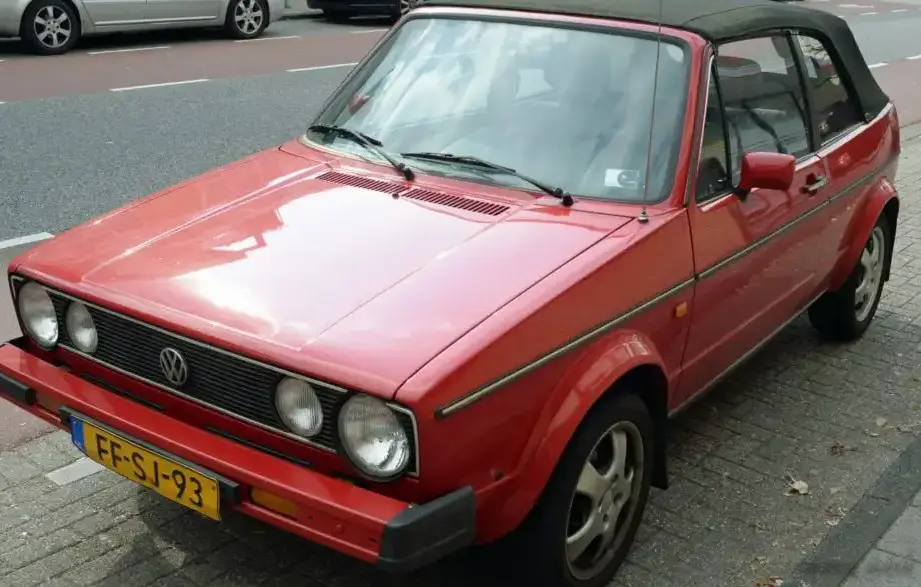
The Volkswagen Golf I Cabrio GLi 1.6, produced between March 1979 and August 1982, was a desirable variant within the first generation Golf Cabriolet range. Positioned as an upgrade over the base models, the GLi (Gran Turismo Injection) offered increased performance and a more comprehensive equipment list. This open-top Golf was primarily aimed at the European market, where convertibles were popular, and provided a more affordable alternative to premium convertibles. Built on the A1 platform, shared with the standard Golf Mk1, it distinguished itself with its unique body style and performance-oriented engine options.
Powertrain & Engine Architecture
The Golf I Cabrio GLi 1.6 was powered by the Volkswagen EG engine, a 1.6-liter inline four-cylinder gasoline engine. This engine featured a single overhead camshaft (SOHC) valvetrain with two valves per cylinder. A key feature was the Bosch K-Jetronic multi-port fuel injection system, a sophisticated system for its time that improved fuel efficiency and performance compared to carbureted engines. The EG engine produced 110 horsepower at 6100 rpm and 140 Nm (103.26 lb-ft) of torque at 5000 rpm. The engine’s transverse mounting and front-wheel drive configuration were typical of Volkswagen’s engineering philosophy, maximizing interior space and improving handling. The standard transmission was a five-speed manual gearbox, offering precise control and enhancing the driving experience.
Driving Characteristics
The 1.6-liter GLi Cabriolet offered a noticeable performance increase compared to the base Golf Cabriolet models. While not a sports car by today’s standards, the 110 hp engine provided adequate power for spirited driving, considering the car’s relatively light weight. Acceleration from 0 to 60 mph took approximately 9.7 seconds, and it could achieve a top speed of 172 km/h (106.88 mph). The five-speed manual transmission allowed drivers to keep the engine in its optimal power band, while the front-wheel drive layout provided good traction. Compared to the later 1.8-liter versions, the 1.6 offered a slightly more economical driving experience, but with a corresponding reduction in outright performance. The open-top nature of the Cabriolet added to the driving enjoyment, but also introduced some body flex, common in convertibles of this era.
Equipment & Trim Levels
The GLi trim level included several features that distinguished it from the base Golf Cabriolet. Standard equipment typically included upgraded cloth upholstery, a leather-wrapped steering wheel, and a more comprehensive instrument cluster. Optional extras included power windows, central locking, and a higher-quality audio system. The interior design was functional and straightforward, reflecting the Golf’s practical nature. The GLi also featured slightly upgraded exterior trim, including body-colored bumpers and wheel arch extensions.
Chassis & Braking
The Golf I Cabriolet utilized a McPherson strut front suspension with coil springs and an anti-roll bar, providing a comfortable and controlled ride. The rear suspension employed a trailing arm setup with a transverse stabilizer. Braking duties were handled by disc brakes at the front and drum brakes at the rear. While adequate for everyday driving, the braking system lacked the stopping power of more modern vehicles. The steering was a rack-and-pinion system, offering precise and responsive handling. The car rode on 175/70 R13 tires mounted on 5.5J x 13 steel wheels.
Market Reception & Comparison
The Golf I Cabrio GLi 1.6 was generally well-received by automotive critics. It was praised for its sporty handling, comfortable ride, and relatively affordable price. Compared to other convertibles on the market at the time, the Golf Cabriolet offered a compelling combination of practicality, performance, and style. However, some critics noted the car’s relatively basic interior and the presence of rear drum brakes. Fuel economy was considered good for the era, and the engine proved to be reasonably reliable. Compared to the later 1.8-liter GLi models, the 1.6 offered a more balanced driving experience, prioritizing fuel efficiency and affordability over outright performance.
Legacy
The Volkswagen Golf I Cabrio GLi 1.6 remains a popular classic car today. The EG engine is known for its durability and relatively simple maintenance requirements, although age-related issues such as oil leaks and corrosion can be common. Parts availability is generally good, thanks to the Golf’s widespread popularity. Well-maintained examples of the GLi 1.6 are sought after by enthusiasts and collectors, representing a piece of automotive history and a reminder of the early days of the open-top Golf. The car’s enduring appeal lies in its combination of classic styling, enjoyable driving characteristics, and relatively affordable ownership costs.