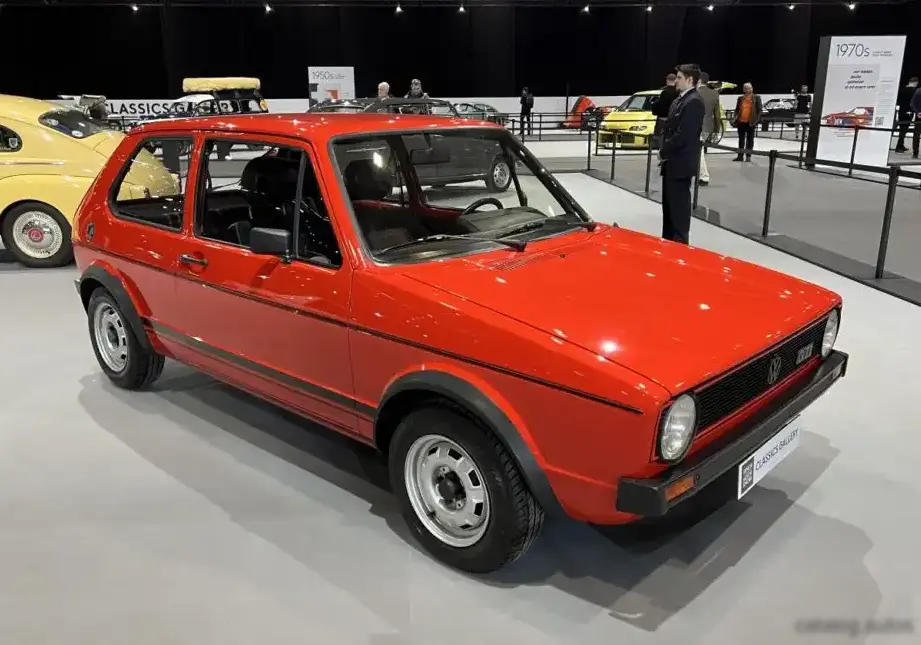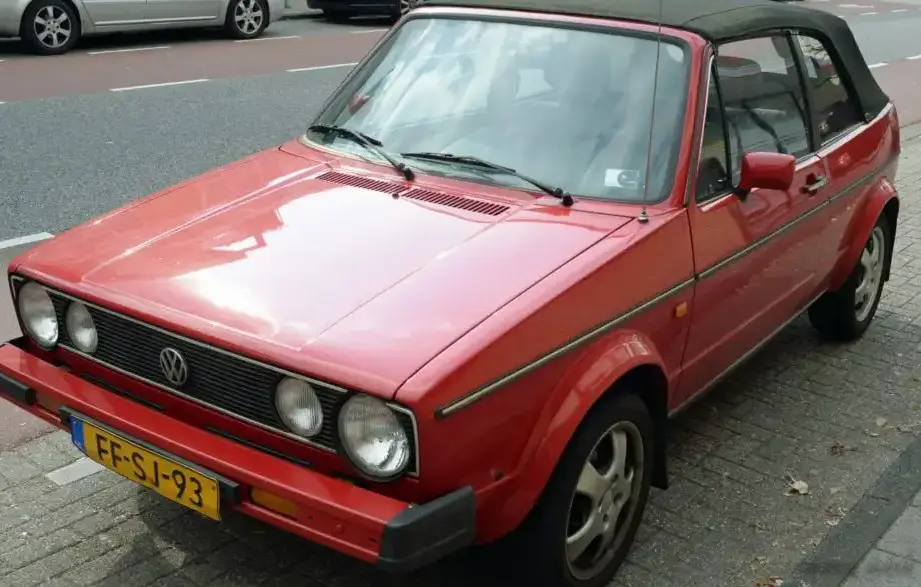
The Volkswagen Golf I Cabrio GLS 1.5, produced between March 1979 and August 1982, represents a key iteration of the first-generation Golf Cabriolet. Positioned as a desirable, though not top-of-the-line, trim, the GLS 1.5 offered open-air motoring with a focus on affordability and practicality. It was a significant model for Volkswagen, expanding the Golf range and appealing to a broader customer base, particularly in Europe and North America where the convertible market was gaining traction. This variant utilized the 1HX0/A3 platform shared with the standard Golf I, but with modifications to accommodate the convertible body style. The 1.5-liter engine and four-speed manual transmission combination aimed to provide a balance between reasonable performance and fuel efficiency.
Technical Specifications
| Brand | Volkswagen |
| Model | Golf |
| Generation | Golf I Cabrio |
| Type (Engine) | GLS 1.5 (70 Hp) |
| Start of production | March, 1979 |
| End of production | August, 1982 |
| Powertrain Architecture | Internal Combustion engine |
| Body type | Cabriolet |
| Seats | 4 |
| Doors | 2 |
| Fuel consumption (urban) | 10.3 l/100 km (22.8 US mpg, 27.4 UK mpg, 9.7 km/l) |
| Fuel consumption (extra urban) | 7.1 l/100 km (33.1 US mpg, 39.8 UK mpg, 14.1 km/l) |
| Fuel Type | Petrol (Gasoline) |
| Acceleration 0 – 100 km/h | 14.3 sec |
| Acceleration 0 – 62 mph | 14.3 sec |
| Acceleration 0 – 60 mph | 13.6 sec |
| Maximum speed | 150 km/h (93.21 mph) |
| Weight-to-power ratio | 13 kg/Hp, 76.9 Hp/tonne |
| Weight-to-torque ratio | 8.3 kg/Nm, 120.9 Nm/tonne |
| Power | 70 Hp @ 5600 rpm |
| Power per litre | 48 Hp/l |
| Torque | 110 Nm @ 2500 rpm (81.13 lb.-ft. @ 2500 rpm) |
| Engine layout | Front, Transverse |
| Engine Model/Code | JB |
| Engine displacement | 1457 cm3 (88.91 cu. in.) |
| Number of cylinders | 4 |
| Engine configuration | Inline |
| Cylinder Bore | 79.5 mm (3.13 in.) |
| Piston Stroke | 73.4 mm (2.89 in.) |
| Compression ratio | 8.2:1 |
| Number of valves per cylinder | 2 |
| Fuel injection system | Carburettor |
| Engine aspiration | Naturally aspirated engine |
| Valvetrain | SOHC |
| Engine oil capacity | 3.5 l (3.7 US qt | 3.08 UK qt) |
| Coolant | 4.5 l (4.76 US qt | 3.96 UK qt) |
| Kerb Weight | 910 kg (2006.21 lbs.) |
| Max. weight | 1270 kg (2799.87 lbs.) |
| Max load | 360 kg (793.66 lbs.) |
| Trunk (boot) space – minimum | 220 l (7.77 cu. ft.) |
| Fuel tank capacity | 40 l (10.57 US gal | 8.8 UK gal) |
| Permitted trailer load with brakes (12%) | 1000 kg (2204.62 lbs.) |
| Permitted trailer load without brakes | 400 kg (881.85 lbs.) |
| Length | 3815 mm (150.2 in.) |
| Width | 1610 mm (63.39 in.) |
| Height | 1410 mm (55.51 in.) |
| Wheelbase | 2398 mm (94.41 in.) |
| Front track | 1390 mm (54.72 in.) |
| Rear (Back) track | 1358 mm (53.46 in.) |
| Ride height (ground clearance) | 125 mm (4.92 in.) |
| Minimum turning circle (turning diameter) | 10.3 m (33.79 ft.) |
| Drivetrain Architecture | The Internal combustion engine (ICE) drives the front wheels of the vehicle. |
| Drive wheel | Front wheel drive |
| Number of gears and type of gearbox | 4 gears, manual transmission |
| Front suspension | Independent, type McPherson with coil spring and anti-roll bar |
| Rear suspension | Transverse stabilizer, Trailing arm |
| Front brakes | Disc |
| Rear brakes | Drum |
| Steering type | Steering rack and pinion |
| Wheel rims size | 5J x 13 |
Powertrain & Engine Architecture
The Golf I Cabrio GLS 1.5 was powered by the Volkswagen JB engine, a 1.5-liter inline-four cylinder gasoline engine. This engine, a mainstay of the early Golf range, featured a single overhead camshaft (SOHC) valvetrain with two valves per cylinder. Fuel delivery was managed by a carburetor, a common setup for the time, offering simplicity and relatively low cost. The JB engine produced 70 horsepower at 5600 rpm and 110 Nm (81.13 lb-ft) of torque at 2500 rpm. The engine’s relatively modest output was typical for entry-level and mid-range models of the era. The four-speed manual transmission was the standard offering, providing a straightforward driving experience. The engine was mounted transversely at the front of the vehicle, driving the front wheels.
Driving Characteristics
The 1.5-liter engine, paired with the four-speed manual gearbox, provided adequate, but not exhilarating, performance. Acceleration from 0 to 60 mph took approximately 13.6 seconds, and the top speed was around 93 mph. The car felt best suited for relaxed cruising rather than spirited driving. The gear ratios were spaced to prioritize fuel economy and everyday usability. Compared to the later 1.8-liter versions or the more powerful GTI models, the 1.5 GLS felt noticeably slower. However, the lighter weight of the 1.5-liter engine contributed to a more balanced feel in corners compared to the heavier engines. The manual transmission offered a direct connection to the engine, allowing for precise control, but required more driver involvement than an automatic.
Equipment & Trim Levels
The GLS trim level represented a step up from the base Golf Cabriolet. Standard features included cloth upholstery, a basic instrument cluster, and a steering wheel. The GLS also typically included features like a more comprehensive trim package and upgraded door panels. Optional extras included a sunroof (in addition to the convertible top), upgraded audio systems, and different wheel covers. The interior was functional and relatively spartan, reflecting the car’s price point. The focus was on providing a comfortable and practical open-air driving experience rather than luxury.
Chassis & Braking
The Golf I Cabriolet utilized a McPherson strut front suspension with coil springs and an anti-roll bar, providing a reasonable level of comfort and handling. The rear suspension employed a trailing arm setup with a transverse stabilizer. Braking duties were handled by disc brakes at the front and drum brakes at the rear. This configuration was typical for cars in this class during the late 1970s and early 1980s. The braking system was adequate for normal driving conditions, but lacked the stopping power of more modern systems. The relatively light weight of the 1.5-liter model helped to mitigate the limitations of the drum brakes at the rear.
Market Reception & Comparison
The Golf I Cabrio GLS 1.5 was generally well-received by critics as an affordable and practical convertible. It offered a good balance between price, fuel economy, and open-air enjoyment. However, its performance was often criticized as being somewhat underwhelming, especially when compared to the more powerful GTI models. Fuel economy was a strong point, with combined fuel consumption around 27 mpg. Compared to other convertibles of the time, the Golf Cabriolet offered a more practical and reliable alternative to more exotic and expensive options. The 1.5-liter engine was considered more reliable than the later 1.6-liter versions, which were prone to overheating issues.
Legacy
The Volkswagen Golf I Cabrio GLS 1.5 remains a popular classic car today, particularly among enthusiasts who appreciate its simplicity and affordability. The JB engine is known for its durability and relatively easy maintenance. Parts availability is generally good, although some specific trim pieces can be difficult to find. Well-maintained examples command a reasonable price in the used car market. The Golf I Cabriolet, in all its variants, played a significant role in popularizing the modern convertible, and the GLS 1.5 represents a particularly accessible and enjoyable entry point into the world of classic Volkswagen motoring. The car’s enduring appeal lies in its timeless design and the simple pleasure of open-top driving.